

 Phoenix 24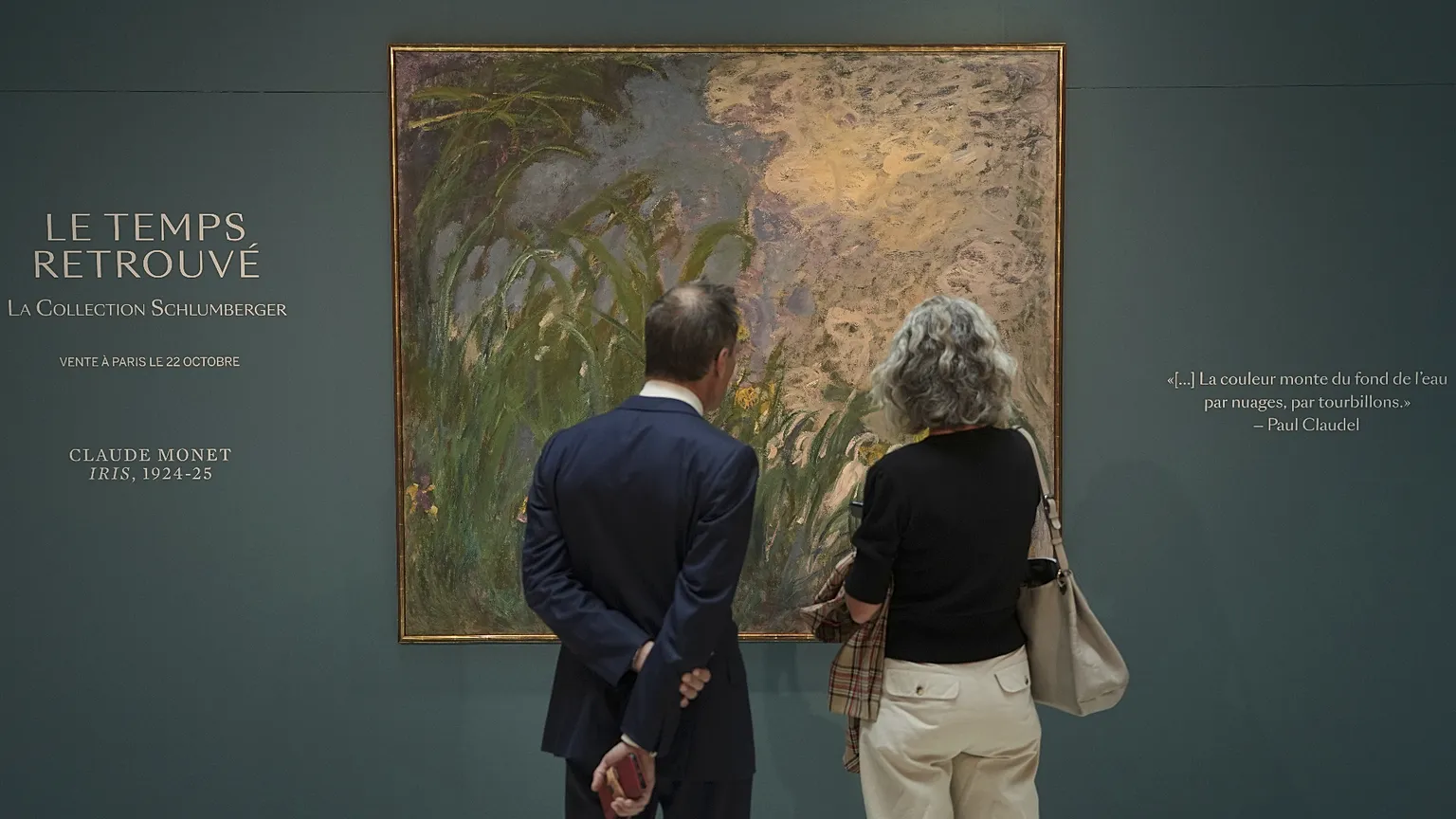
Two hidden treasures reveal Impressionism’s enduring artistic legacy.
Paris, France.
Two exceptional paintings by Claude Monet, Iris and Saule pleureur (Weeping Willow), are emerging from a century of private ownership ahead of a major Sotheby’s auction in Paris on October 22. The works belong to the Schlumberger family collection, which includes 28 pieces valued collectively at more than €40 million. Iris, estimated at between €22 million and €30 million, carries what Sotheby’s describes as the highest presale estimate ever assigned to a painting at a French auction. Their appearance offers collectors and art historians a rare opportunity to encounter works that have remained largely inaccessible to the public.
Painted during the final years of Monet’s life, Iris occupies a distinctive position within the artist’s late exploration of color, texture and natural forms. Sotheby’s specialists describe the monumental canvas as being in exceptional condition, retaining its original support without varnish or restoration. Thomas Bompard, co-head of modern and contemporary art at Sotheby’s France, emphasized that the painting remains remarkably close to the condition in which Monet completed it approximately a century ago. Such preservation is particularly significant because the artist’s late techniques depended heavily on the physical properties of paint.
Art historian Marianne Mathieu explains that varnish can alter a painting’s chromatic relationships, while restoration risks disturbing the thick layers of pigment that characterize Monet’s later production. These textured surfaces, known as impasto, reveal the artist’s increasingly material approach to representing light and landscape. Preserving them allows viewers to encounter not only the finished composition but also evidence of the painter’s working process. The exceptional condition of Iris consequently carries significance beyond its estimated market value.
The second painting, Saule pleureur, is expected to command between €9 million and €10 million. Both works remained in the Schlumberger family’s living room for approximately a century after collector Jeanne Schlumberger acquired them from Monet’s family through art dealer Katia Granoff. They entered the collection without passing through public auction, contributing to their limited visibility. Although specialists knew of their existence, the wider public had never encountered them in color.
The sale coincides with the centenary of Monet’s death on December 5, 1926, a milestone accompanied by exhibitions examining his artistic legacy in Paris. The auction also includes two additional Monet paintings, works by Gustave Moreau and a sculpture by Camille Claudel. Three paintings by Paul Cézanne, forming a mural composition, have been designated national treasures, creating a 30-month period intended to facilitate a possible acquisition by the French state. Their inclusion introduces a cultural preservation dimension into an otherwise commercial event.
The Schlumberger auction illustrates the complex relationship between private collecting and public access to artistic heritage. Private ownership can preserve important works across generations, yet it can also limit opportunities for scholarly examination and public appreciation. Their reappearance creates possibilities for renewed research, exhibition and changes in ownership, although the eventual buyers remain unknown.
For Monet’s legacy, the significance extends beyond auction records. These paintings offer an uncommon encounter with the material, color and artistic experimentation of a painter whose influence continues to shape modern perceptions of art.
Más allá de la noticia, el patrón. / Beyond the news, the pattern.