

 Phoenix 24
The next limit is not only computation.
Seoul, May 2026. OmniXtend, a memory interconnection technology developed by South Korea’s Electronics and Telecommunications Research Institute, points to one of artificial intelligence’s least visible constraints: the gap between processing power and memory access. As AI models grow larger, the problem is no longer just how many GPUs a data center can deploy, but whether those systems can access enough memory quickly and efficiently.

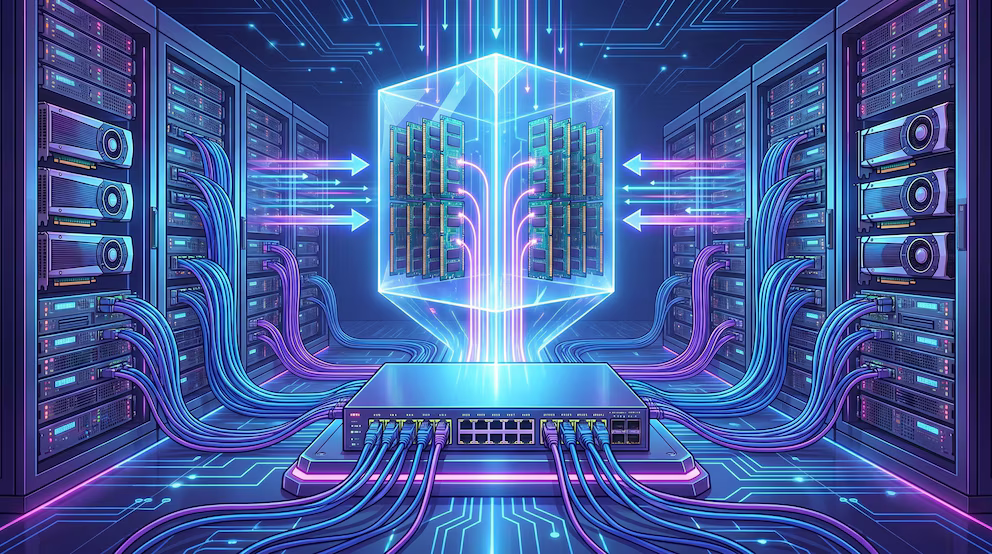
The technology uses standard Ethernet to connect distributed memory resources, allowing servers and accelerators to draw from a shared pool without replacing entire infrastructure. That matters because Ethernet is already widely deployed in data centers, making the proposal less disruptive and potentially cheaper than architectures that require specialized networks or complete hardware renewal.
In reported tests, performance dropped when available memory was insufficient, a common problem in large language models and high-performance computing. When memory was expanded through Ethernet, inference performance recovered significantly, approaching levels closer to systems with enough conventional memory. The technical promise is simple but powerful: reduce the “memory wall” without forcing every organization to rebuild from zero.
The memory wall has become one of AI’s structural bottlenecks. GPU capacity keeps improving, but models still depend on rapid access to massive volumes of data. If memory cannot keep pace with computation, expensive accelerators remain underused, costs rise and training or inference becomes less efficient.
OmniXtend therefore speaks to a deeper shift in the AI race. The competition is no longer limited to chips, models or cloud platforms; it is moving into the architecture of data centers themselves. Memory, bandwidth, energy use and interconnection design are becoming as strategic as algorithms.
The broader implication is economic. If shared memory over Ethernet proves scalable, it could help smaller companies, universities and research centers expand AI capacity without buying entirely new systems. That would not eliminate the dominance of major cloud providers, but it could reduce part of the infrastructure barrier that keeps advanced AI concentrated in the hands of a few actors.
The risk is that technical promise still requires operational proof. Latency, reliability, security, compatibility and large-scale deployment will determine whether OmniXtend becomes a real standard or remains a specialized innovation. In AI infrastructure, elegance matters less than endurance under continuous load.

The lesson is clear: artificial intelligence does not advance only through smarter models. It also advances through cables, memory pools, protocols and hidden engineering layers that users never see. OmniXtend reveals that the future of AI may depend as much on how machines share memory as on how they generate answers.
Información que anticipa futuros. / Information that anticipates futures.