

 Phoenix 24

SAN FRANCISCO, UNITED STATES — November 2, 2026. Two mobile phones launched just four years apart helped define one of the most significant technological transformations of the 21st century. The Nokia 1100, introduced in 2003, represented an era when affordability, durability and reliable communication were the industry’s primary priorities. Apple’s original iPhone, unveiled in 2007, introduced a radically different approach by combining a touchscreen, internet browsing and multimedia capabilities in a single device. Nearly two decades later, comparing these products reveals how mobile technology evolved from a practical communication tool into a platform that reshaped business, education, entertainment and everyday life.
The Nokia 1100 was developed for simplicity and accessibility. Its compact design featured a physical numeric keypad, monochrome display, removable battery and integrated flashlight. Users could make calls, send text messages, store contacts and access basic utilities without navigating complicated menus. Its construction emphasized durability, including a protective casing and a keypad designed to resist dust. These characteristics made the device particularly attractive in markets where purchasing power, electricity availability and telecommunications infrastructure could limit access to more sophisticated technologies.

Commercial success demonstrated the effectiveness of Nokia’s strategy. According to Guinness World Records, more than 250 million Nokia 1100 units were shipped worldwide, establishing it among the most successful individual mobile phone models ever produced. Its popularity extended across emerging economies, including India, where inexpensive and reliable telecommunications devices played an important role in expanding personal connectivity. The Nokia 1100 illustrated that technological innovation does not necessarily require advanced functionality; delivering essential services affordably can create substantial economic and social value.
Apple challenged that philosophy on January 9, 2007, when Steve Jobs introduced the original iPhone at the Macworld conference in San Francisco. Rather than improving the traditional keypad, Apple eliminated it almost entirely, replacing fixed controls with a 3.5-inch multitouch display. The device integrated mobile calling, music playback, photography, email, web browsing and digital maps. Its interface allowed users to interact directly with images and applications through finger gestures, transforming the screen from a passive information display into the principal mechanism for controlling the device.
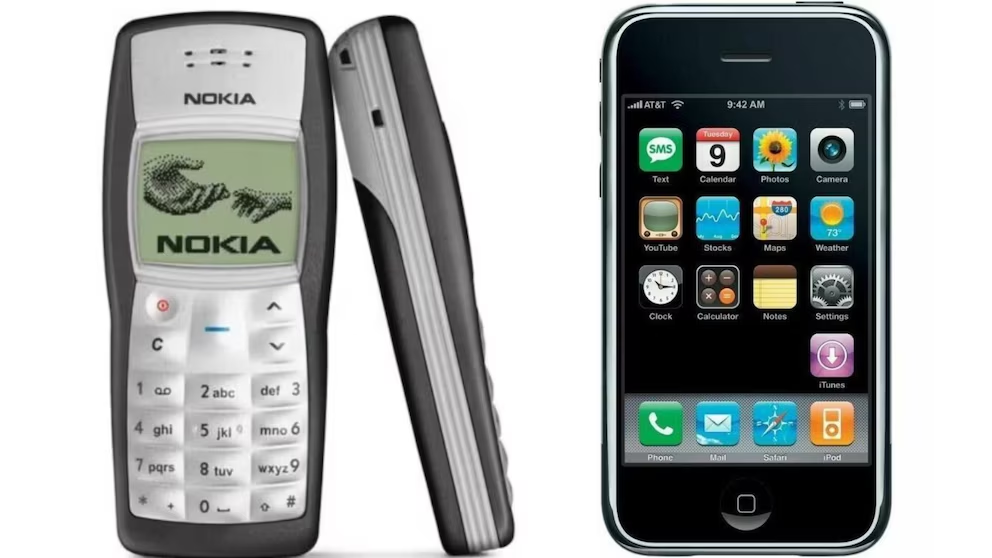
The difference became particularly evident in text communication. On the Nokia 1100, users entered messages through repeated presses of physical number keys or predictive text functionality. Although the system required practice, experienced users could operate the device quickly and often without continuously examining the screen. The iPhone introduced a software keyboard that appeared only when needed, allowing the same display to accommodate different applications and functions. This flexibility became fundamental to smartphone design, enabling developers to create interfaces that could evolve through software rather than remain constrained by permanent hardware controls.
Internet connectivity represented an even greater distinction. The Nokia 1100 was designed primarily for voice calls and SMS messaging and lacked the hardware necessary for conventional web browsing. The original iPhone, by contrast, incorporated Apple’s Safari browser, Wi-Fi connectivity and EDGE mobile data, enabling access to websites, email and online information. However, its capabilities were limited by the standards of the period: the first model did not support 3G networks, and mobile browsing could be considerably slower than modern users expect. Its significance lay in making internet interaction more accessible through a touch-based interface.
The iPhone also introduced important multimedia possibilities. Its two-megapixel camera, integrated music player and synchronization with iTunes allowed users to combine functions previously distributed across several electronic devices. Yet the original model was considerably less capable than contemporary smartphones. It did not launch with the App Store, which Apple introduced in July 2008, and its software ecosystem initially relied on built-in applications and web-based services. The distinction matters because the modern smartphone emerged through successive improvements in hardware, operating systems, applications and telecommunications networks rather than through a single product announcement.
Pricing revealed another fundamental difference between the two business models. Nokia emphasized mass-market accessibility, making basic mobile communication available to consumers with limited financial resources. Apple’s original iPhone entered the American market at prices of $499 for the 4GB version and $599 for the 8GB model, positioning it as a premium technological product. These strategies addressed different consumer requirements, demonstrating that the expansion of digital connectivity depended both on affordable communication devices and on innovations that increased the range of activities possible through mobile technology.
The long-term economic consequences were substantial. Touchscreen smartphones eventually became central to electronic commerce, digital banking, social networking, navigation and mobile productivity. Entire industries developed around application distribution, mobile advertising and location-based services. Nevertheless, the transition also introduced new challenges involving digital dependency, personal data protection, cybersecurity and the environmental consequences of increasingly frequent device replacement. Technological progress expanded opportunities while creating vulnerabilities that the designers of early mobile phones could scarcely have anticipated.
The comparison also highlights the importance of technological accessibility. Modern smartphones offer extraordinary capabilities, but their complexity, purchasing costs and dependence on software ecosystems can create barriers for certain users. Basic mobile phones continue serving practical needs where affordability, battery endurance and straightforward operation remain priorities. Consequently, the history of mobile technology should not be interpreted simply as the replacement of inferior devices by superior ones, but as the evolution of products designed for different technological and social conditions.
The Nokia 1100 and the original iPhone ultimately represent two complementary stages of digital transformation. Nokia helped make mobile communication accessible to millions of people, while Apple accelerated the development of a new relationship between individuals and connected computing. Their legacies demonstrate that transformative innovation can take different forms: sometimes by simplifying technology to reach more people, and sometimes by expanding its possibilities to redefine what people can accomplish.
Phoenix24: Beyond the technology, the transformation of society. / Más allá de la tecnología, la transformación de la sociedad.