

 Phoenix 24
Authoritarian power now speaks through borrowed systems.
Managua, April 2026. Nicaragua’s regime is refining its propaganda machinery with growing support from China and Russia, deepening a model of political control that no longer depends only on repression. The strategy points toward a more sophisticated authoritarian ecosystem where media narratives, digital coordination, ideological training and foreign alliances reinforce one another.
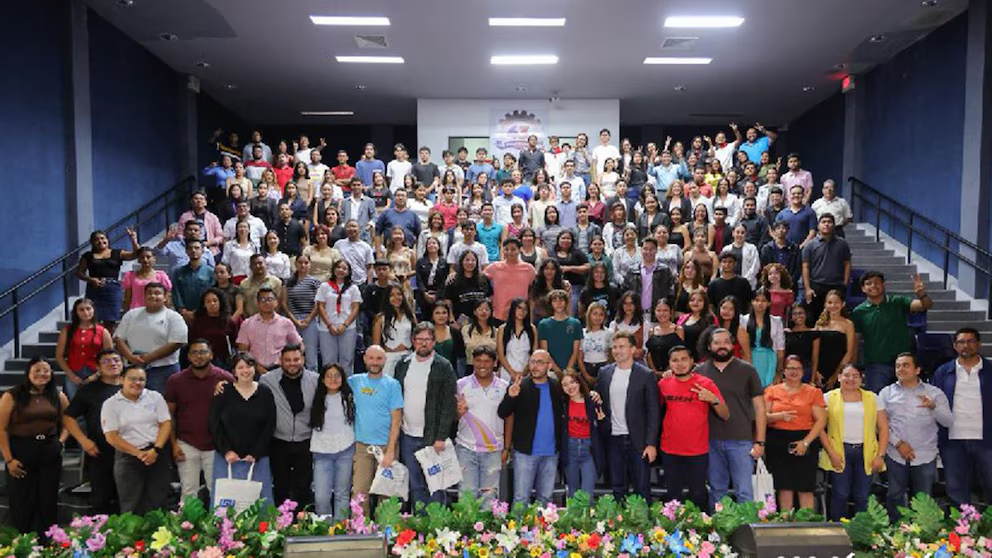
Daniel Ortega and Rosario Murillo have already consolidated a political structure marked by persecution of opponents, control over institutions and systematic pressure against independent voices. What now appears to be evolving is the communicational layer of that control. Propaganda is becoming less improvised and more institutional, less local and more connected to the global authoritarian toolkit.
China and Russia bring different but complementary models. Beijing offers a doctrine of information discipline, technological governance and state-centered narrative control. Moscow contributes experience in disinformation, geopolitical messaging and the use of media ecosystems to blur truth, exhaust audiences and turn uncertainty into political advantage.
For Nicaragua, this support is strategically useful because the regime does not need only to silence dissent; it needs to manufacture legitimacy. Propaganda allows power to present isolation as sovereignty, repression as stability and international criticism as foreign aggression. In that narrative, the state is never responsible for crisis; it is always defending itself from enemies.
The danger is not limited to domestic politics. Nicaragua can become a regional node in a wider information network aligned with authoritarian interests. Through training, media coordination and ideological messaging, the country may serve as a platform for narratives that weaken democratic institutions, discredit civil society and normalize anti-Western geopolitical framing across Latin America.
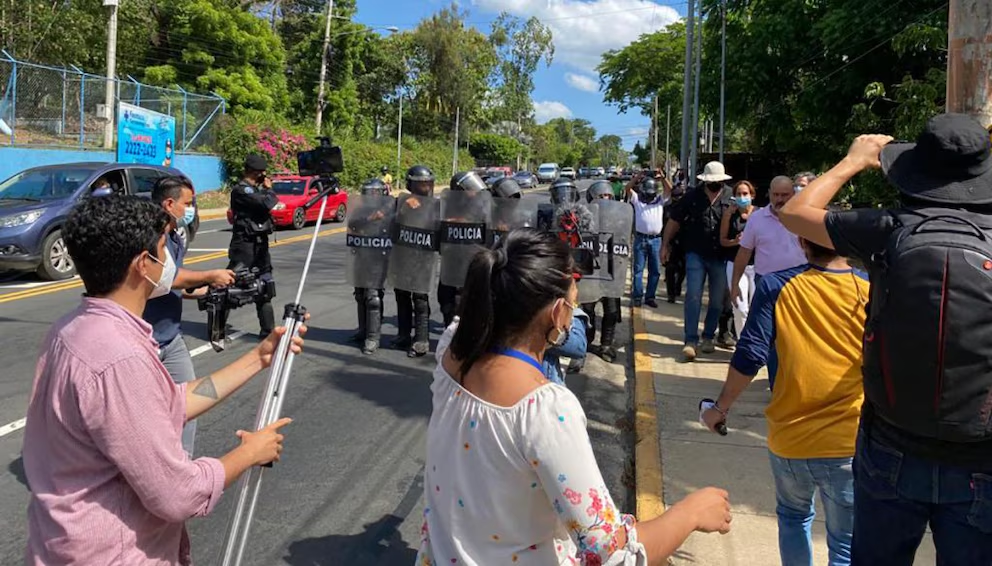
This also reveals a broader transformation in contemporary authoritarianism. The old model depended on censorship as a wall; the new one uses propaganda as an atmosphere. Citizens are not only prevented from accessing certain truths; they are surrounded by competing narratives designed to confuse, fatigue and neutralize political judgment.
The deeper issue is that propaganda does not merely defend a regime; it redesigns reality around it. In Nicaragua, the convergence with China and Russia suggests that information control is becoming part of state infrastructure. When power controls not only institutions but also the language through which society interprets them, democracy does not collapse in silence; it is slowly rewritten.
Detrás de cada dato, hay una intención. Detrás de cada silencio, una estructura.