

 Phoenix 24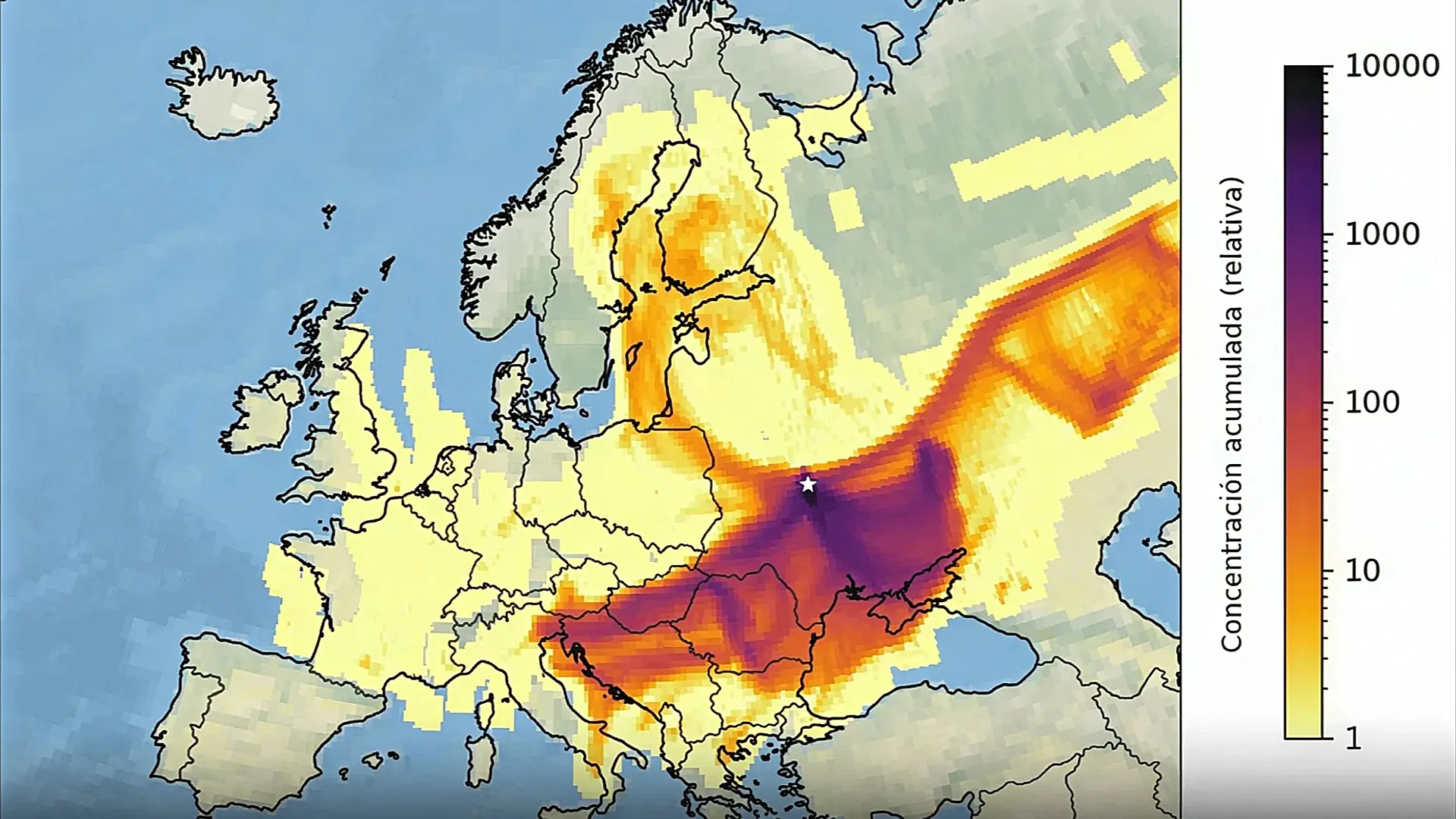
A nuclear shadow redrew Europe’s invisible borders.
Madrid, April 2026. Forty years after the Chernobyl disaster, one of its most revealing lessons remains atmospheric rather than political: radiation did not spread across Europe with equal force, nor did geography alone determine exposure. The Iberian Peninsula largely escaped the radioactive plume because the dominant winds and weather systems carried the contamination north, west and centralward across Europe, leaving Spain and Portugal comparatively shielded from the heaviest fallout.
The explosion at Reactor 4 in April 1986 released radioactive material into the atmosphere at a scale that transformed a Soviet nuclear accident into a continental emergency. Yet the path of that contamination was shaped by meteorology, not ideology. Air currents, rainfall patterns and the timing of atmospheric circulation determined where particles descended, creating an uneven map of exposure that punished some regions while sparing others.
The Iberian case illustrates how environmental risk often operates through invisible systems. Spain and Portugal were not protected by distance alone, but by a temporary alignment of wind direction and precipitation patterns that kept the most contaminated air masses away from the peninsula. In contrast, parts of Scandinavia, Central Europe and the Balkans recorded higher levels because radioactive particles were carried into those regions and, in some cases, washed down by rain.
This distinction matters because Chernobyl was never only a nuclear event. It was also a crisis of information, governance and public trust, intensified by delayed Soviet disclosure and fragmented European monitoring. The fact that radiation was first detected outside the Soviet Union before Moscow fully acknowledged the disaster became a defining symbol of how secrecy can magnify technological catastrophe.
Forty years later, the Iberian exception offers a sharper reading of vulnerability. Modern societies often imagine risk as something distributed through borders, institutions and official maps, but atmospheric contamination follows another logic. It moves through wind, pressure, water and terrain, exposing the limits of political control when infrastructure fails.
The deeper lesson is not that Iberia was safe, but that it was spared by contingency. Chernobyl showed that technological disasters can become transnational in hours, while their consequences remain geographically unequal for decades. In that imbalance, Europe learned that the most dangerous borders are sometimes the ones no state can draw.
Detrás de cada dato, hay una intención. Detrás de cada silencio, una estructura.