

 Phoenix 24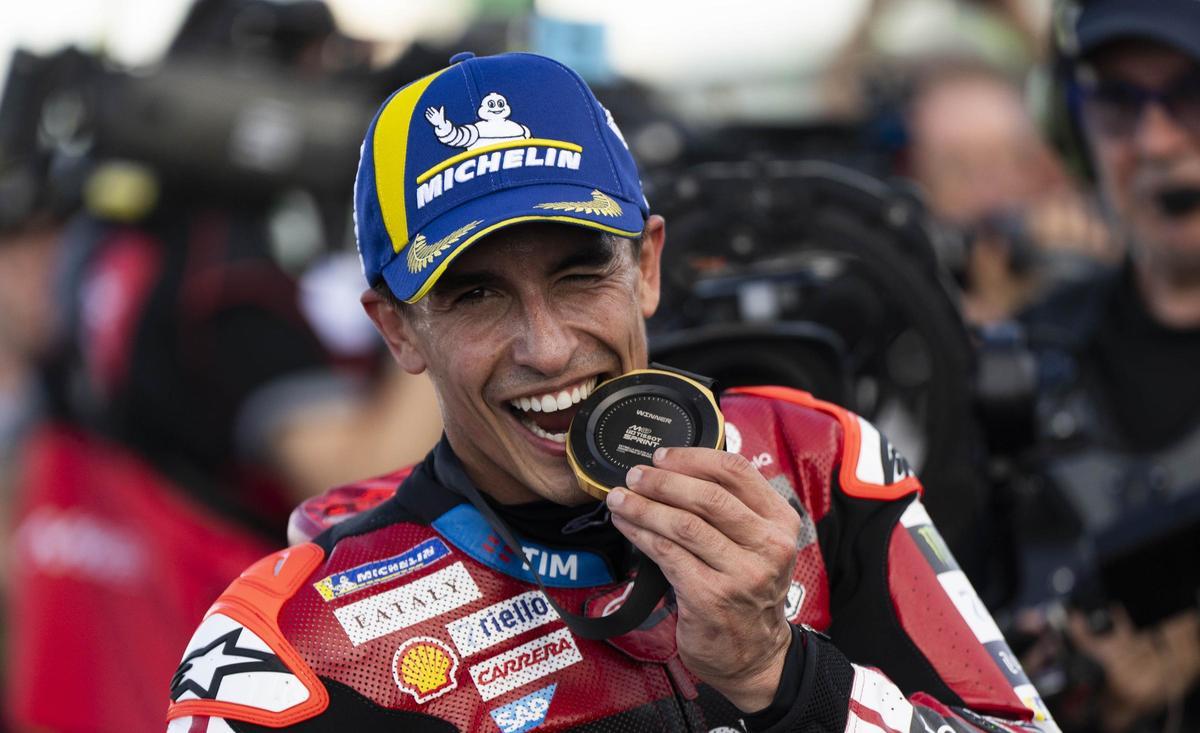
The result came first. The rhythm did not.
Goiânia, March 2026. Marc Márquez closed Saturday in Brazil with the kind of result that usually settles the conversation in a MotoGP paddock: a sprint victory, a return to the top step, and a reminder that he remains one of the most dangerous riders on the grid when the race begins to compress. But his own assessment was much colder. Rather than framing the win as proof that everything is back in place, he made it clear that he still feels physically rigid and far from his ideal level on the bike.
That tension is what makes his Brazilian weekend more interesting than the result alone. Márquez did not simply dominate from start to finish with visible ease. The win carried the marks of adaptation, calculation and tactical intelligence rather than total physical freedom. In elite motorcycling, that distinction matters. A rider can still produce a strong result through experience, aggression and race management even when the body is not yet responding with full fluidity. Over a sprint, that can be enough. Over a longer Grand Prix, it becomes a more serious question.
His own words sharpen that reading. The important detail is not only that he won, but that he won while openly admitting discomfort. That suggests a rider who knows the scoreboard and the sensations are not fully aligned. In Márquez’s case, that is especially relevant because his career has always been defined by a riding style built on instinct, violence of movement and absolute trust in the body’s ability to react at the limit. If that physical spontaneity is still restricted, then the result in Brazil says as much about his intelligence as it does about his form.
The weekend also unfolded under unstable conditions, adding another layer to the story. Track irregularities, difficult grip and the broader sense of a race environment still settling into itself meant that improvisation became part of the contest. Márquez has historically thrived in those scenarios. Chaos often creates openings for riders who can process risk faster than the rest. But even that advantage has limits. Surviving chaos is not the same as feeling fully in command of the machine, and his post-race tone suggests he knows the difference.
That is why this sprint victory should not be read as a full restoration narrative. It restores confidence, yes, and it proves he still knows how to punish hesitation, manage pressure and win under imperfect conditions. But it does not yet confirm that the deepest version of Márquez has returned. What it confirms is something slightly different and, in its own way, just as dangerous for the rest of the field: even when he is not fully comfortable, he can still win.
For his rivals, that creates an uncomfortable scenario. A fully sharp Márquez is one of the defining threats of the modern era. A Márquez who is still rebuilding but already collecting results suggests that the margin for error around him remains very small. For him, however, the internal standard is clearly higher. Victory alone does not seem sufficient if it arrives without the bodily confidence he expects from himself.
That is what the Brazil sprint really leaves behind. Not just a win, but a warning wrapped in dissatisfaction. Márquez got the result, but he did not present it as closure. He presented it as proof that there is still more to recover, more to align and more to improve. In a championship season, that may be the more important message: the rider is back in the fight, but he does not yet believe he is back in full.
La narrativa también es poder. Narrative is power too.