

 Phoenix 24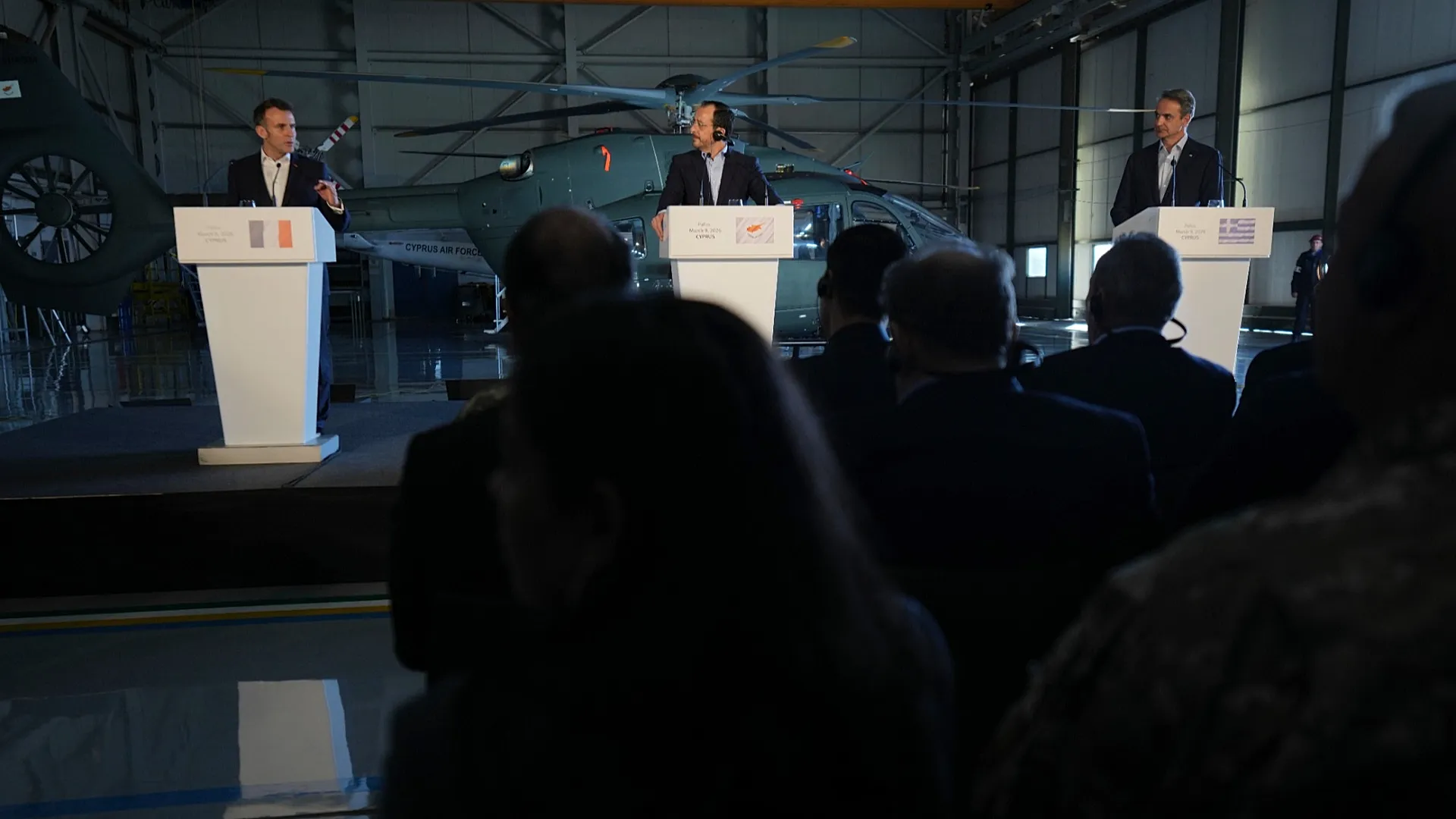
Deterrence becomes credible only when spoken plainly.
Paphos, March 2026
Emmanuel Macron’s statement, “When Cyprus is attacked, Europe is attacked,” is not diplomatic theater. It is an attempt to redraw the strategic map of the current Middle East war by declaring that Cyprus is no longer a peripheral island exposed to regional spillover, but an exposed edge of Europe itself. Macron delivered the message in Paphos alongside the leaders of Cyprus and Greece after drone threats and strikes tied to the Iran war hit Cyprus, including the first direct wartime impact on European territory in this crisis. France paired the words with military signaling, reinforcing the eastern Mediterranean with naval assets and air-defense support while framing the move as defensive solidarity rather than escalation.
The strategic importance of the phrase lies in what it tries to solve. Europe has spent years speaking the language of principles while often hesitating at the level of force posture. Macron is trying to close that gap. By saying an attack on Cyprus is an attack on Europe, he is elevating Cyprus from vulnerable member state to collective test case. That matters because ambiguity is dangerous in deterrence. If adversaries believe Cyprus is politically isolated, the island becomes a permissive target for pressure, signaling and calibrated attacks. If they believe Cyprus automatically triggers a wider European security response, the cost of touching it rises. Macron is not only reassuring Cyprus. He is trying to increase the price of further strikes.
This also reflects a wider shift in European security thinking. France announced a reinforced military posture around Cyprus and signaled support for maritime security efforts tied to the crisis, including planning for a future escort mission linked to reopening the Strait of Hormuz when conditions allow. Greece also moved assets, which underlines that the eastern Mediterranean is now being treated less as a regional side theater and more as a live European security perimeter. In practical terms, that means the EU’s southern flank is no longer being discussed only in terms of migration, energy or diplomacy. It is being discussed in air-defense, naval and deterrence terms.
The political subtext is just as important. Cyprus has always occupied an unusual position inside Europe: fully European in legal and institutional terms, but often treated in strategic debates as a special case shaped by geography and unresolved regional tensions. Macron’s formula rejects that ambiguity. He is effectively saying that geography cannot be used to downgrade solidarity. If drones linked to a wider war reach Cyprus, then the war has already entered Europe’s security space. This is an especially important message for smaller EU states, which often fear that collective defense language is strongest in theory and weakest at the edges.
There is also a second audience for Macron’s words: Washington. Europe is watching a conflict in which U.S. decisions, Iranian retaliation and regional escalation can rapidly alter European energy prices, shipping routes, insurance costs and domestic politics. By speaking so forcefully in Cyprus, Macron is asserting that Europe will not remain a passive downstream victim of decisions taken elsewhere. Even if France remains aligned with its allies, it wants Europe to appear as an actor with agency, not simply as a market absorbing shocks. That is why the visit mattered as much as the quote. Presence is policy when territory feels exposed.
Still, the phrase carries risk. Once a leader declares Cyprus a European red line, credibility must be maintained. If another strike lands and Europe’s response looks fragmented, rhetorical solidarity will collapse into strategic weakness. Macron therefore raised the standard not only for adversaries, but for Europe itself. The test is no longer whether Brussels issues statements of concern. The test is whether Europe can sustain real defensive protection for a member state under pressure. In deterrence, language creates obligation.
What Macron has done, then, is convert Cyprus from a regional vulnerability into a continental symbol. He is telling the region that the island cannot be treated as an expendable outpost and telling Europe that the old habit of strategic hesitation is no longer tenable. Whether that line holds will depend less on the phrase itself than on what follows it. But the phrase already matters because it marks a European attempt to speak the language of hard security without apology.
Facts that do not bend. / Hechos que no se doblan.