

 Phoenix 24
Polarization turns crowds into accelerants.
Lyon, February 2026.
France’s political temperature has found a brutal marker in the death of Quentin Deranque, a 23 year old nationalist activist who died after a violent assault on the margins of a campus event in Lyon. Police have detained 11 people as investigators reconstruct what began as a protest atmosphere and ended as a homicide inquiry. The case is not only about who threw the first punch, but about how fast rival militias can form when politics migrates from institutions to sidewalks. When a death follows a clash around a university venue, the story stops being local disorder and becomes a signal about the state’s capacity to prevent ideological street enforcement.
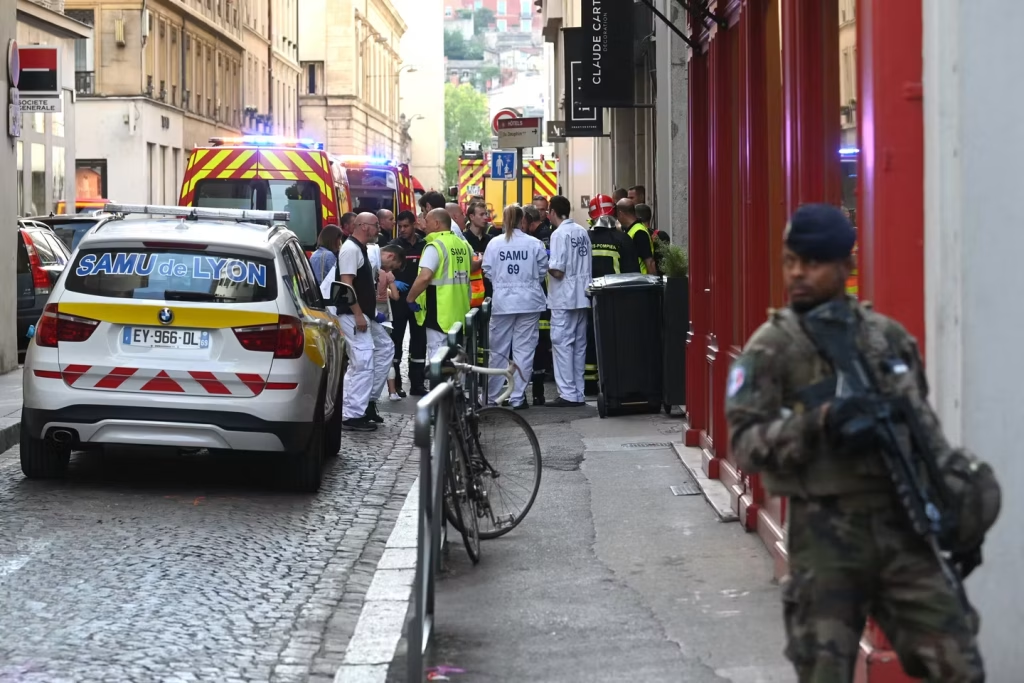
According to the Lyon prosecutor’s office, Deranque suffered a severe brain injury after being thrown to the ground and beaten by at least six individuals during an incident tied to tensions outside a talk where European Parliament member Rima Hassan was appearing. That detail matters because it situates the violence inside a recognizable pattern: political actors arrive to intimidate, counter actors arrive to block them, and the confrontation escapes the perimeter of any formal debate. The prosecutor’s framing has emphasized intentional homicide, a legal category that implies more than spontaneous brawling. Even before trials, the official vocabulary already tells the public that the state is treating this as planned violence rather than mere chaos.
The arrests quickly expanded the story into national politics. Reports indicate that among those detained was an assistant connected to a hard left member of parliament, with additional links to the same political orbit emerging in public discussion. The individual lawmaker announced the assistant’s dismissal, a move that reads like damage control as much as discipline. For the far right, the presence of a parliamentary aide in the investigative perimeter becomes a narrative weapon, proof that the street and the legislature are bleeding into each other. For the hard left, the risk is different: being framed as tolerating militant escalation at the exact moment it claims to oppose intimidation.

The event also exposes a structural vulnerability in modern protests: the ease with which small, determined groups can hijack a setting designed for speech into a contest for physical dominance. Universities are particularly exposed because they carry symbolic weight and provide predictable venues, entrances, and times. Security planning that works for typical public order challenges can fail against targeted confrontations where participants arrive prepared for violence. In this case, the alleged presence of multiple attackers, some described as masked, suggests coordination rather than a single altercation that spiraled. That possibility will be tested in court, yet it already shapes how the public reads the state’s preventive posture.
European security institutions have repeatedly warned that violent extremism is no longer confined to one ideological label, and that hybridization is accelerating. Europol has described an environment where radicalization can be fed by online ecosystems, then expressed in street level action when a trigger event appears. The Lyon death fits that logic in a domestic register: the trigger is not a foreign policy shock or a terrorist plot, but a localized political appearance that becomes a proxy battlefield for national grievances. The danger is that repeated clashes normalize the idea that politics is adjudicated by force. Once that norm takes root, each side arrives expecting violence, and expectation itself becomes the spark.

The American experience offers a parallel lesson about the operational pathway from rhetoric to violence. The FBI has emphasized that domestic violent extremism often emerges when polarized narratives frame opponents as existential threats, making aggression feel like self defense. France’s ideological spectrum is different, yet the cognitive mechanics are similar: when activists believe they are defending the nation, the republic, or the vulnerable, restraint becomes betrayal. That mental shift lowers the threshold for attacks that would have seemed unthinkable in calmer cycles. The death of a young activist, regardless of politics, then becomes fuel for recruitment and retaliation, a feedback loop that law enforcement struggles to break with arrests alone.
There is also a broader global pattern that matters for interpretation. The Institute for Economics and Peace has tracked how political instability and social fragmentation correlate with spikes in violence, even when the incidents are not classified as terrorism. In such environments, a single killing can function as a catalytic symbol, amplifying distrust in institutions and pushing communities toward factional self protection. France is not an unstable state, yet it is experiencing a credibility stress where each camp assumes the system is biased against it. That perception weakens the authority of courts, police, and elected officials to de escalate, because any intervention is read as partisan.
The most delicate issue for French authorities is how to enforce public order without validating claims of selective repression. If the state responds with heavy measures, one side will argue it is criminalizing political speech. If it responds softly, the other side will claim it is tolerating militant intimidation. In the short term, prosecutors can pursue individual culpability, but the long term risk is that the street becomes a permanent arena for political scoring. The state needs not only convictions, but deterrence, visible capacity to secure public events, and a narrative that makes violence socially costly across the spectrum. Otherwise, each new clash becomes rehearsal for the next.
What makes this case especially volatile is its timing. France is already operating inside a landscape where electoral incentives reward outrage and where algorithmic attention systems elevate the most inflammatory interpretations. A homicide linked to rival activists is the type of event that can be weaponized instantly, with simplified villains and martyr imagery spreading faster than verified facts. If institutions fail to communicate clearly, the vacuum will be filled by propagandists who profit from escalation. The challenge is not to depoliticize the incident, which is impossible, but to prevent it from becoming a template for routine violence.
Contra la propaganda, memoria. / Against propaganda, memory.