

 Phoenix 24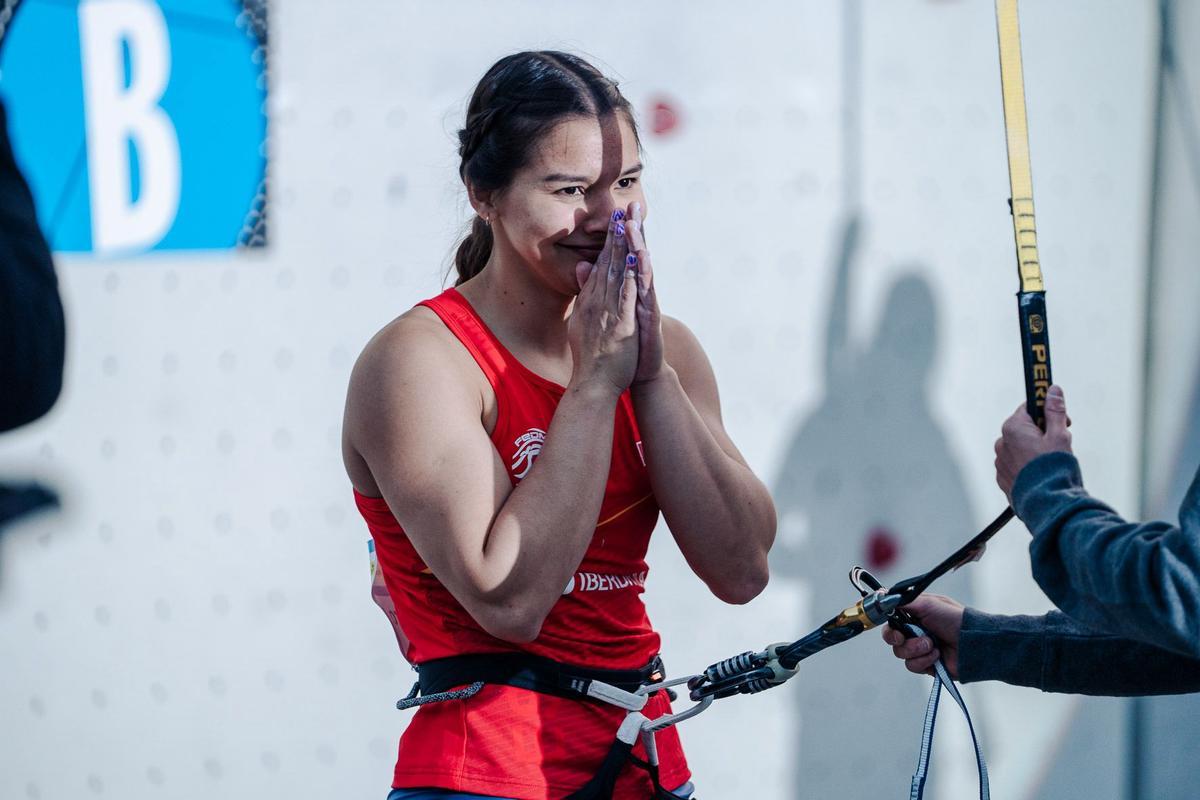
Starting over can become a competitive weapon.
Barcelona, March 2026
Leslie Romero’s reflection that she had to start from zero lands with unusual force because it speaks to more than an athlete rebuilding form. It captures the deeper structure of a sporting life shaped by migration, reinvention, and a discipline that offers very little margin for hesitation. Romero is not simply another climber on Spain’s roster. She is one of the clearest examples of how elite sport now often depends on an athlete’s ability to reconstruct identity as much as performance. In speed climbing, where races are decided in seconds and progress is brutally measurable, starting over is not a metaphor. It is a condition of survival.
Her trajectory gives that phrase real weight. Reporting around Paris 2024 described Romero as a Venezuelan-born Spanish climber who reached the final phase after a difficult qualification path, while federation and competition records show that she has represented Spain since 2022 and has built a notable list of results in European speed events. That timeline matters. It means her current profile was not inherited through a long, stable institutional pipeline. It had to be assembled in a compressed period, under competitive pressure, in a sport where late consolidation is especially demanding. When Romero speaks about beginning again, she is talking from within a biography of accelerated adaptation.
What makes her case particularly revealing is that speed climbing rewards precision but punishes instability. Athletes are measured not only against rivals, but against fractions of a second, technical rhythm, and the psychological burden of repetition. A fresh start in such a discipline is harsher than in many others because every flaw becomes public immediately. There is no room to hide inside team structure or long tactical phases. International competition records show Romero competing across World Cups, European Cups, and world-level championships, which confirms that her development has unfolded in a highly exposed circuit. To restart under those conditions is not merely difficult. It is professionally unforgiving.
The personal dimension also matters because Romero’s story is inseparable from displacement and self-redefinition. Public reflections associated with her own recent messaging describe Spain as the place where she learned to be alone, start from zero, grow in silence, and sustain herself when nobody was watching. Even read cautiously, that language reveals an athlete framing her evolution not as a linear rise, but as a lonely act of reconstruction. In elite sport, such narratives are often flattened into motivational cliché. Here they deserve to be taken more seriously. Reinvention is not decorative language for Romero. It appears to be the underlying method by which she has remained viable.
That is one reason her career resonates beyond climbing itself. Spain’s sporting conversation still tends to reserve its deepest symbolic investment for football, tennis, cycling, or Formula One, while disciplines like speed climbing fight for intermittent visibility. An athlete in Romero’s position therefore carries a double burden. She must perform at elite level and, at the same time, help explain why her sport merits attention. Coverage after Paris suggested exactly that dynamic, presenting her not only as a competitor but as part of the effort to expand the cultural legitimacy of speed climbing in Spain. In that sense, starting from zero also refers to building public recognition in a field that still lacks entrenched national infrastructure.
Her post-Paris context reinforces that reading. Public signals from early 2026 show Romero positioning the new season as another opportunity rather than as a completed arrival. That posture is revealing. Athletes who view a major tournament as the end point often drift into symbolic satisfaction. Athletes who frame the next cycle as another beginning usually understand that elite status is never secure. For Romero, the most important achievement may not be that she reached the Olympic stage, but that she seems unwilling to let that stage become her final narrative. Starting over, in that sense, becomes a discipline of ambition rather than a confession of fragility.
There is also a wider structural lesson here for women’s sport. Romero’s story resists the old expectation that athletes must emerge through neat national pathways, early institutional support, and uninterrupted progression. Her career suggests something messier and more contemporary: that elite performance can come through relocation, delayed consolidation, and repeated self-reconstruction. That does not romanticize precarity. It clarifies it. Modern sport increasingly rewards athletes who can metabolize instability without allowing it to erase technical excellence. Romero’s competitive record and Olympic presence indicate that she has done precisely that.
What makes her voice compelling now is not only what she has already achieved, but the way she interprets achievement itself. To say that she had to begin from zero is to reject the comforting illusion that high performance always follows a clean upward line. Sometimes it comes from rupture, silence, and rebuilding under conditions that offer no guarantees. Leslie Romero’s value, then, is not limited to medals, rankings, or national representation. She embodies a harder truth about elite sport in the present tense: that the athlete who survives is often the one who learns how to become new without losing competitive edge. And in a discipline measured in fractions, that may be the sharpest strength of all.
Phoenix24: journalism without borders. / Phoenix24: journalism without borders.