

 Phoenix 24
Abduction also functions as state policy.
Kyiv, April 2026
A newly documented case from occupied Kherson has pushed one of the war’s darkest patterns back into view: the forced removal of Ukrainian children under armed control. The case centers on the transfer of 15 children from the village of Novopetrivka in 2022, with Ukrainian prosecutors alleging that Russian forces threatened those in charge of the children, blocked their ability to leave freely, and then moved them deeper into occupied territory before transferring them into Russia. What makes the episode so consequential is not only the brutality of the act, but the way it strips away the softer language of evacuation and replaces it with a harsher reality of coercive displacement. In that shift of language, the political meaning of the act becomes much harder to conceal.
The details matter because they cut directly into the logic used to justify such removals. According to the documented account, the place where the children were staying had food, medicine, shelter and no immediate battlefield necessity that would make a forced emergency evacuation appear unavoidable. Yet the children were still taken under armed pressure and later moved through occupied areas and onward into Russian-controlled institutional space. That sequence suggests that force was not incidental to the transfer but central to it. The removal was not merely about movement; it was about control over who decides a child’s future under occupation.

This case also fits into a much wider pattern that international bodies have already treated with grave seriousness. Investigators and human rights institutions have concluded that the deportation and forcible transfer of Ukrainian children cannot be understood as scattered wartime irregularities. The pattern has been described as systematic, involving large numbers of children across multiple occupied regions and raising questions that go far beyond battlefield conduct. Once the transfer of children becomes repeated, organized and difficult to reverse, the war is no longer only about territory. It becomes a struggle over identity, guardianship and long term demographic power.
That is why these cases carry such heavy strategic weight. Occupation is not sustained only through soldiers, checkpoints or administrative decrees. It also works by breaking continuity between children and their language, families, schools, communities and legal protections, then embedding them in new structures meant to normalize separation. When that happens, the act is not simply removal from danger, as official narratives may claim. It becomes an attempt to reorganize the social future of an invaded population.
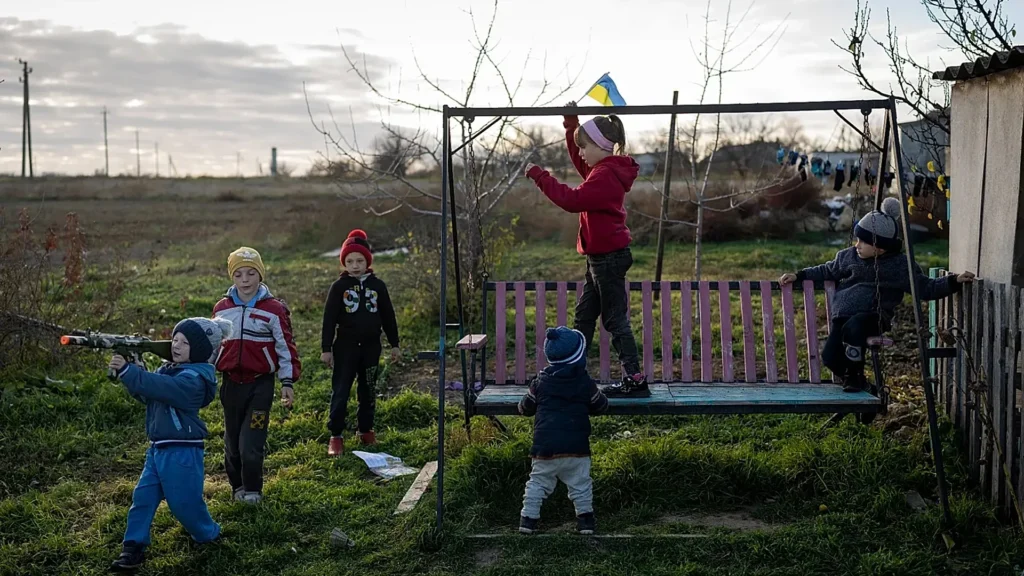
The legal and moral stakes deepen when return is obstructed or delayed. International humanitarian law does not treat the movement of children from occupied territory as a neutral administrative matter, especially when coercion, threat or absence of lawful necessity is involved. The more these documented episodes accumulate, the harder it becomes to sustain the fiction that they are humanitarian gestures rather than instruments of domination. What is at stake is not only where the children are taken, but what authorities intend to erase or overwrite once they arrive there.
The deeper pattern is brutal in its clarity. This is not only a story about children removed from one part of Kherson, but about how modern occupation extends beyond land seizure into memory, identity and generational control. The seizure of children is one of the clearest signs that the war is being fought not only over geography, but over who will belong to that geography in the future. In that sense, the crime is not only physical displacement. It is an assault on continuity itself.
Facts that do not bend. / Facts that do not bend.