

 Phoenix 24
Rock prestige did not survive the gallery test.
London, June 2026
Jack White’s first public visual art exhibition has collided with one of the harshest rules of cultural prestige: fame can open the gallery door, but it cannot guarantee critical legitimacy. The former White Stripes frontman presented These Thoughts May Disappear at Newport Street Gallery in London, backed by Damien Hirst and with collaborations involving Ai Weiwei, yet the institutional glow around the project did not shield it from a devastating review.
The exhibition brings together more than 100 pieces, including sculptures, installations, furniture, found objects and interactive works. White’s creative universe is built around discarded materials, handmade construction, musical memory and the visual language that has accompanied his career for decades. In theory, the show could have functioned as an expansion of his artistic identity beyond rock. In practice, critics argued that the result lacked the depth, originality and conceptual force expected from a major contemporary art space.
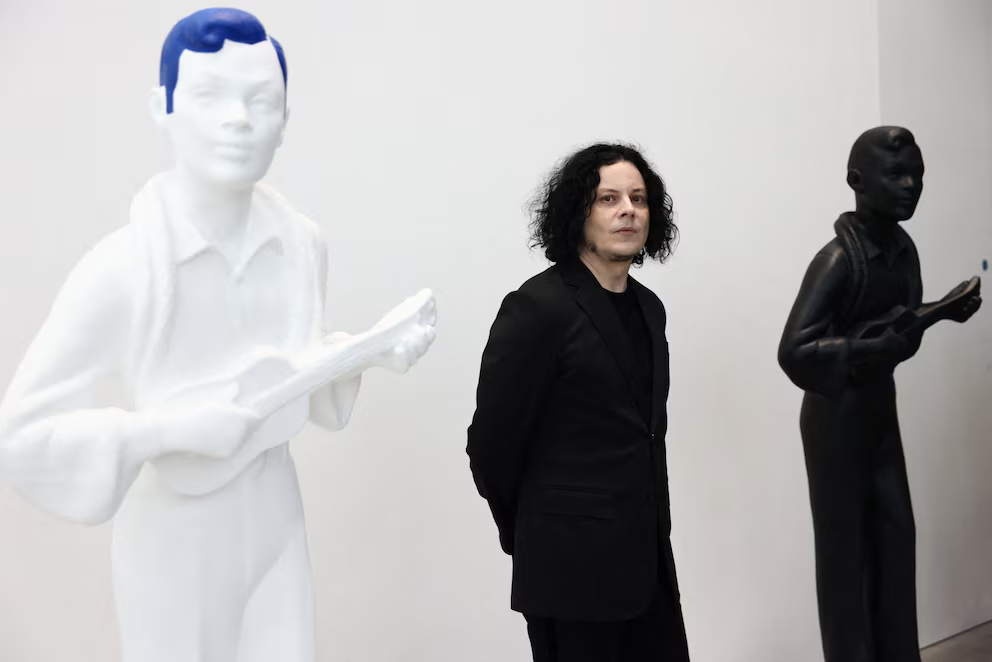
The most severe criticism came from Jonathan Jones, who described White as an outsider to visual art rather than a convincing new voice within it. His review framed the exhibition as derivative, superficial and intellectually thin, suggesting that White’s instinct for music did not translate into plastic invention. The presence of Hirst, Ai Weiwei and other celebrated names only intensified the problem: instead of legitimizing the show, their proximity made the weakness of the work more visible.
That tension reveals a broader cultural dilemma. Contemporary art often celebrates crossing disciplines, but not every successful musician, actor or designer can automatically convert symbolic capital into artistic authority. White’s reputation as a musician depends on rawness, restraint, blues memory and aesthetic control. The gallery, however, demands a different kind of rigor, where objects must survive without the electricity of the stage or the mythology of the performer.
The failure, if it can be called that, is not that White tried. The problem is that the exhibition appears trapped between personal archive, celebrity experiment and curated spectacle. It shows a restless creator testing another language, but also exposes how difficult it is to move from one artistic system to another without being judged by the standards of the new territory.
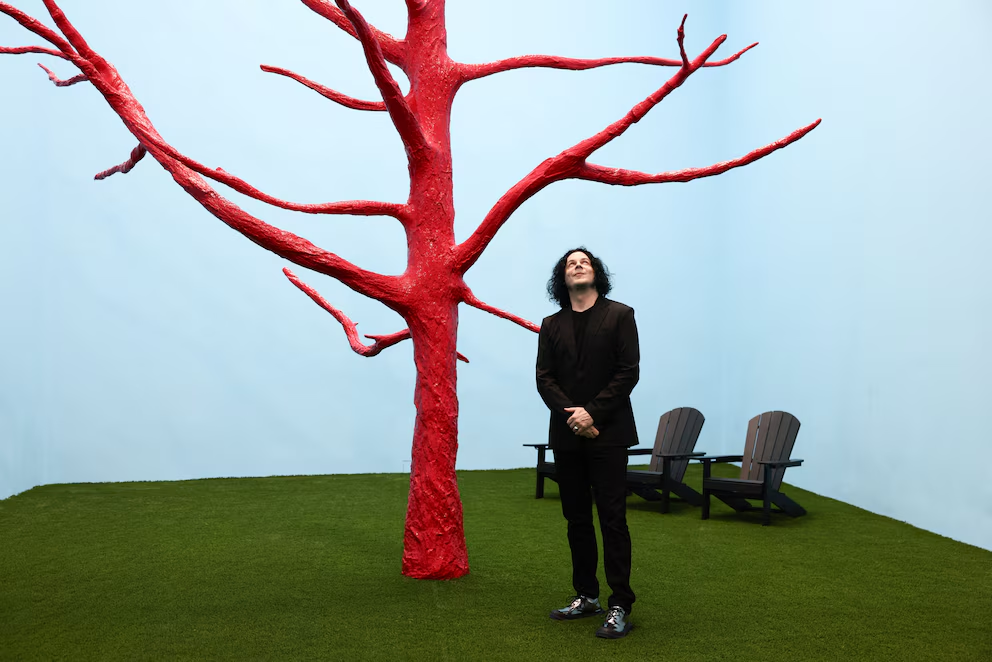
For Jack White, the episode may become either a humiliating detour or the beginning of a more serious visual practice. For the art world, it is a reminder that endorsement does not equal substance. Even the blessing of Damien Hirst and Ai Weiwei cannot transform a weak exhibition into a necessary one.
Narrative is power too. / La narrativa también es poder.