

 Phoenix 24
When a music platform bridges social connections, the way we experience sound shifts from a solitary act to a shared cultural moment.
New York, January 2026. Spotify has rolled out a feature that allows users to see what their contacts are listening to in real time, a design aimed at deepening social engagement within the streaming experience. This option reflects a broader evolution in how music platforms balance individual privacy with communal discovery, blending personal taste with networked visibility in ways that change how people share and explore audio content.
The feature works by showing a feed of listening activity among selected contacts, highlighting tracks, playlists and artists they are engaging with at the moment. Users must opt in explicitly to share their listening data, and the platform includes granular controls that let individuals determine which contacts can view specific types of activity. This opt-in model stems from an awareness of privacy concerns that have accompanied social features in digital services, and it represents a compromise between transparency and control.

On the technical side, the system integrates with user libraries and activity logs to generate an up-to-the-minute snapshot of listening habits. When a contact plays a song, the track title and artist appear in the feed, along with the time stamp of that session. The design does not reveal detailed logs of full listening histories, but rather a real-time glimpse that can spark discovery or conversation. Contacts who choose not to share their activity remain private, and their listening remains invisible in the shared feed, reinforcing user autonomy over personal data.
Music industry analysts observe that this type of social listening feature responds to a broader trend in digital culture, where experiences are increasingly communal even when consumed on individual devices. Playlists, shared sessions and collaborative curations have already blurred the lines between personal and group music consumption. The new Spotify option takes this a step further by reducing the friction between private listening and social awareness, without forcing shared exposure for all contacts.

Privacy advocates have noted that the opt-in mechanism is critical, especially in an era where streaming data can reveal more about personal identity and mood than users may realize. While some people are comfortable sharing their current listening with close friends, others are wary of any live broadcasting of behavioral data. The platform’s decision to implement choice architecture that foregrounds consent is seen as a response to these differing user expectations.
The rollout of this feature also dovetails with changes in how people discover music today. Traditional radio and expert recommendations have given way to algorithmic suggestions calibrated to individual taste profiles. Adding a social dimension offers an alternative vector for discovery: peer influence. A song that appears in a friend’s feed can prompt curiosity and broaden listening horizons, turning passive streaming into a more interactive cultural exchange.
Privacy settings are a key component of the new functionality. Users can designate specific contacts for sharing, block particular individuals from seeing activity, or disable the feature entirely. These options are designed to let people tailor their social footprint without feeling pressured into sharing more than they want. For those who prioritize privacy, the default setting is off, and the activation of any shareable visibility requires affirmative action.
Content creators and artists have reacted to the feature with interest, recognizing that peer influence is an important driver of listening trends. Independent musicians in particular see potential in informal social sharing, where fans’ activity among networks can cascade into broader exposure. Labels and promoters are already considering how this real-time visibility could factor into launch strategies, particularly for singles and curated playlist campaigns.
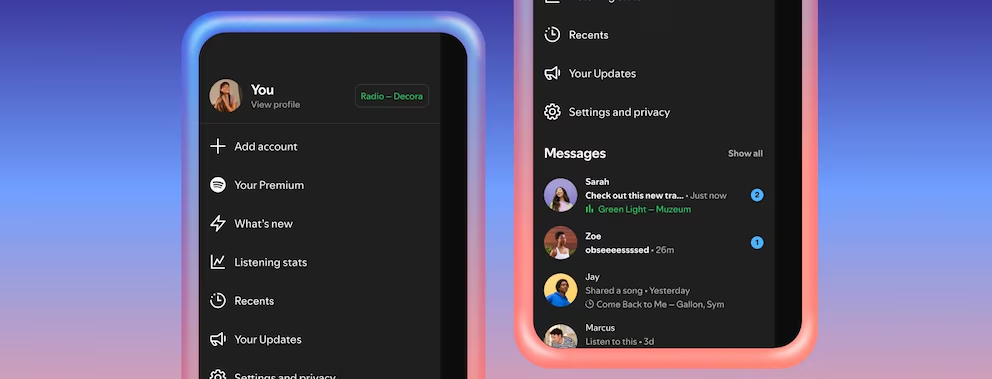
The platform also allows contextual commentary, where users can add brief notes or reactions to a track that appears in their feed. This optional layer of expression aims to make the social listening experience richer, enabling brief exchanges and recommendations without diverting users to external messaging channels. In this way, the feature is not just about exposure to content but about shared interpretation and communal resonance.
However, experts caution that increased visibility into listening habits may also create subtle social pressures. Social psychologists note that while sharing can strengthen bonds, it can also induce conformity or anxiety over digital presentation. When users know that their activity is visible to others, they may adjust their listening in ways that reflect social expectations rather than personal preference. The platform’s emphasis on consent and control is intended to counterbalance these dynamics, giving users agency over their public audio persona.
For users who embrace the feature, the experience becomes a kind of live soundtrack of their social circle, a musical map of what friends and connections are engaging with at any given moment. It transforms listening from a solitary ritual into a shared narrative, where moments of discovery are amplified by community awareness.
The impact of this feature will evolve as users adapt to its social possibilities and limitations. What remains clear is that music streaming is no longer just about songs and playlists. It is about connection, context and the ways in which personal taste intersects with the rhythms of community.
Each silence speaks.
Every silence speaks.