

 Phoenix 24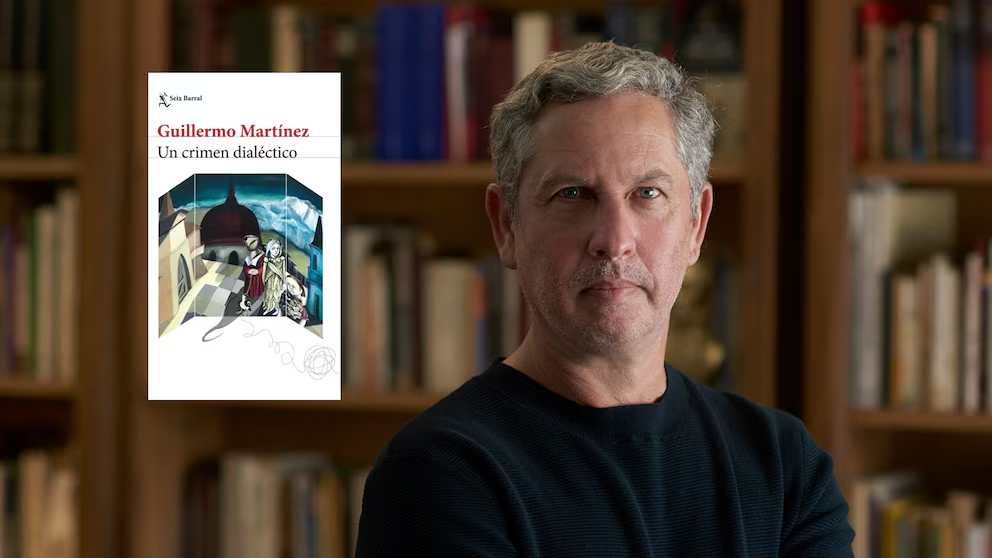
Literature confronts power, violence and disappearing freedoms.
Buenos Aires | July 2026
Argentine writer and mathematician Guillermo Martínez has warned that contemporary society is undergoing what he describes as a sustained “march toward the Middle Ages,” driven by political extremism, cultural censorship, declining humanism and the normalization of violence against civilian populations.
The reflection emerged during an extensive interview surrounding the publication of his new novel, Un crimen dialéctico, a philosophical crime story that explores free will, political loyalty, moral responsibility and the dangers of manipulating human behavior in the name of an ideological cause.
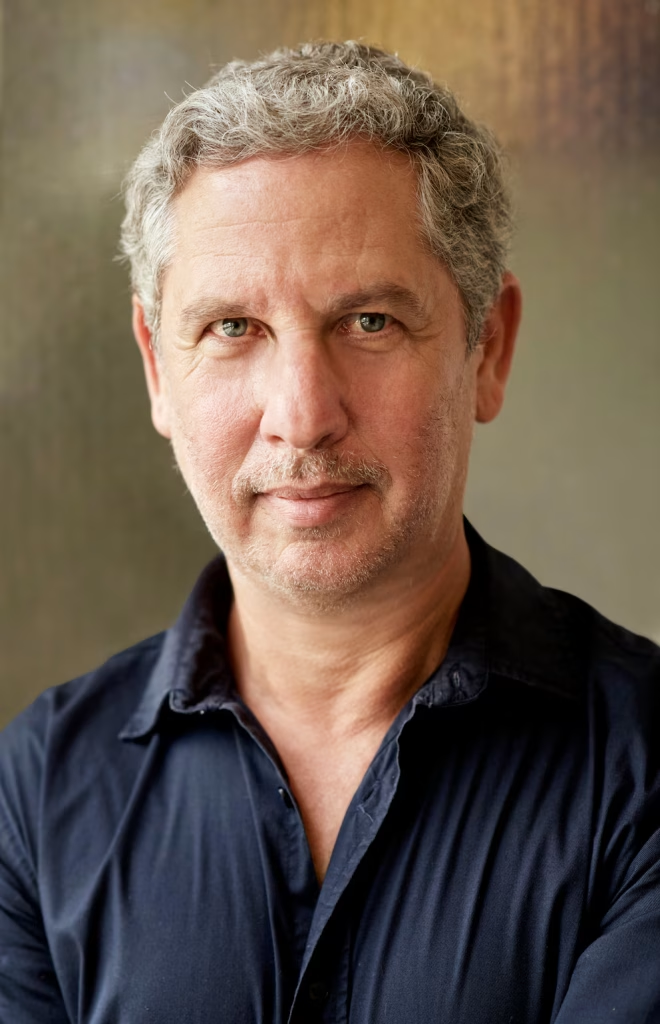
Martínez, born in Bahía Blanca in 1962, holds a doctorate in mathematical sciences from the University of Buenos Aires. His literary work has been translated internationally and includes Crímenes imperceptibles, adapted for cinema as The Oxford Murders, and Los crímenes de Alicia, which received Spain’s Nadal Prize.
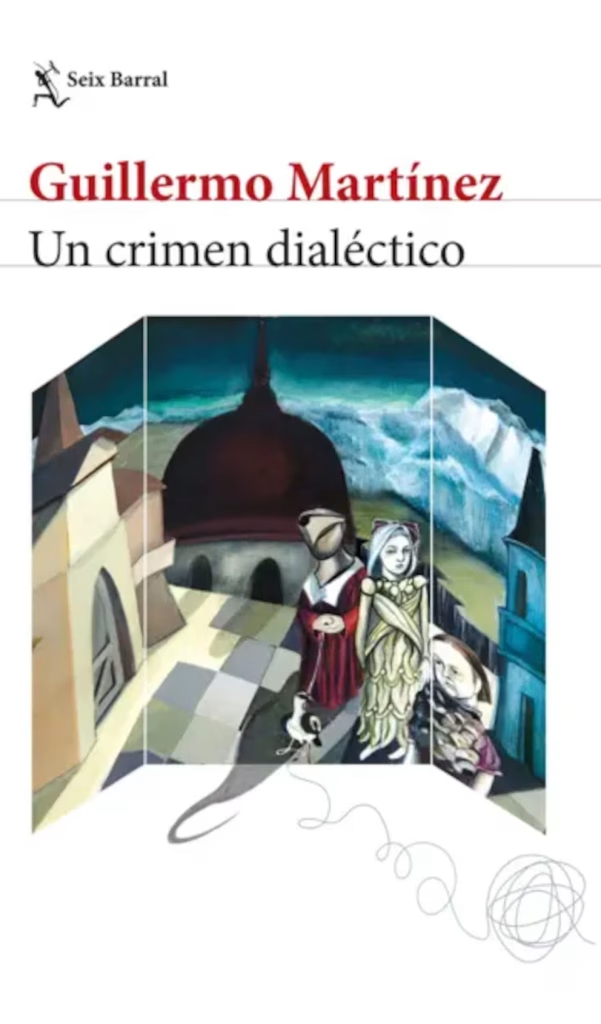
His latest novel returns to the intellectual territory where science and fiction intersect. Its protagonist is a former revolutionary militant who has become a scientist and lives outside his country. As a dictatorship approaches its end, he returns with a mission ordered by his political organization: to participate in a murder intended to influence an approaching election.
The central character studies a neuroscience experiment that appears to challenge the existence of free will. His scientific investigation becomes inseparable from his personal dilemma: whether he can choose independently or whether his decisions have already been determined by ideology, history, loyalty and hidden chains of causality.
Martínez explained that the novel examines how individuals can be manipulated by someone who believes he understands their deepest motivations. The narrator attempts to guide other characters toward actions opposite to their established personalities, using honor, desire, religious faith and political commitment as instruments.
That mechanism gives meaning to the title. The crime is “dialectical” because it develops through opposition, contradiction and the transformation of each character into an unexpected version of themselves.
The novel draws intellectual inspiration from Jean-Paul Sartre’s play Dirty Hands, Witold Gombrowicz’s Cosmos and Premeditated Crime, as well as the fiction of Jorge Luis Borges. Martínez acknowledged that readers have identified echoes of Borges’s Emma Zunz and the poem Chess in the structure of the story.
The scientific debate at the heart of the novel also reflects one of the defining philosophical conflicts of the twentieth century. Sartre argued that human beings are condemned to freedom, while historical materialism emphasizes the social, economic and historical forces that shape thought and behavior.
Martínez does not present an easy resolution. He said people want to believe that they can recognize their own class, family and cultural biases and still make meaningful choices. Yet the possibility that unseen causes govern those decisions remains intellectually disturbing.
The story also examines the moral difference between sacrificing one’s own life and deliberately taking another person’s life. Martínez emphasized that dying for a revolutionary cause is fundamentally different from planning the death of a specific individual.
That distinction becomes especially important for a protagonist who remains loyal to the promises of his youth but wants to avoid physically carrying out the crime. The character attempts to preserve his moral innocence by manipulating others into completing the act.
For Martínez, the dilemma is not confined to revolutionary movements of the past. It raises a broader question about what remains of political commitment when ideals encounter the practical exercise of power.
He observed that revolutionary projects can begin with aspirations for justice and liberation but later produce torture, repression and violence. The novel therefore examines the distance between theoretical purity and the morally compromised reality created when ideology becomes action.
The interview also moved from fiction toward the present political environment. Martínez expressed alarm over the international resurgence of far-right movements and what he sees as the weakening of organized responses from progressive and humanist sectors.
He argued that powerful states increasingly appear able to use military force or territorial ambition without generating the level of public rejection that similar actions might have produced in previous decades.
Martínez pointed to the destruction in Gaza and the suffering of civilians as evidence of what he described as a profound abandonment of humanist values. His comments represented his political interpretation of the conflict and his concern over the normalization of violence against children and noncombatants.
The writer also questioned how opponents of authoritarianism should respond when traditional forms of protest appear insufficient against governments and institutions possessing far greater power.
He rejected romanticizing passive suffering and suggested that political resistance requires new forms of intelligence and strategy. At the same time, he acknowledged that violence used to confront violence has repeatedly produced destructive consequences.
His concern extended to Argentina’s economic and social conditions. Martínez referred to pensioners, people with disabilities and families unable to afford medicines or basic necessities, warning that prolonged desperation can generate unpredictable social reactions.
He expressed hope that voters could produce a peaceful change in policy, but argued that continued austerity without credible alternatives could create tensions that institutional politics may struggle to contain.
The most direct cultural warning came when Martínez discussed censorship and the role of younger generations. He said he continues to place his hope in science and in the possibility that new generations will understand the present more clearly and move beyond its prevailing forms of intolerance.
He referred specifically to lists of books removed or prohibited in schools and public libraries in the United States. For Martínez, such restrictions are particularly disturbing because they emerge in a country historically presented as a defender of freedom of expression.
He described campaigns against books associated with progressive, racial, gender or sexual-diversity themes as evidence of cultural regression. The blacklisting of ideas, he suggested, reflects a return to a period when authority sought to regulate not only political behavior but also imagination, knowledge and private identity.
“I see a sustained march toward the Middle Ages,” Martínez said, expressing hope that the political and cultural winds will eventually change.
The phrase summarizes a concern that extends beyond conventional political disagreement. It describes a world in which censorship, religious dogmatism, militarized power and hostility toward intellectual complexity increasingly displace democratic debate.
Martínez’s response is not entirely pessimistic. His expectation that a new generation may “turn the page” preserves a belief in historical change, education and the human capacity to recognize previous mistakes.
That hope is also visible in the structure of his fiction. Un crimen dialéctico places its characters inside systems of ideology, memory and causality, but still asks whether moral choice remains possible.
The novel does not separate literature from the public conflicts surrounding it. Science, religion, revolution and personal loyalty become competing explanations for why human beings act as they do.
At a moment when political language increasingly demands absolute certainty, Martínez’s work returns to doubt as an intellectual necessity. His warning suggests that societies move backward not only when rights are formally eliminated, but when complexity itself becomes intolerable.
Phoenix24 | Freedom survives where thought remains impossible to prohibit. La libertad sobrevive donde el pensamiento sigue siendo imposible de prohibir.