

 Phoenix 24
The spectacle depends on labor few ever see.
London, April 2026
Formula 1 has once again revealed a truth that the glamour of the paddock usually hides: the championship’s global machine depends not only on elite engineers, billion-dollar teams, and television rights, but on a vast volunteer labor structure without which race weekends would be operationally impossible. According to figures highlighted by the FIA, the full season requires more than 20,000 volunteers, with an average of 838 per Grand Prix. That means the sport’s image of precision and technological supremacy is sustained by a human architecture that remains largely invisible to the audience.

The scale of that contribution is not symbolic. Across the season, these volunteers account for roughly 965,000 hours of work, much of it concentrated in safety, track operations, incident response, signaling, and race control support. In practical terms, they are the first layer of order in a sport built around speed, danger, and logistical complexity. Marshals wave flags, secure accident zones, assist stranded drivers, help extinguish fires, clear debris, and protect the continuity of the event. Without them, the race does not simply become more difficult to organize. It becomes unmanageable.
What makes the model more striking is its economic logic. Replacing that volunteer labor with paid staff would reportedly add around 15.5 million dollars in annual costs to Formula 1’s operating structure. This exposes a deeper reality about modern elite sport: even at the highest commercial tier, financial efficiency often depends on non-remunerated work embedded within a culture of prestige, passion, and professional identity. Formula 1 presents itself as the apex of motorsport modernity, yet one of its structural pillars still rests on unpaid commitment.
That does not mean the volunteers are unskilled or marginal. On the contrary, their role requires training, discipline, and operational reliability under pressure. Many remain active in the sport for years, and a significant share take vacation time or unpaid leave from their regular jobs in order to serve during race weekends. This points to a paradox at the heart of Formula 1’s labor ecosystem: one of the most technologically advanced competitions in the world still relies on a workforce motivated less by salary than by belonging, vocation, and proximity to the sport’s inner machinery.
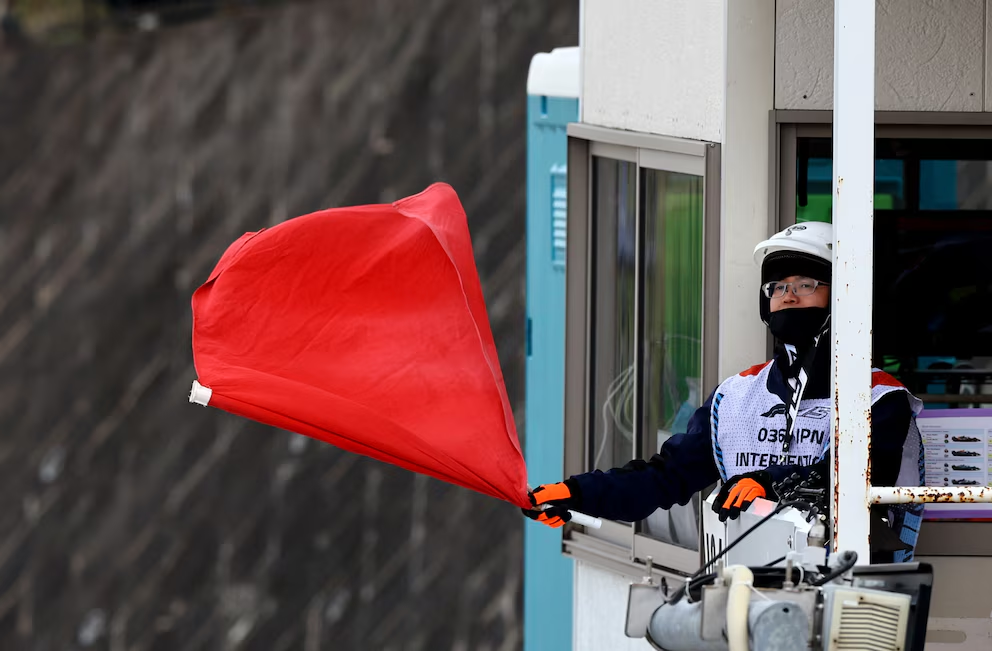
The FIA appears increasingly aware that this model cannot be romanticized indefinitely. Workloads have reportedly grown in recent years, and the governing body is investing in training and development programs to secure future generations of officials and race personnel. That investment matters because volunteer retention is no longer just a cultural asset. It is a strategic requirement. As the championship expands in scale, complexity, and global reach, the pressure on its human support system also intensifies.
The broader lesson extends beyond Formula 1. Mega-events often present themselves as products of capital, technology, and branding, but beneath that polished surface they depend on disciplined labor systems that are frequently under-recognized. In Formula 1, the volunteers are not an auxiliary feature. They are part of the sport’s operational backbone. The spectacle may belong to the drivers and the teams, but the conditions that make it possible are sustained by people whose names rarely appear on screen.

What this reveals is a more uncomfortable truth about elite global sport. Its image is futuristic, but its logistics still depend on forms of labor that are partly civic, partly emotional, and only indirectly compensated through experience, status, and access. Formula 1 sells speed, innovation, and engineering supremacy. Yet behind the image of cutting-edge competition stands an old principle that remains fully intact: every empire of performance still requires an unseen workforce to hold it together.
Behind every fact, there is an intention. Behind every silence, a structure.