

 Phoenix 24
Her account exposes pressure inside demanding productions.
LOS ANGELES, UNITED STATES — July 2026.
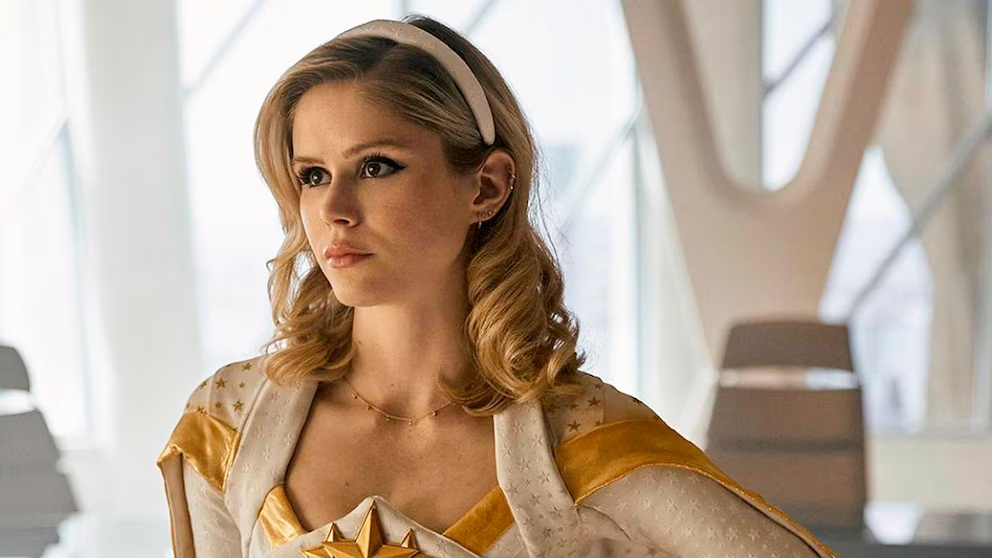
Erin Moriarty has revealed that she filmed an intimate scene for The Boys while suffering from a severe staph infection that left her unable to move her right arm. The actress, known for playing Annie January and Starlight in the Prime Video series, described the experience as physically painful and emotionally isolating. Her account centered on a scene from the second season, in which Starlight shares her first sexual encounter with Hughie, played by Jack Quaid. The disclosure has renewed attention on the physical demands placed on performers and the difficulty many actors face when attempting to set limits on set.
Moriarty shared the story during an appearance on the podcast MesSy, where she reflected on the pressures young actresses often internalize early in their careers. She said the production was informed about her condition before the nighttime shoot, but the filming schedule continued with only limited adjustment. According to her account, the infection had become visibly severe, producing swelling under her arm and making basic movement difficult. She recalled feeling that people heard her words but did not fully understand the seriousness of the situation until they saw the infection themselves.

The actress said she had pushed herself to keep working because she wanted to be viewed as professional, reliable and cooperative. Her comments suggested a pattern familiar across entertainment industries, where performers may feel they must endure pain or illness to avoid being labeled difficult. That pressure can become even stronger during intimate scenes, which already require vulnerability, choreography, trust and heightened attention to consent. When illness is added to that context, the balance between artistic commitment and workplace safety becomes especially important.
Moriarty described the infection as a severe staph episode that developed after her body had been worn down. Staphylococcus bacteria can live on the skin, but certain infections may become serious when the immune system is stressed or when bacteria enter deeper tissue. While Moriarty did not present the story as a medical case study, her description made clear that the symptoms were alarming enough to require urgent attention. Her inability to move her arm underscored how far the situation had progressed before the production environment fully responded.
The scene itself became more complicated because of its narrative and emotional function inside The Boys. Starlight and Hughie’s relationship is one of the series’ more human counterpoints to its violent satire of superhero celebrity, corporate power and political manipulation. Intimate scenes are usually carefully planned so that actors can perform within controlled physical and emotional boundaries. Moriarty’s account raises questions about whether those protections can function properly when a performer is physically compromised and still feels pressure to complete the work.
Her comments also connect with wider conversations about labor conditions in film and television after years of industry debate over safety, burnout and power imbalance. Actors, crews and unions have increasingly pushed for clearer rules around long hours, medical needs, intimacy coordination and the right to pause work without retaliation. The presence of a medical issue should normally trigger careful reassessment because a production schedule cannot be more important than a person’s health. Moriarty’s story illustrates how a professional culture built on endurance can sometimes blur the difference between commitment and self-neglect.
The actress has also spoken publicly about a separate and longer health struggle involving Graves’ disease, an autoimmune disorder associated with an overactive thyroid. She was diagnosed in 2025 after nearly two years of symptoms that reportedly included extreme fatigue, heart palpitations, memory problems, weakness and cognitive difficulties. Moriarty later wrote that the diagnosis gave her an answer after a confusing period in which other possible explanations had been considered. Her willingness to discuss the condition has made her part of a broader public conversation about invisible illness, delayed diagnosis and the importance of listening to the body.

Moriarty’s health disclosures should be treated carefully because they involve personal medical history rather than entertainment spectacle. Her hospitalization after a serious mental health crisis in 2025 was also described by the actress as part of the aftermath of prolonged illness and recovery. That context matters because physical health, professional pressure and emotional exhaustion can interact in ways that outsiders may not immediately understand. Public discussion should therefore avoid sensationalism and instead focus on the systemic lessons her experience brings forward.

The response to Moriarty’s account may encourage more scrutiny of how high-pressure productions handle illness, vulnerability and consent. The Boys is known for pushing boundaries through graphic violence, satire and provocative scenes, but boundary-pushing storytelling still depends on strong protections behind the camera. Actors can deliver demanding work without being expected to ignore serious medical warnings or suppress basic needs. Moriarty’s story ultimately points beyond one difficult shoot and toward a larger question about whether entertainment workplaces are prepared to value human safety as much as performance.
Phoenix24 — Global news with clarity and perspective.