

 Phoenix 24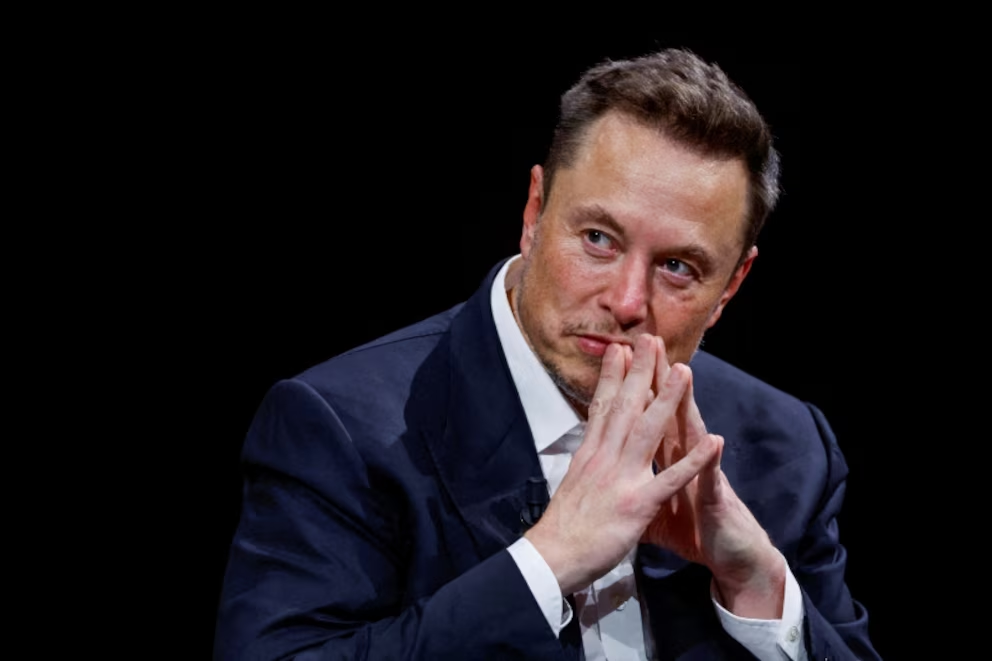
A technological warning that is redefining what it means to heal and to advise.
California, August 2025
With his characteristic bluntness, Elon Musk declared on X that artificial intelligence already outperforms most doctors and that it will soon do the same with lawyers. His statement echoes a broader technological disruption: AI is not only altering professions but challenging the very foundations of human roles.
Different regions interpret his prediction through distinct lenses. In the United States, the comment reverberates across Silicon Valley, where the automation of medical diagnostics is no longer futuristic. In Europe, regulators and professional associations treat it as a signal to legislate urgently on medical and legal AI applications. Meanwhile, in Asia, engineers and academics view the declaration as an invitation to lead global ethical frameworks before they are overtaken by change.
Musk’s hypothesis is not baseless. Recent studies show advanced AI models reaching diagnostic accuracy levels near ninety percent, surpassing human professionals even when aided by technology. On this basis, Musk suggested that human beings may soon become a kind of biological backup of intelligence—less fragile than silicon systems, but no longer central.
The impact is equally stark when applied to law. Repetitive legal tasks—document review, contract drafting, case law searches—are highly automatable. While the courtroom still stands as the proving ground of human judgment, algorithmic tools are rapidly narrowing the space where lawyers once reigned uncontested.
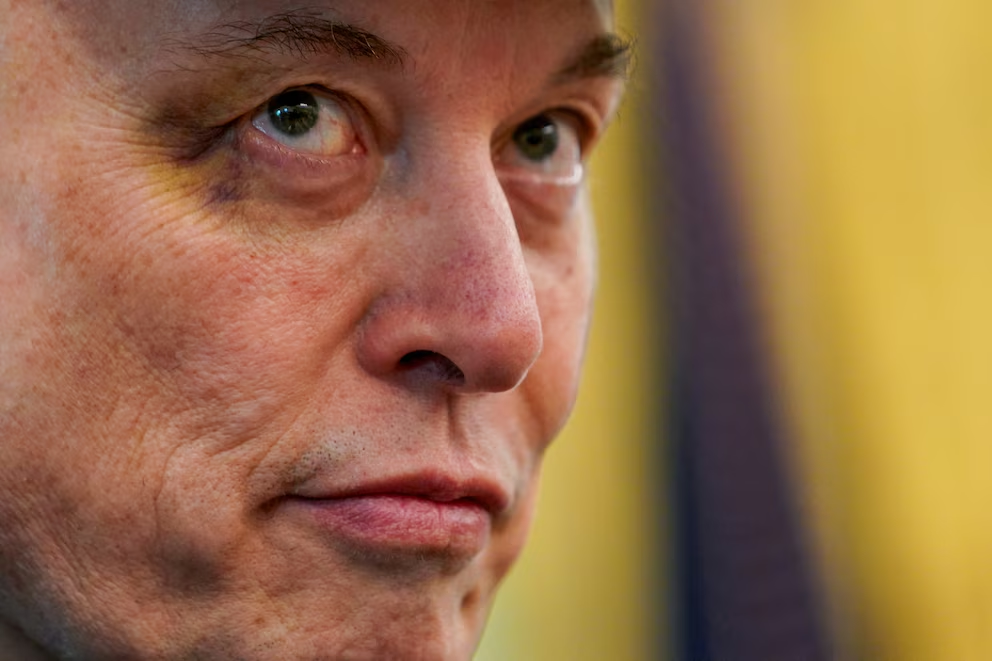
Critics push back strongly. Physicians and jurists argue that their work demands empathy, adaptability, and contextual judgment—qualities that AI cannot reproduce. The unpredictable nature of patients or legal disputes, with their emotional and human variables, remains a space where human presence cannot be replaced without ethical or professional cost.
Beyond the provocation, Musk’s forecast underscores a collective urgency. In the Americas, it may trigger integration of AI as a complementary tool. In Europe, it accelerates regulation and professional certification standards. In Asia, it fuels research aimed at combining automation with ethical safeguards. The larger challenge is ensuring that technological progress does not erase dignity or diminish the human role in critical professions.
Ultimately, Musk’s remark functions as a mirror. It suggests that automation is not just technical—it is a moment of reflection on what we choose to preserve as meaningful human work. If AI can replace diagnoses and legal advice, what remains for us to define as uniquely human responsibility?
Against propaganda, memory.
Contra la propaganda, memoria.