

 Phoenix 24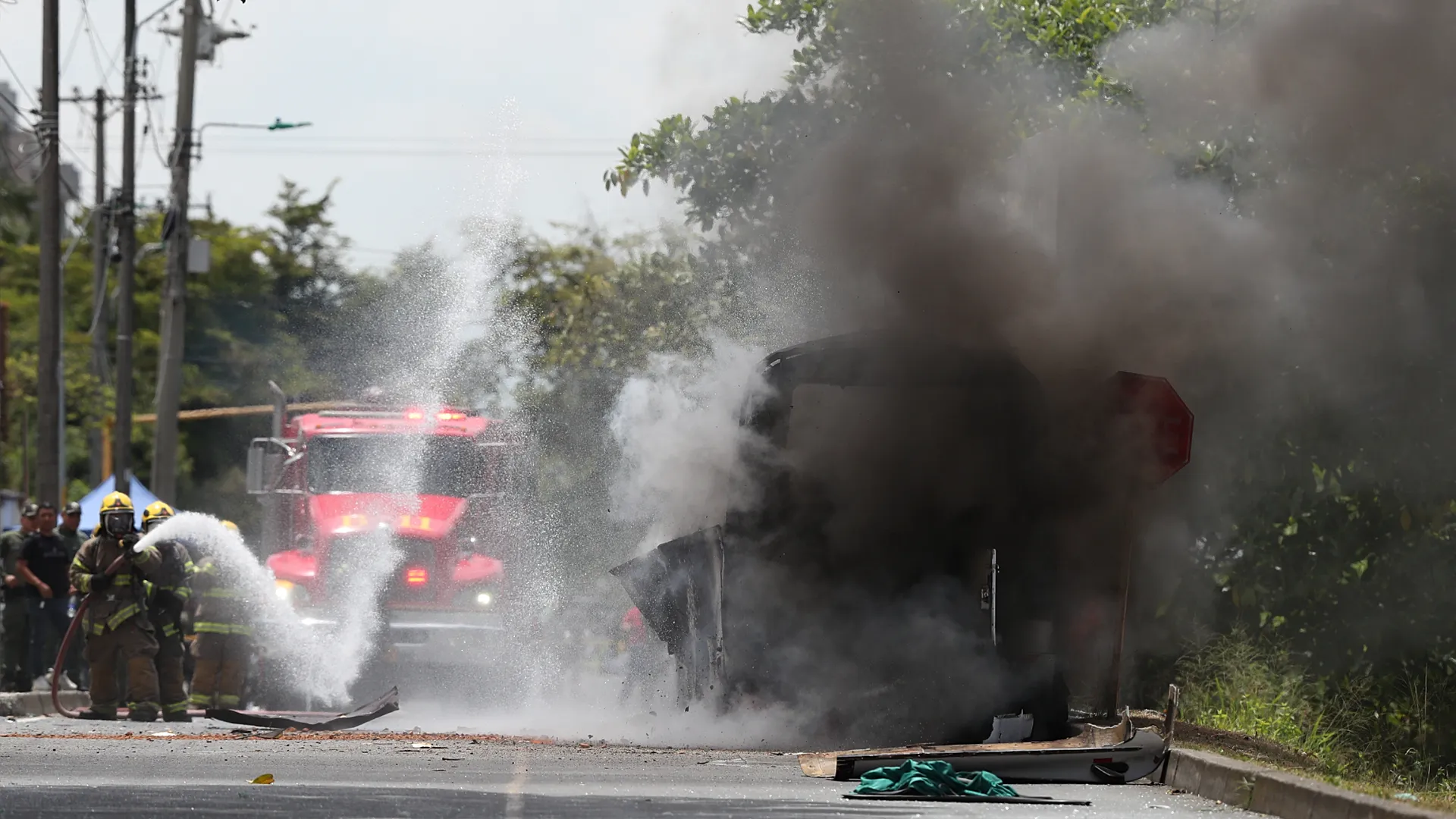
The explosion revealed a conflict still mutating.
Cali, April 2026. A failed explosive attack against the Pichincha Battalion in Cali has reopened one of Colombia’s most sensitive security wounds: the persistence of armed violence inside urban space. Authorities reported that explosive devices were launched toward the military installation, where Colombia’s Third Army Brigade operates, but the attack did not reach its full destructive potential. One gas cylinder loaded with explosives entered the base without detonating, while another device exploded in a nearby bus, causing fire, panic and injuries among civilians.
The episode immediately placed Cali back under a familiar atmosphere of alarm. Two women were reported injured without life-threatening wounds, but the limited casualty count does not reduce the seriousness of the operation. The attack showed planning, mobility and intent, even if part of the explosive mechanism failed. In a city already marked by previous attacks against military targets, the message was not only tactical; it was psychological.
Local authorities indicated that the attackers used a bus as a launching platform before fleeing the area. That detail matters because it shows how armed actors are adapting improvised methods to dense urban environments, using civilian infrastructure as both cover and instrument. When a public vehicle becomes part of an attack sequence, the boundary between battlefield and city collapses. The result is not only material damage, but a deeper erosion of public confidence.
The preliminary suspicion has fallen on the Jaime Martínez Front, a dissident faction linked to the former FARC structures that rejected or drifted away from Colombia’s peace process. This group has been associated with violent operations in the corridor connecting Cauca and Valle del Cauca, a region where illegal economies, territorial control and armed fragmentation continue to shape the security landscape. Cali’s vulnerability comes from that geography: it is a major city placed near conflict corridors that remain active, profitable and difficult to contain.
The failed detonation inside the military base also introduces a dangerous paradox. On one hand, the attack could have been far more lethal had the explosive cylinder functioned as intended. On the other, the failure itself reveals the experimental character of contemporary insurgent and criminal violence, where groups test methods, probe defenses and refine tactics through repetition. In that sense, the incident cannot be dismissed as an isolated failure; it must be read as part of a learning cycle within armed networks.
Cali’s recent history reinforces that interpretation. The city suffered a major attack in 2025 near a military air facility, an episode that left multiple deaths and dozens of injured people, most of them civilians exposed to violence intended for security infrastructure. That precedent remains embedded in the collective memory of the city. The new attack therefore does not arrive in a vacuum; it lands on a population already trained by fear to recognize the sound, smoke and uncertainty of urban conflict.
For the Colombian state, the challenge is no longer limited to controlling rural enclaves. The deeper problem is the projection of armed power into urban centers through low-cost, high-impact methods. Explosives, motorcycles, vehicles, drones, cylinders and improvised launch mechanisms can transform ordinary spaces into operational platforms. This is the logic of asymmetric pressure: limited resources can produce disproportionate political and psychological effects when used against symbolic targets.
The military base in Cali represents more than a physical installation. It embodies the presence of the state in a region where armed groups seek to contest authority, disrupt normality and demonstrate operational reach. Attacking that perimeter allows illegal actors to send a message beyond the immediate blast radius. They are signaling that the state may control institutions, but not necessarily the full tempo of insecurity.
This is why the civilian dimension is central. Even when the declared target is military, the surrounding population becomes the real audience of the attack. Fire, evacuation, traffic paralysis, rumors and emergency sirens spread the impact far beyond the damaged area. Urban terrorism functions through that multiplication of fear, turning a limited detonation into a citywide signal of vulnerability.
The incident also complicates Colombia’s national security narrative under the shadow of post-conflict expectations. The 2016 peace agreement reduced one form of armed confrontation, but it did not dissolve the economic structures that sustain violence. Coca corridors, illegal taxation, extortion networks and territorial disputes survived the formal demobilization of major guerrilla structures. What has emerged is not the old war in identical form, but a fragmented ecosystem of armed actors with flexible identities and pragmatic objectives.
That mutation is what makes the Cali attack strategically important. It shows that Colombia’s security problem cannot be understood only through the vocabulary of insurgency or organized crime. The threat now occupies a hybrid zone where political residue, criminal revenue and territorial signaling overlap. Groups may invoke old banners, but their operational behavior often reflects the logic of illicit markets and localized power.
The state response will need to be more than reactive. Arrests, rewards and emergency deployments may be necessary, but they do not answer the deeper question of how these networks move explosives, select targets and penetrate urban perimeters. Intelligence coordination, municipal surveillance, military readiness and community-level prevention must converge before attacks occur. Otherwise, each incident becomes another forensic exercise after the damage is done.
Cali now stands as a test case for Colombia’s ability to govern insecurity in transitional zones. It is not a rural battlefield, but it is not insulated from the armed geography surrounding it. It is a metropolis exposed to the pressure of nearby conflict economies, which makes its security architecture especially difficult to manage. Protecting the city means understanding that violence does not respect administrative boundaries.
The attack against the Pichincha Battalion should therefore be read as a warning, not merely as a failed bombing. The failed device reduced the casualty count, but it did not erase the operational intent behind the assault. A city does not need mass casualties to understand that its security perimeter has been tested. Sometimes the most revealing attacks are those that almost succeed.
Colombia’s unfinished war is not returning because it never fully left. It changed form, redistributed itself and found new methods of pressure inside the spaces where ordinary life continues. Cali’s explosion is part of that transformation: a reminder that post-conflict societies can remain structurally violent when armed economies survive beneath the language of peace. The blast may have been contained, but the signal behind it was not.
Detrás de cada dato, hay una intención. Detrás de cada silencio, una estructura.