

 Phoenix 24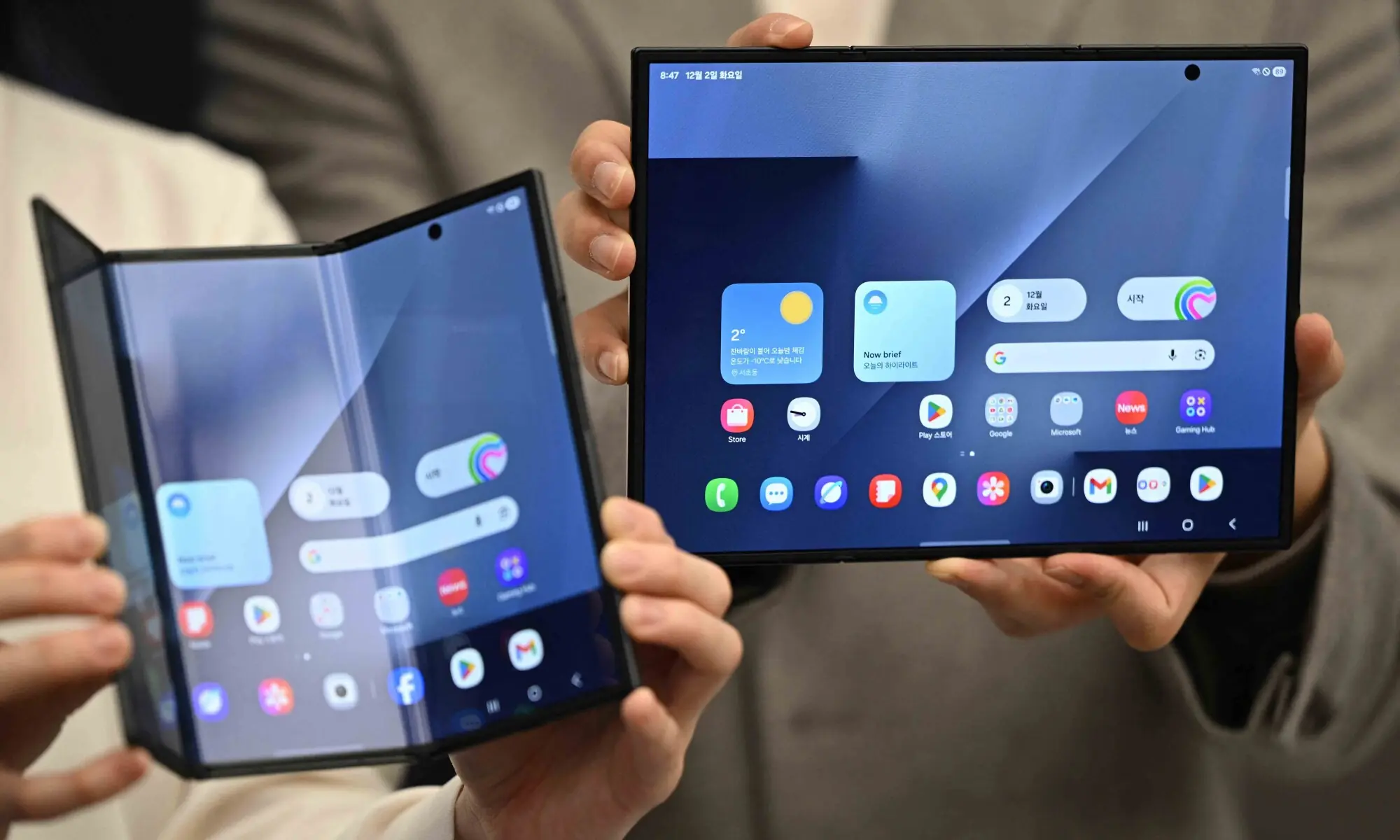
Scale can become a design trap.
Seoul, April 2026
The smartphone industry spent years teaching consumers to associate larger screens with progress, premium status, and better performance. That logic is now meeting its limits. Samsung’s Galaxy Z TriFold, with a display that expands to tablet size, has exposed a problem the market can no longer hide behind engineering spectacle alone. A device can be technically impressive and still fail as a mass product if its size, cost, and complexity push it outside the habits that make smartphones commercially viable in the first place.
That matters because the smartphone is not just another consumer gadget. It is the most intimate mass device in modern life, shaped by portability, speed, and constant physical proximity to the body. Once a phone grows too large, it begins to compete with the wrong category. It stops feeling like an extension of daily movement and starts behaving like an object that demands special handling. At that point, what is gained in screen real estate can be lost in usability, comfort, and adoption scale.

Samsung’s TriFold makes that contradiction unusually visible. When unfolded, it offers a ten inch display closer to a compact tablet than to a conventional phone. On paper, that sounds like the natural endpoint of years of hardware ambition. In practice, however, the product reveals the burden of pushing one category too far into another. More hinges, more battery demands, more components, more engineering strain, and a much higher retail price all raise the question the market eventually asks of every futuristic device: is this innovation, or just an expensive detour.
The commercial signal is telling. Limited production, minimal replenishment, and the absence of a clear second generation roadmap suggest that even Samsung understands the TriFold more as a demonstration of capability than as a durable mass strategy. That distinction is crucial. Companies often need halo products to prove technical leadership, but halo products do not automatically become market norms. Sometimes they do the opposite. They reveal where the boundary between ambition and practicality actually sits.
This is where the broader market context becomes important. Smartphones are no longer expanding inside the same atmosphere of explosive demand that once rewarded bold form factor experiments more easily. Growth has slowed, replacement cycles are longer, and consumers have become more selective about what counts as meaningful innovation. In such an environment, giant devices face a harder question. They are not competing only against smaller phones. They are competing against user fatigue, tighter budgets, and a market that increasingly wants refinement rather than exaggerated novelty.
The cost structure deepens that problem. Very large foldables require more memory, more battery capacity, more structural reinforcement, and more expensive hinge systems. All of that drives prices into territory where comparison becomes dangerous. Once a phone begins to cost as much as, or more than, a premium laptop or tablet, the buyer starts evaluating it less as a phone and more as an overconcentrated compromise. A product meant to replace several devices can end up reminding consumers why specialized devices still exist.
There is also a behavioral reality the industry sometimes underestimates. Bigger screens may improve multitasking, media consumption, and visual immersion, but most people still use their phones within routines built around one hand operation, pocketability, quick retrieval, and frictionless repetition. The success of a smartphone category depends not only on what it can do when fully opened, but on how naturally it fits into hundreds of ordinary gestures across the day. If a design interrupts those gestures too often, technical brilliance becomes commercially fragile.

This is why Apple’s expected entry into foldables matters by contrast. The lesson from Samsung’s extreme experiment may not be that foldables are doomed, but that the market is drawing a line between useful flexibility and excessive size. A foldable phone can still work if it respects the physical logic of the category. Once it begins trying to become a phone, a tablet, and a prestige engineering object all at once, it risks satisfying enthusiasts more than actual consumers. The future of the segment may belong not to the largest foldable, but to the most disciplined one.
The deeper pattern is now clear. In consumer technology, bigger is no longer a self justifying argument. Maturity in the smartphone market means innovation must prove not only that it is possible, but that it belongs. Devices that stretch beyond practical use may still attract attention, but attention is not the same as adoption. The era when size alone signaled superiority is fading. What replaces it is a stricter market question, and perhaps a healthier one: not how far a phone can grow, but how much growth a phone can survive before it stops making sense.
Phoenix24: claridad en la zona gris. / Phoenix24: clarity in the grey zone.