

 Phoenix 24
Sometimes control says more than spectacle.
Monte Carlo, April 2026. Carlos Alcaraz did not need a dramatic comeback or a marathon match to announce himself in Monte Carlo. He only needed precision, rhythm, and the kind of controlled intensity that turns a clay debut into a warning for the rest of the draw. His 6 1, 6 3 win over Sebastián Báez on April 7 was not merely a clean start to the week. It was the performance of a player trying to reestablish command on the surface where tactical maturity and emotional balance matter most.
What made the victory notable was not simply the scoreline, but the tone of the match. Báez is not an opponent who usually grants comfort on clay, yet Alcaraz reduced the Argentine’s resistance with a level of authority that suggested he had returned to the surface with less rust than expected. Reports on the match emphasized that the Spaniard closed it in just over an hour, imposed his pace early, and allowed only a brief dip in the second set before restoring order immediately. That is the kind of win that looks routine on paper but carries strategic weight inside a tournament.

The result matters because Monte Carlo is not just another stop on the calendar for Alcaraz. He arrived as defending champion and as a player navigating the opening phase of the European clay season under the shadow of a much larger narrative: the pressure of points, rankings, and the looming chase from Jannik Sinner. Several reports published after the match noted that Alcaraz himself acknowledged how difficult it will be to retain the number one ranking, given the heavy burden of points he must defend during the clay stretch. In that sense, the match was not only about advancing. It was about stabilizing the season at a moment when every result now carries structural consequences.
That is why this victory should be read as more than an efficient sporting performance. On clay, Alcaraz often looks less like a pure aggressor and more like a player constructing pressure with layers. Against Báez, he combined force with management, controlling exchanges without appearing frantic and showing that his game on dirt still carries that rare ability to accelerate without losing shape. The phrase victory of oficio fits because what he displayed was not improvisational brilliance alone, but the calm technical authority of someone who understands how to make a demanding first match look deceptively simple.
There is also a psychological dimension to this start. Monte Carlo is one of those tournaments where the early rounds can become traps for favorites who arrive short on rhythm or overloaded by expectation. Alcaraz avoided both dangers. He entered, imposed, and exited without drama. That matters because championship runs on clay are often built not only on flashes of genius, but on the elimination of unnecessary turbulence. A player who can keep his opening match emotionally clean is often a player who intends to stay deep into the week.
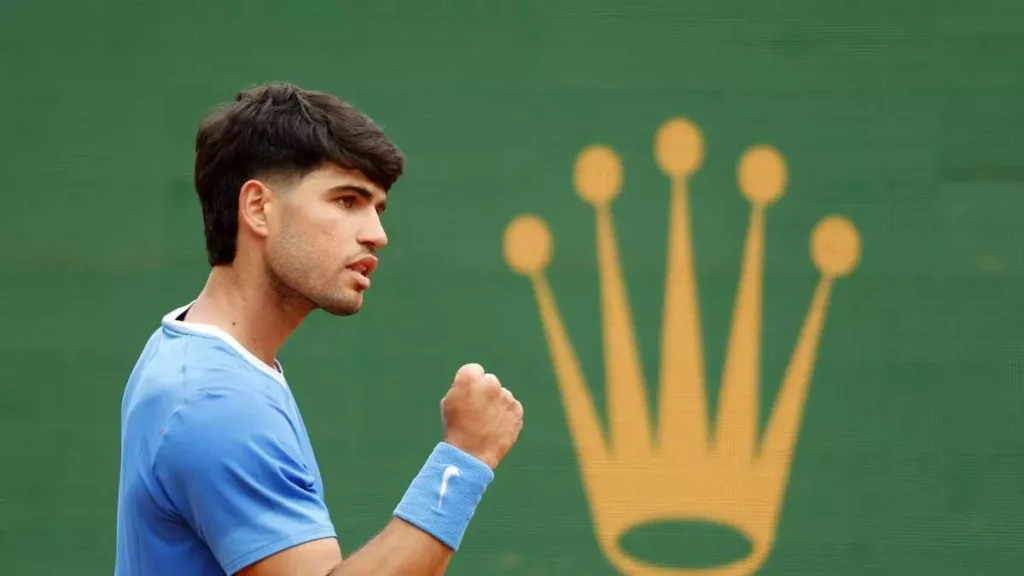
The broader context sharpens the significance further. Sinner also opened strongly, which means the rivalry at the top remains active even before a direct meeting becomes possible. The clay season therefore begins not with a vacuum, but with a parallel race between two players whose every result is now interpreted through the lens of hierarchy. Alcaraz’s answer in Monte Carlo was clear: whatever pressure the rankings create, his game on clay still carries a different kind of legitimacy. It is not only about numbers. It is about surface identity, and on this terrain he continues to project the instincts of a natural dominator.
For Spanish tennis, the performance also carried symbolic value after other setbacks in the draw. With Roberto Bautista Agut forced out by injury, Alcaraz remains the central Spanish figure in the tournament, and he looked every bit the part. His debut did not feel like a tentative reentry into clay competition. It felt like a reminder that when he is settled on this surface, he can make even strong specialists appear second to the script of his own match.
What follows will be more demanding, of course. First wins can flatter, and Monte Carlo has a way of tightening with each round. But the quality of this opening should not be understated. Alcaraz did not simply win. He reintroduced himself to the clay season with the posture of a player who knows that this part of the calendar can define not only titles, but authority. In a tour increasingly shaped by rivalry, ranking arithmetic, and compressed expectations, that kind of opening statement matters.
Detrás de cada dato, hay una intención. Detrás de cada silencio, una estructura.
Behind every data point, there is an intention. Behind every silence, a structure.