

 Mario López Ayala, PhD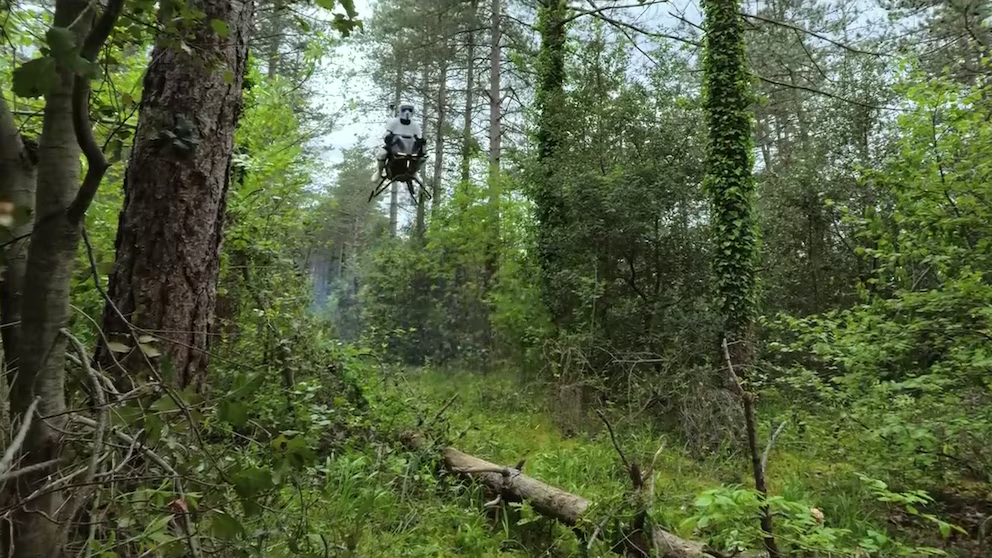
A new era of adrenaline-fueled innovation is lifting off from the ground, blending speed, technology, and human daring like never before.
Warsaw, October 2025
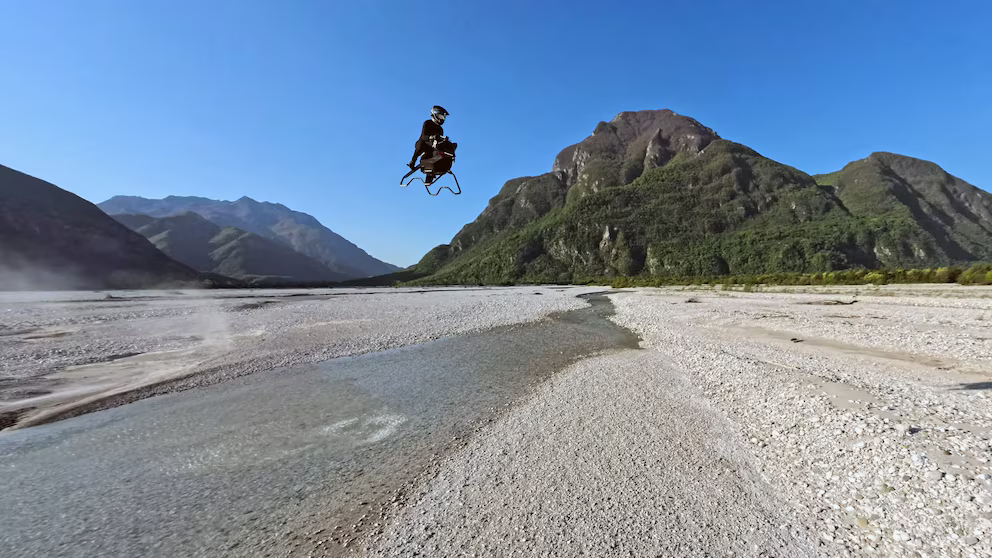
The concept of a flying motorcycle has long existed at the intersection of science fiction and human ambition. Now, that vision is inching closer to reality. A European startup has unveiled a fully functional prototype capable of soaring through the air at speeds of up to 200 kilometers per hour, promising to redefine the limits of extreme sports and personal mobility. The machine, known as the Volonaut Airbike, represents a leap forward in engineering, materials science, and aerodynamics, merging the thrill of motorcycling with the limitless possibilities of flight.
At first glance, the Airbike looks like something out of a futuristic film. Its frame, constructed from lightweight carbon fiber and precision-built with advanced 3D printing techniques, weighs significantly less than a conventional motorcycle. The sleek design is not merely aesthetic; every element is optimized for balance, maneuverability, and aerodynamics. The vehicle is powered by a jet propulsion system capable of generating enough thrust to lift both rider and machine into the air with remarkable stability. A sophisticated onboard computer continuously analyzes wind speed, altitude, and pilot input, adjusting thrust and tilt to maintain smooth, controlled flight.
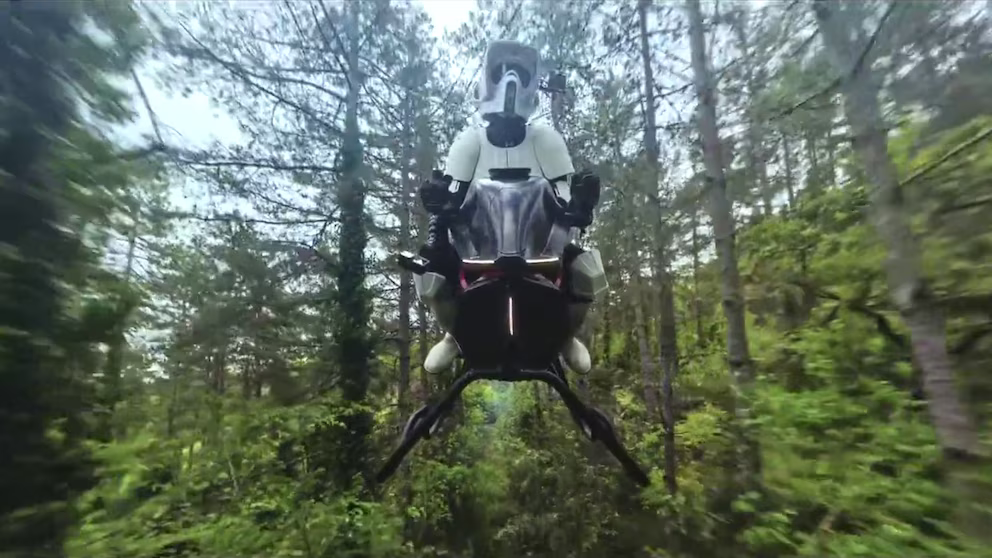
The idea behind the Airbike is not to replace conventional transport but to push the boundaries of personal mobility and redefine the future of high-adrenaline sports. Its developers envision a new category of aerial competition where speed, skill, and control converge above the ground. Imagine high-speed races over open landscapes, obstacle courses suspended in the air, or freestyle aerial maneuvers once thought impossible outside of jetpacks and experimental drones. Such possibilities are no longer theoretical. They are being tested today in closed courses and demonstration events across Europe.
The development of the Airbike reflects broader trends in aerospace innovation. Advances in materials, propulsion, and control systems are allowing engineers to build vehicles that once existed only in concept drawings. Carbon fiber composites reduce weight without compromising structural integrity. Miniaturized jet engines provide immense power while remaining compact and efficient. AI-assisted stabilization systems make it possible for even amateur pilots to control complex flight dynamics. Each of these breakthroughs contributes to the viability of a machine that is as thrilling to ride as it is technologically sophisticated.
Yet the path from prototype to commercial product remains complex. Regulatory hurdles are among the most significant challenges. Aviation authorities worldwide are still adapting to the emergence of personal flight vehicles, which do not fit neatly into existing categories such as drones, ultralight aircraft, or helicopters. Questions around licensing, airspace management, safety protocols, and insurance must all be resolved before machines like the Airbike can become widely available. Manufacturers are working closely with regulators to develop new standards and certification processes that balance innovation with safety.
Safety is a central focus of the project’s next phase. Engineers are conducting extensive testing to ensure the Airbike’s reliability in diverse conditions. This includes performance under varying altitudes, wind patterns, and temperatures, as well as emergency protocols in case of system failure. Redundant propulsion units, automatic landing sequences, and integrated parachute systems are being considered to enhance pilot safety. Early results are promising, but extensive validation will be necessary before the vehicle can leave the test track and enter the consumer market.
The potential applications extend beyond sports and recreation. Personal aerial vehicles could one day become a niche form of transportation, particularly in areas with difficult terrain or limited infrastructure. Emergency responders might use them to reach remote locations quickly. Security agencies could deploy them for rapid surveillance. Even tourism companies could offer aerial experiences previously confined to aircraft. While these applications remain speculative for now, they underscore the broader significance of the technology.
There are also cultural implications to consider. Throughout history, humanity has been fascinated by the dream of individual flight. From Leonardo da Vinci’s sketches to early aviation pioneers and modern-day jetpacks, the idea of soaring through the skies under one’s own control represents both freedom and mastery over nature. The Airbike taps into that centuries-old aspiration, offering a glimpse of a future where flight is not just a means of transport but an extension of personal expression and athleticism.
Despite the excitement, affordability remains a barrier. Early versions of the Airbike are expected to cost several hundred thousand dollars, putting them out of reach for most consumers. As production scales and technology matures, however, costs are likely to fall, potentially opening the market to high-end enthusiasts, professional athletes, and specialized commercial operators. Just as electric cars and drones were once prohibitively expensive before becoming mainstream, the Airbike’s journey from luxury prototype to accessible product may follow a similar trajectory.
For now, the Volonaut Airbike stands as a symbol of possibility. It represents the fusion of cutting-edge engineering, bold design, and human imagination. It invites us to rethink the relationship between technology and adventure and challenges the limits of what machines — and humans — can achieve together. Whether it becomes a cornerstone of a new sporting discipline, a tool for specialized applications, or simply an icon of futuristic innovation, one thing is clear: the future of speed and adrenaline is no longer confined to the ground.
Information that anticipates futures. / Información que anticipa futuros.