

 Phoenix 24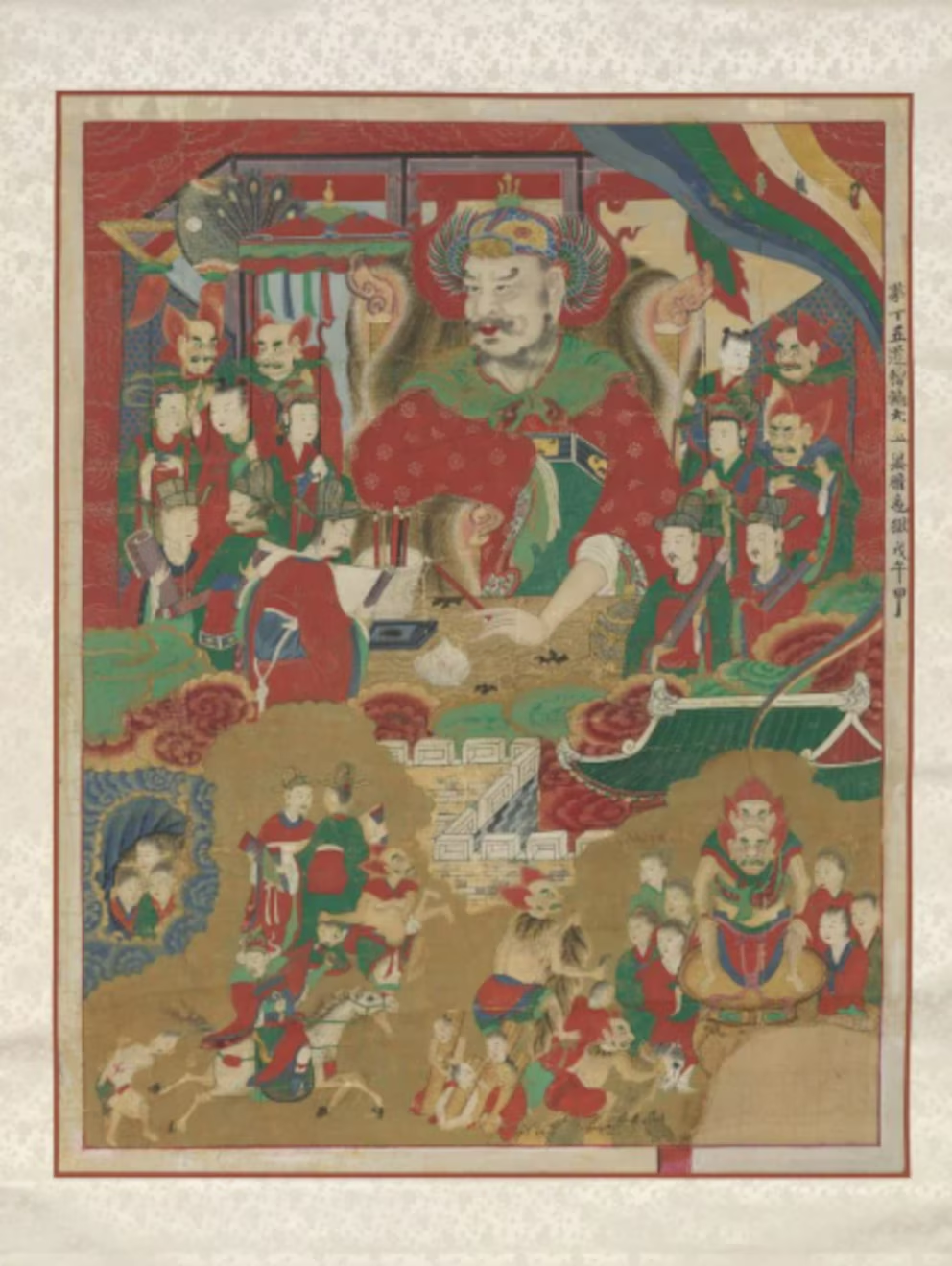
When an artwork returns home, it does not travel alone; it brings back the history that once went missing with it.
Seoul, November 2025
The return of an eighteenth century Buddhist painting from one of the world’s most influential museums to a Korean temple has reignited a global debate about cultural restitution, institutional accountability and the authority nations now assert over their displaced heritage. What appears at first glance to be the simple repatriation of a devotional artwork reveals, upon closer examination, a shifting geopolitical landscape in which art becomes a vessel of sovereignty, identity and unresolved historical tension.
The painting, created during the late Joseon era, had long resided in a prestigious North American institution that held it as part of its Asian art collection. Its provenance story, however, contained the ambiguities characteristic of objects displaced by conflict and political upheaval. American cultural policy analysts familiar with museum governance note that the broader trend across major institutions is now moving toward aggressive provenance verification, driven by public scrutiny, ethical pressure and a recognition that institutional legitimacy increasingly depends on transparency rather than accumulation. This momentum has accelerated repatriation cases worldwide.
In Europe, policy advisers observing restitution debates argue that such returns reflect a deeper recalibration of cultural diplomacy. European museums, many with collections shaped by colonial acquisitions, face mounting demands from Asian, African and Middle Eastern states. These demands are no longer framed as requests but as negotiated obligations. The Korean case becomes part of a continental pattern: international institutions now must weigh not only legal ownership but moral credibility, diplomatic risk and public opinion. This shift redefines the power dynamic between museums and the nations whose heritage they house.
Across Asia, cultural scholars and religious historians emphasize that the significance of this return extends beyond aesthetics. The temple that will receive the painting views it not as an artifact but as a fragment of spiritual continuity long interrupted. In Buddhist practice, ritual images are not decorative objects but doctrinal tools and carriers of collective memory. Korean experts highlight that the absence of such works creates gaps in lineage, ritual practice and community cohesion. Their return restores not only artistic patrimony but an anchor in cultural and religious identity.
Yet this moment also exposes systemic tensions. The painting is only one fragment of a larger set dispersed decades ago, its remaining companions scattered or untraced. Restitution, therefore, is not a neat conclusion but a reminder of fragmentation. Heritage lawyers observing the case point out that such returns often serve as symbolic victories while leaving structural issues unresolved: incomplete collections, uncertain provenance trails and an international market still willing to circulate sacred or culturally sensitive pieces with minimal oversight.
The public narrative often frames repatriation as a noble gesture by the returning institution, but researchers in cultural sociology warn against such simplification. Museums have long benefited from the prestige, tourism and intellectual capital generated by holding disputed objects. The decision to repatriate frequently follows reputational pressure, investigative journalism or legal analysis rather than spontaneous ethical awakening. In this light, the return of the Korean work becomes both a correction and an admission — that cultural authority is no longer unidirectional.
At the same time, the event marks a philosophical shift in how nations articulate their cultural rights. South Korea, like Japan and China, has strengthened its strategy of reclaiming dispersed heritage as part of a broader assertion of soft power. Cultural ministries across Asia increasingly view heritage repatriation as a diplomatic instrument, signalling that identity and memory are political resources, not passive inheritances. The successful retrieval of the painting reinforces this strategic narrative.
For the temple community, however, the stakes are far more intimate. Monks and local visitors will encounter a work that has survived war, displacement and institutional oblivion. Art historians note that the ritual reintegration of such an object can alter the cultural landscape of an entire region, reshaping narratives taught in schools, guiding new research and strengthening the continuity of Buddhist imagery within Korean cultural consciousness. The return is therefore not simply administrative; it is restorative.
The case also challenges the global museum model itself. If institutions continue to shed contested works, their mission may shift from encyclopedic accumulation to collaborative stewardship. This evolution could redefine how knowledge is produced, how exhibitions are built and how the meaning of “universal museum” is interpreted. It forces the world to confront an uncomfortable but necessary question: what does it mean to claim guardianship of another culture’s memory?
By returning this painting, global actors acknowledge that heritage is neither neutral nor interchangeable. It is rooted, relational and often wounded by history. And when a society receives back a piece of what was taken from it, the restored object becomes more than art; it becomes evidence of a world trying, however imperfectly, to correct its own record.
Phoenix24: every silence speaks. / Cada silencio habla.