

 Phoenix 24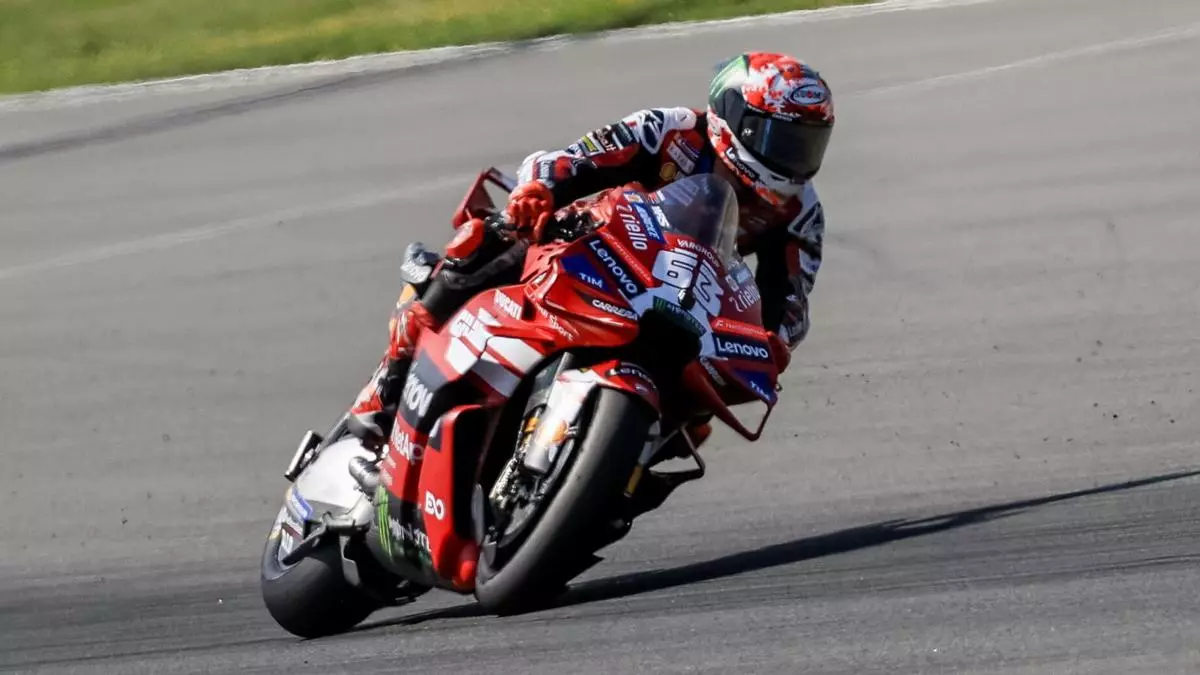
The Ducati star found answers beyond the machine.
BRNO, Czech Republic, June 2026.
Pecco Bagnaia has identified a change in his own riding approach as the decisive factor behind his renewed competitiveness in MotoGP. After enduring an irregular opening phase of the 2026 season, the Ducati rider has produced stronger performances across recent rounds and returned to the front at the Czech Grand Prix. Rather than attributing the improvement to a technical revolution inside the garage, Bagnaia acknowledged that he needed to adapt himself more effectively to the motorcycle. His assessment shifts responsibility away from Ducati and reveals the internal process behind his sporting recovery.
The Italian arrived in Brno after three consecutive Sunday podiums, including a third-place finish at the Hungarian Grand Prix. That result was especially valuable because the demanding Balaton Park circuit exposed many of the difficulties he had faced with the Desmosedici during rapid changes of direction. Bagnaia admitted that the motorcycle had not suddenly become easier to ride and that Ducati had not introduced a transformation capable of explaining his progress. The improvement instead emerged from a more precise understanding of how he needed to position, brake and manage the bike.
His comments represent an important change from the frustration that marked the first part of the campaign. Bagnaia frequently struggled to reproduce the confidence and consistency that made him MotoGP world champion in 2022 and 2023. Instability during corner entry and difficulty rotating the motorcycle prevented him from exploiting his usual precision under braking. Those limitations became especially visible when teammates and rivals appeared capable of accessing greater performance from similar machinery.
Bagnaia eventually concluded that continuing to search exclusively for technical modifications would not solve every problem. He began concentrating on his own movements, riding lines and capacity to tolerate sensations that did not match his preferred style. The process required him to accept that the motorcycle demanded a different interpretation rather than waiting for engineers to restore the exact feeling he wanted. That adjustment has gradually allowed him to recover speed without abandoning the disciplined method that has defined his career.
The breakthrough became visible during the Czech Grand Prix weekend, where Bagnaia qualified on the front row and delivered a commanding start in the sprint race. He moved into the lead at the opening corner and controlled the contest ahead of Ai Ogura and Marc Márquez. Appropriate tire selection under intense heat helped him maintain the rhythm needed to resist pressure during the closing laps. The victory ended an eight-month period without the level of authority once associated with his strongest performances.
Bagnaia’s resurgence also carries psychological significance because his difficulties developed while sharing the factory garage with Márquez. The Spanish champion’s speed and ability to extract performance under difficult conditions increased the competitive pressure surrounding the Italian. Every comparison intensified questions about whether Bagnaia had lost his technical reference or confidence inside Ducati. By assuming responsibility for his limitations, he has attempted to replace that external narrative with a clearer and more controllable recovery plan.
The Italian has been careful not to accuse the manufacturer of failing to provide adequate machinery. He emphasized that the motorcycle remained competitive and that his results were connected to how effectively he could interpret its behavior. Such an admission protects the working relationship with engineers while demonstrating the level of self-criticism required at the highest level of motorsport. It also suggests that the solution may be more sustainable than a temporary setup improvement limited to one circuit.
The challenge now is to confirm whether the progress can be maintained across tracks with different braking zones, corner speeds and grip conditions. Brno rewards smooth acceleration and confidence through flowing sections, while upcoming circuits may again expose the directional changes that previously weakened Bagnaia. A genuine resurgence will require him to preserve the same adaptability when the motorcycle produces less favorable sensations. Consistency, rather than a single victory, will determine whether he has permanently reversed the decline.
His return to the front arrives at a critical moment in the championship. Marco Bezzecchi’s recent errors have reduced the stability of his advantage, while Márquez continues to recover ground following an interrupted start to the season. Bagnaia remains outside the strongest position in the title fight, but renewed competitiveness could reshape the balance among the leading riders. Even when the championship margin is difficult to recover, victories can influence team dynamics and define the final phase of a season.
Bagnaia’s explanation offers a broader lesson about elite competition, where technological analysis can sometimes obscure the human element. MotoGP machines generate enormous quantities of data, yet a rider must still translate that information into instinctive decisions at extreme speed. Engineers can adjust geometry, electronics and suspension, but they cannot completely replace confidence or adaptability. Bagnaia’s recovery began when he accepted that part of the solution had to come from himself.
The Czech sprint victory did not erase the problems that preceded it, but it provided tangible evidence that the adjustment is producing results. Bagnaia again appeared aggressive at the start, controlled under pressure and capable of dictating the race rather than reacting to others. His task is now to transform that renewed clarity into a sustained sequence of performances. The motorcycle may not have changed dramatically, but the rider operating it has begun to rediscover the method that once made him the benchmark at Ducati.
Más allá de la noticia, el patrón. / Beyond the news, the pattern.