

 Phoenix 24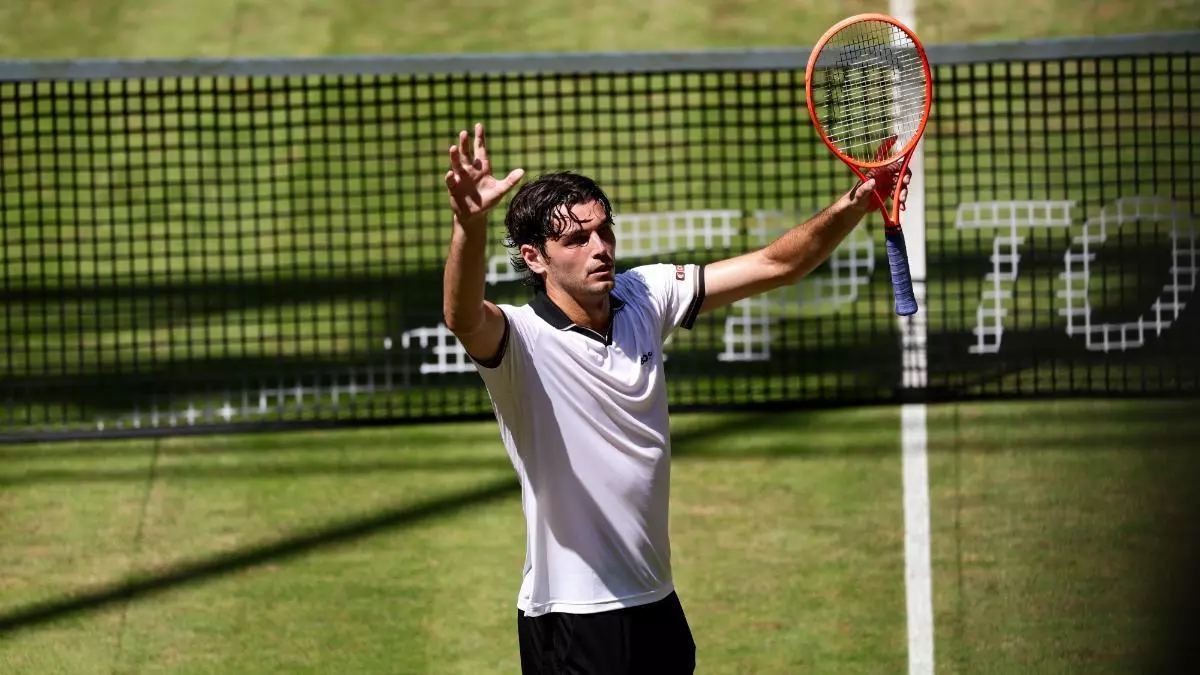
The American remains an unsolved problem for Zverev.
HALLE, Germany, June 2026.
Taylor Fritz ended Alexander Zverev’s 10-match winning streak and advanced to the Halle Open final after overcoming the German 6-7(4), 6-4, 7-5 in a demanding semifinal. The American recovered after losing the opening set and completed the comeback in two hours and 39 minutes on the grass courts of the ATP 500 tournament. His victory extended his extraordinary dominance over Zverev to seven consecutive matches. The result also stopped the German’s momentum only two weeks after he captured the first Grand Slam title of his career at Roland Garros.
Zverev entered the match as the top seed and world number three, strengthened by the confidence generated by his historic triumph in Paris. He had won 10 consecutive matches and appeared capable of carrying that form onto a surface where he has traditionally produced strong results without securing a title. Fritz, however, arrived with the psychological advantage of having repeatedly defeated him in recent seasons. That pattern became increasingly important as the semifinal developed into another tense and physically demanding confrontation.
The German made the stronger start and obtained an early break, using his first serve and deep groundstrokes to control the initial exchanges. Fritz responded before the set escaped him, recovering the break and forcing a tiebreak after both players protected their service games. Zverev remained composed during the decisive sequence and won it 7-4, placing himself one set away from another final in Halle. His ability to survive the American’s pressure appeared to suggest that his recent losing sequence against Fritz might finally be ending.
The rhythm changed dramatically in the second set as Fritz raised the intensity of his return game and began controlling the shorter rallies. At one stage, the American won 12 consecutive points, a burst that disrupted Zverev’s confidence and transformed the momentum of the match. Fritz attacked the second serve more aggressively and prevented the German from settling into the patient baseline patterns that had worked earlier. A decisive break allowed him to take the set 6-4 and force the semifinal into a final chapter.
The third set became a test of concentration, endurance and resistance under difficult weather conditions. High temperatures affected both players, although Zverev appeared particularly uncomfortable and required treatment during the contest. Neither man created much separation during the opening games of the deciding set, with powerful serving reducing the number of genuine opportunities. Fritz remained patient and waited until the closing stages to increase the pressure on the German’s service game.
With Zverev serving to remain in the match at 5-6, Fritz produced the decisive breakthrough. The American maintained depth from the baseline, forced his opponent into increasingly defensive positions and converted the opportunity that secured his passage to the final. His reaction reflected both the significance of reaching the championship match and the satisfaction of overcoming an opponent who had arrived with one of the strongest winning runs on the tour. Zverev was left without an opportunity to contest another tiebreak and extend the battle.
The victory improved Fritz’s career record against Zverev to 10 wins and five defeats. More significantly, he has now won their seven most recent encounters, creating one of the clearest matchup advantages between leading players on the men’s circuit. Fritz’s combination of a powerful serve, flat groundstrokes and willingness to redirect the ball appears particularly effective against the German’s deeper court position. Zverev has often struggled to prevent the American from controlling the middle of the court once rallies accelerate.
The defeat also ended Zverev’s attempt to win his first professional title on grass. He previously reached the Halle final in 2016 and 2017 but was unable to lift the trophy, and his latest elimination marked another missed opportunity at his most prominent home tournament. Despite a career that now includes a Grand Slam crown, Olympic gold and multiple elite titles, success on grass remains absent from his record. The loss was especially frustrating because his recent form had made him one of the leading candidates for the championship.
Fritz’s performance reinforced his reputation as one of the most dangerous grass-court players of his generation. His serve provides a natural advantage on the surface, while his compact strokes allow him to take the ball early and reduce the reaction time available to opponents. The American also demonstrated emotional control after surrendering the first set, refusing to change his approach or force unnecessary risks. That discipline allowed him to remain competitive until Zverev’s physical and tactical resistance began to weaken.
The result carries additional importance ahead of Wimbledon, where both players will be considered serious contenders. Zverev leaves Halle with confirmation that his Roland Garros form can transfer to grass, but also with unresolved questions about his repeated difficulties against Fritz and other elite opponents. The American reaches the final with renewed confidence after navigating consecutive demanding matches against Ben Shelton and Zverev. His campaign has shown that he can survive pressure as well as dominate with his serve.
Fritz will face either Frances Tiafoe or German wildcard Daniel Altmaier in the championship match. A meeting with Tiafoe would produce an all-American final, while Altmaier would carry the support of the home crowd and the momentum of an unexpected run through the tournament. Regardless of the opponent, Fritz enters the final after defeating the tournament’s leading seed and most successful player of the previous two weeks. His latest victory over Zverev has become more than another result in their rivalry, confirming a competitive pattern the German has still been unable to reverse.
Hechos que no se doblan. / Facts that do not bend.