

 Phoenix 24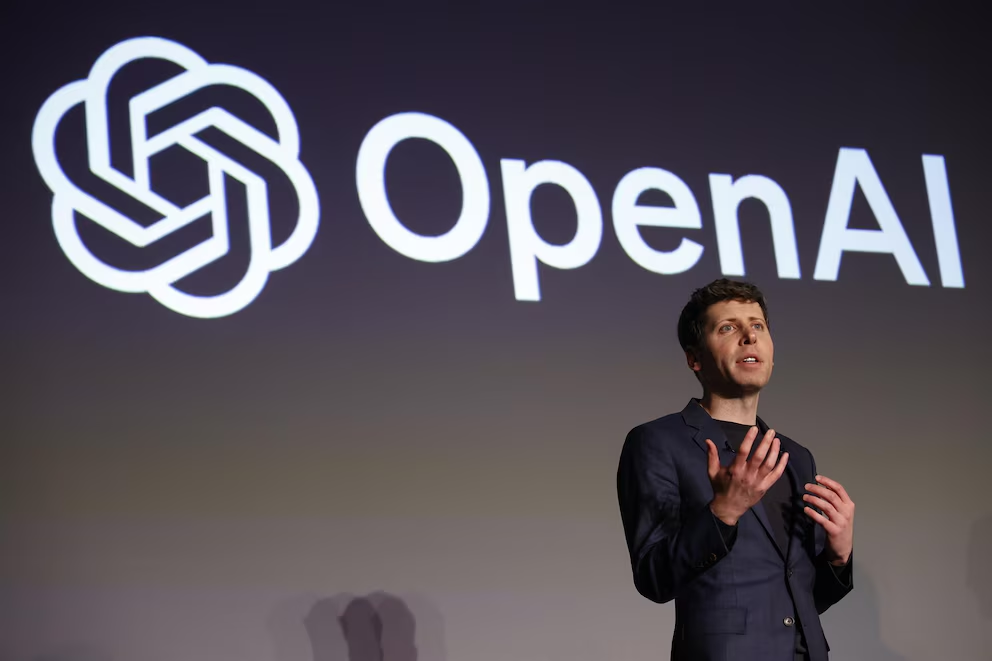
Wall Street Enters the Battle for Intelligence Infrastructure
San Francisco, June 2026 — OpenAI’s potential arrival on Wall Street would mark more than a financial milestone. It would signal a new phase in the global race for artificial intelligence, where capital markets, national security, technological infrastructure and corporate governance converge around one of the most influential companies of the digital age.
The move reflects a basic reality of the AI economy: advanced models require extraordinary amounts of money. Training frontier systems, building data centers, securing chips, hiring elite talent and expanding global products demand investment at a scale few private structures can sustain indefinitely. Public markets offer access to massive capital, but they also impose new pressures.

For OpenAI, going public would change the balance between mission and market. The company was originally associated with a vision of artificial intelligence developed for broad human benefit. A stock market listing would expose that mission to quarterly expectations, shareholder demands and valuation discipline. The central question becomes whether a company building systems with enormous social impact can remain governed by public-interest principles while operating under market logic.
Transparency would also become unavoidable. Public companies face greater disclosure requirements, investor scrutiny and regulatory oversight. That could clarify parts of OpenAI’s business model, revenue structure, infrastructure spending and risk exposure. At the same time, not all aspects of frontier AI can be fully transparent, especially when models intersect with cybersecurity, defense, intellectual property and geopolitical competition.
The geopolitical dimension is decisive. Artificial intelligence is now embedded in the strategic rivalry between the United States and China. Chips, cloud capacity, data access, energy supply and model governance have become instruments of national power. If OpenAI enters public markets, it would not be treated merely as a technology company. It would become part of the strategic infrastructure of American influence.
That creates a delicate governance problem. Investors want growth. Governments want control. Users want trust. Researchers want openness. Regulators want accountability. These interests do not always move in the same direction. The future of OpenAI would therefore be shaped not only by engineering breakthroughs, but by institutional negotiation among markets, states and civil society.
The IPO would also intensify competition across the AI sector. Rivals such as Anthropic, Google, Meta and emerging international players would face greater pressure to raise capital, accelerate deployment and define their own governance models. The result could be an arms race in infrastructure, talent and commercialization.
Yet the risks are equally clear. A market boom around AI could inflate valuations faster than sustainable revenues. If investors treat artificial intelligence as an unlimited growth machine, the sector could face speculative distortions similar to earlier technology bubbles. The difference is that AI is not only a market category; it is a general-purpose technology with consequences for labor, security, education, media and democracy.

OpenAI’s potential listing would therefore represent a turning point. It would move frontier AI deeper into the architecture of global finance and state power. The question is no longer whether artificial intelligence will transform markets. The question is who will govern the companies that build the systems capable of transforming society itself.
Truth is Structure, Not Noise. | La Verdad es Estructura, No Ruido.