

 Phoenix 24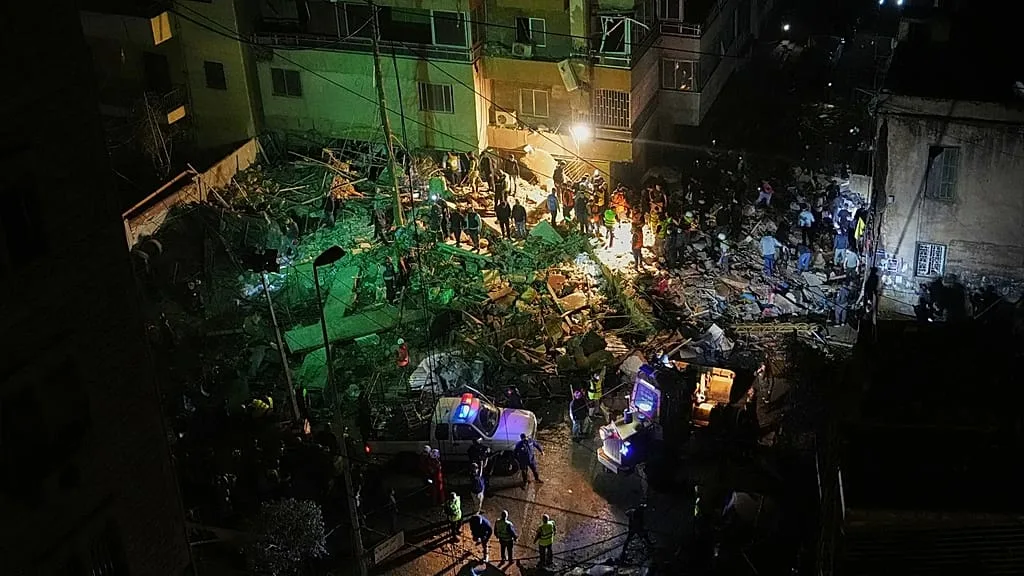
The ceasefire survives, but barely.
Beirut, May 2026. Israel carried out its first major strike on Beirut since the latest ceasefire arrangement with Lebanon, killing a senior Hezbollah commander in an operation that immediately reignited fears of a wider regional escalation. According to Israeli officials, the target was Ahmed Ali Balout, a commander linked to Hezbollah’s elite Radwan Force, a unit long viewed by Israel as one of the organization’s most operationally dangerous structures. The strike shattered weeks of relative calm in the Lebanese capital and exposed the fragility of a truce already strained by mutual accusations and unresolved military objectives.
The attack hit Beirut’s southern suburbs, an area historically associated with Hezbollah infrastructure and political influence. Israeli authorities framed the operation as a preventive security action against an imminent threat, while Lebanese voices described it as a direct violation of the ceasefire framework negotiated under international pressure. Hezbollah did not immediately confirm the death of Balout, but the symbolic and strategic significance of the strike was already evident across the region.
What makes the operation especially consequential is not only the target itself, but the geography of the attack. Beirut had largely been spared from direct Israeli strikes since the April ceasefire arrangements linked to the broader Iran-Israel de-escalation effort. By returning military operations to the Lebanese capital, Israel signaled that the distinction between frontline zones and political centers may no longer hold under the current security doctrine.
The Radwan Force occupies a central place in Israeli strategic calculations. Formed as Hezbollah’s elite offensive wing, the unit has been associated with cross-border operations, asymmetric warfare and advanced battlefield coordination shaped by years of combat experience in Syria and southern Lebanon. Israeli military doctrine increasingly treats high-ranking Radwan figures as strategic assets whose elimination can disrupt Hezbollah’s command continuity and operational planning.
The strike also sends a message beyond Lebanon. At the very moment when indirect negotiations and ceasefire mechanisms involving Iran, Israel, Lebanon and the United States remain active, the attack demonstrates that tactical diplomacy and kinetic operations are now unfolding simultaneously. The Middle East is entering a phase where negotiation tables and missile trajectories coexist rather than replace each other.
For Lebanon, the timing is devastating. The country remains trapped between institutional fragility, economic exhaustion and the geopolitical weight of Hezbollah’s military role. Every new Israeli strike weakens the already narrow space available to the Lebanese state to present itself as the sole legitimate security authority inside its territory. At the same time, Hezbollah’s continued military posture reinforces Israeli arguments that the threat infrastructure remains intact despite ceasefire agreements.
The operation also reveals the changing logic of Israeli deterrence. Previous conflicts often relied on prolonged escalation cycles before strikes reached politically symbolic urban centers. The current pattern is different: Israel appears increasingly willing to conduct precision attacks deep inside highly sensitive zones if intelligence identifies what it considers high-value targets. This reduces warning time, increases unpredictability and places regional diplomacy under constant military pressure.
Internationally, the attack complicates ongoing efforts to stabilize the Lebanese front after weeks of violence linked to the broader confrontation involving Iran and maritime tensions in the Strait of Hormuz. Washington has attempted to preserve a controlled de-escalation architecture between Israel and Lebanon, but each high-profile strike erodes confidence that the current ceasefire can evolve into something more durable.
The psychological impact inside Beirut is equally important. For many Lebanese civilians, the return of Israeli airstrikes to the capital revives memories of previous wars in which urban neighborhoods became strategic battlegrounds. Even limited operations carry a disproportionate emotional effect because they reactivate the sense that no zone is permanently insulated from escalation.
Israel, meanwhile, appears determined to maintain operational freedom regardless of diplomatic optics. Prime Minister Benjamin Netanyahu reinforced that message by declaring there would be “no immunity” for militants considered threats to Israeli security. That language suggests Israel does not view the ceasefire as a comprehensive restraint mechanism, but as a conditional pause compatible with selective military action.
The danger now lies in calibration. Hezbollah may seek a controlled response to avoid a full-scale war neither side appears ready to sustain politically or economically. Yet every targeted killing raises the probability of retaliation, miscalculation or symbolic escalation. In conflicts shaped by deterrence logic, perception matters almost as much as battlefield capability.
The Beirut strike demonstrates that the current Middle Eastern equilibrium is not a stable peace, but an armed suspension shaped by overlapping wars, fragmented negotiations and strategic ambiguity. Ceasefires exist, but they operate inside a landscape where military signaling never fully stops. The result is a region permanently balanced between diplomacy and ignition.
Geopolítica, sin maquillaje. / Geopolitics, unmasked.