

 Aleksi Laaksonen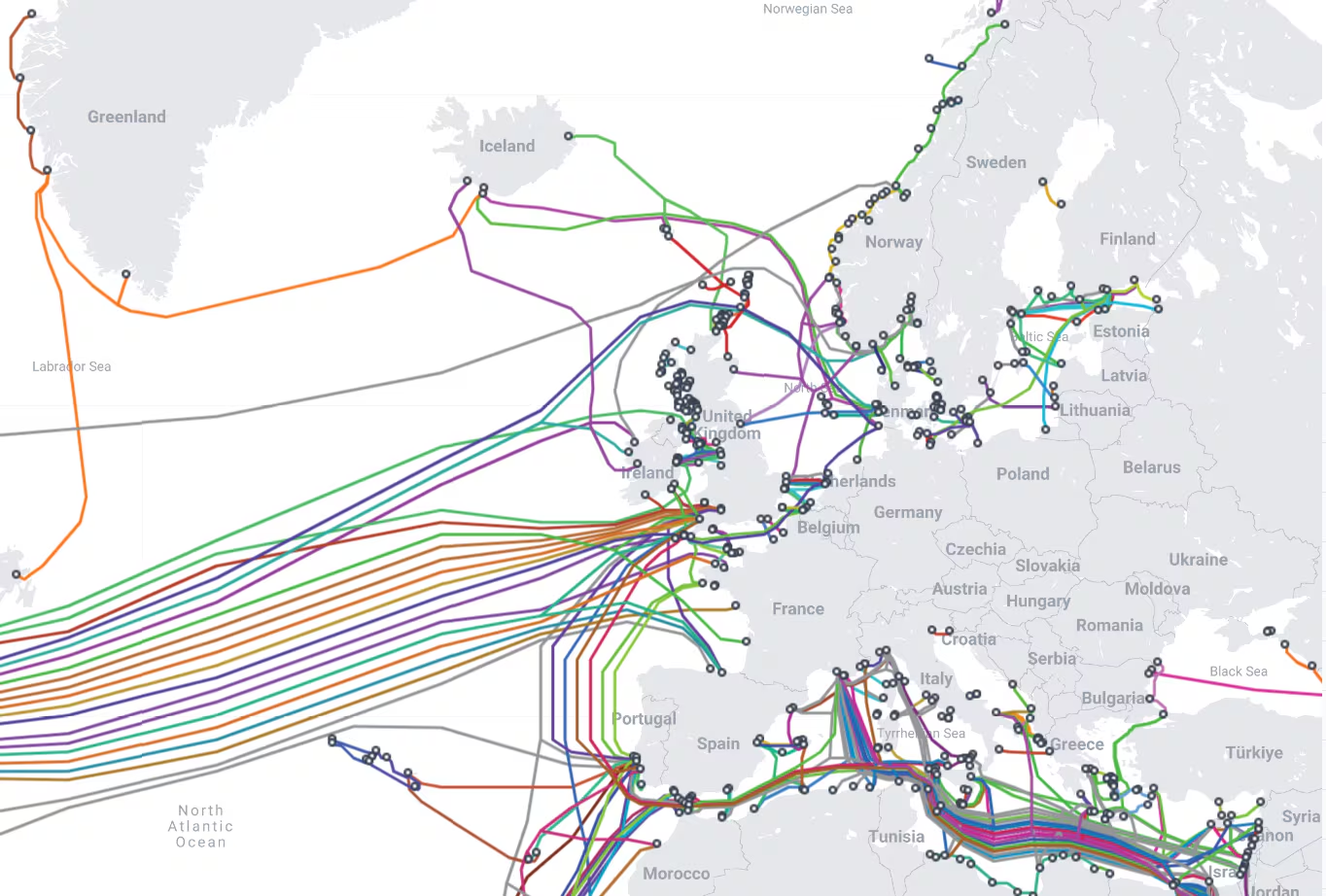
Cybersecurity is now Europe’s northern border.
Helsinki, May 2026. The Baltic Sea used to be described through ports, pipelines, naval routes and inherited suspicion. That vocabulary is still useful, but no longer sufficient. The region has become a test of whether Europe can defend sovereignty in a domain where borders are often recognized only after they have been crossed. In the Baltic, the firewall is not merely a metaphor; it is infrastructure, doctrine and political will under permanent stress.
Russia does not need to cross a border to pressure Europe. It can probe undersea cables, contaminate civic space with disinformation, test energy systems, map institutional vulnerabilities and exploit the fatigue of open societies. The old geography of invasion has not disappeared. It now operates beside a quieter geography of intrusion.
A server, a port authority, a telecommunications node or a municipal database can become part of the same strategic field. For Finland, Estonia, Latvia, Lithuania, Poland and Sweden, NATO membership and cooperation have changed the regional equation, but they have not removed uncertainty. Deterrence in Northern Europe now depends on more than aircraft, ships and troops. It depends on whether democratic states can remain functional while being watched, tested and manipulated.
Europe speaks often about digital sovereignty, sometimes with more confidence than precision. The Baltic region shows how difficult that ambition becomes under pressure. Sovereignty cannot be declared if critical infrastructure depends on opaque supply chains, fragmented cyber rules and platforms governed outside the continent. Nor can it be improvised during crisis.
It must be built before the attack, audited before the breach and trusted before the public is asked to remain calm. This is where the Nordic and Baltic model matters, though not because it is flawless. Its strength lies in institutional density: civil defense traditions, public trust, digital services, transparent governance and cooperation between civilian and military authorities. Still, density is not immunity.
The vulnerability is psychological as much as technical. Russia understands that cyber pressure is not always designed to destroy systems. Sometimes it is designed to make citizens doubt whether their institutions know what is happening. A slow leak of documents, a disrupted service, a manipulated rumor or a suspicious outage can produce political effects greater than the technical damage itself.
The target is confidence. That is why Europe’s firewall cannot be reduced to software, procurement rules or classified exercises. It must include public communication, democratic accountability and a clear chain of responsibility. Citizens can endure disruption when they believe the state is competent and honest.
They become vulnerable when institutions hide behind vague language, overclassify information or confuse strategic patience with silence. NATO faces the same problem in military form. The alliance was built for collective defense in physical space, but Article 5 logic becomes more complex when attacks are deniable, cumulative and deliberately ambiguous. A cyber operation may not look like war, yet it can prepare the battlefield for one.
Hybrid pressure is effective because it lives below the threshold where democracies prefer to make decisions. The Baltic region forces Europe to confront that grey zone without theatrical panic. Undersea infrastructure must be monitored, cloud dependency scrutinized, electoral systems protected and municipal networks hardened. Media ecosystems must also be treated as part of national resilience without turning journalism into state messaging.
The harder question is whether Europe can defend democracy without becoming administratively paranoid. Security policy can easily expand into surveillance, secrecy and permanent emergency logic. Digital sovereignty should not become a polite European name for centralized control. If Europe imitates the authoritarian reflex in order to resist authoritarian pressure, it may secure the network while weakening the republic.
That tension is already visible. Governments want faster cyber responses, stronger intelligence sharing and tighter control over critical digital systems. Many of those measures are reasonable. Necessity, however, is not a blank check.
Nordic governance is strongest when it insists that security and legality evolve together. The Baltic firewall, then, is not only a defense against Russia. It is also a test of Europe’s own political maturity. Can the continent build technological autonomy without protectionism becoming paralysis?
Can it cooperate with NATO while preserving civilian oversight? Can it reduce dependence on foreign platforms without creating closed bureaucratic empires of its own? There is no clean answer, and that uncertainty should not be edited out. Europe’s northern frontier is no longer a line on a map.
It is a system of cables, laws, habits, sensors, public trust and institutional memory. The societies most likely to endure the next phase of cyber conflict will not be those that promise perfect security. They will be those capable of absorbing disruption without surrendering clarity. That is a colder discipline than rhetoric allows.
The Baltic Sea is becoming Europe’s most precise warning. It shows that sovereignty in the digital age is not owned once and defended later. It is maintained every day, in procurement rules, crisis exercises, public briefings, software audits, parliamentary oversight and the quiet competence of institutions that do not wait for applause. This is unglamorous work, which is one reason it matters.
Russia will continue to test the firewall because testing is part of the strategy. Europe’s answer cannot be fear, nor can it be complacency. It must be a form of democratic hardness: technical, legal, civic and calm. In the Baltic, the future of European security may depend less on dramatic speeches than on whether the lights stay on, the networks hold and citizens still believe the state is telling them the truth.