

 Samira El-Khalil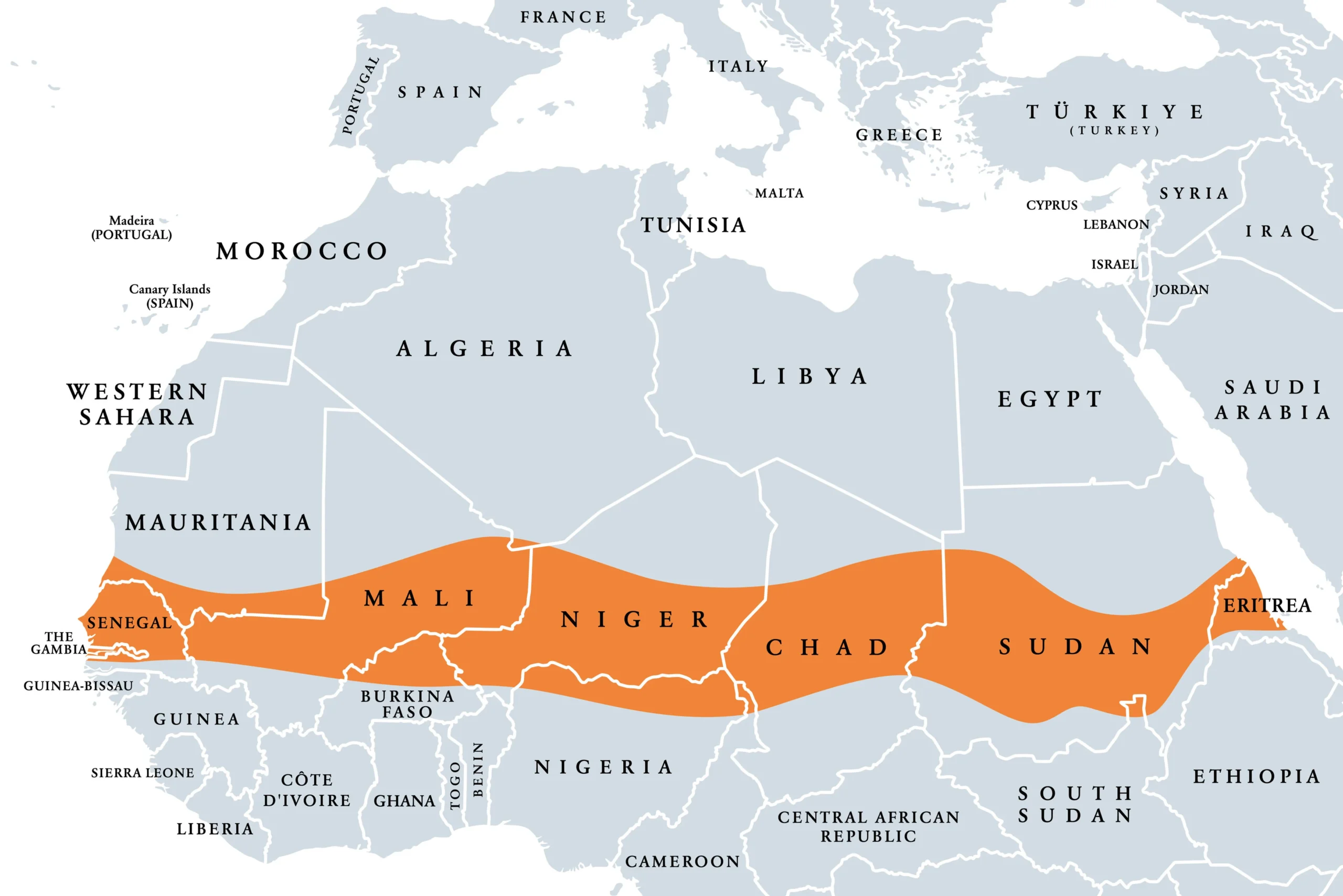
Power no longer arrives only by convoy.
Tunis, May 2026. The Sahel has often been described as a corridor, as if geography were merely a passage between stronger worlds. Sand, trade, migration, insurgency and empire have all crossed it, leaving behind maps that pretend to explain more than they actually know. But something quieter is now moving beneath that familiar surface. The region is being crossed by data.
For decades, foreign power entered through bases, uranium concessions, counterterrorism missions, humanitarian contracts and the diplomatic language of stabilization. Those routes have not disappeared, but they are no longer sufficient to describe the present. The new map runs through fiber lines, biometric systems, mineral corridors, satellite surveillance, border software and databases that decide who becomes visible and who remains disposable. It is not the old colonial road returning exactly as before, but an infrastructure that has learned to travel without announcing itself.
Russia saw the opening created by the collapse of French legitimacy in Mali, Burkina Faso and Niger. Its offer was never only military. It was emotional, symbolic and punitive, a promise that humiliation could be answered through force. Wagner, and later Africa Corps, entered that wounded space by selling protection as sovereignty, while converting insecurity into leverage. The setbacks around northern Mali may expose the limits of that model, but they do not dissolve its attraction.
Influence in the Sahel is no longer measured only by who controls a road, a capital or a garrison. It is measured by dependency, narrative capture and the ability to persuade fragile regimes that survival has only one external guarantor. Europe, for its part, continues to speak the vocabulary of partnership while building a buffer zone far from its own voters. Migration diplomacy has pushed the Mediterranean border deep into African territory, where movement is filtered before it ever reaches the sea.
The border now begins in desert towns, detention sites, police databases and risk models that classify people before listening to them. A worker, a refugee, a threat and an administrative burden can become categories in the same system. China moves through another rhythm, less theatrical and more durable. Its power rarely needs the drama of ideological rescue because infrastructure already speaks in the language of necessity.
Roads, minerals, logistics, ports, telecommunications and industrial corridors form a quieter architecture of influence. Beijing does not always need to govern directly when it can shape the conditions under which others govern. That is why the Sahel is again being treated as empty space, even when it is crowded with memory. This is one of the oldest colonial habits: to call a place unstable before admitting how many external hands helped destabilize it.
The Sahel is not empty. It remembers French military arrogance, Ottoman shadows, Arab slave routes, colonial borders, post-independence betrayals, jihadist violence, failed development projects and the exhaustion of being studied by outsiders who mistake access for understanding. Memory here is not ornament. It is evidence, archive and warning. What is new is not extraction itself, but the interface through which extraction now organizes life.
Gold once needed guards. Uranium needed contracts. Migration needed patrols. Now all three need data, and data needs populations made legible enough to be sorted. The village, the mine, the checkpoint and the phone have entered the same architecture of control.
A displaced person’s fingerprint, a miner’s informal payment, a militant’s encrypted message, a border guard’s database and a satellite image of a convoy may appear unrelated. They are not. They belong to an emerging order in which security, commerce and governance are increasingly fused. The result is not always visible as occupation, which makes it more difficult to resist.
The next imperial competition in the Sahel will not always arrive with flags or speeches about civilization. It may appear as efficiency, connectivity, modernization, counterterrorism or administrative reform. It may promise to make fragile states governable by making their populations measurable. That promise should be heard carefully, because legibility has always been one of empire’s most intimate ambitions.
To be seen by power is not always to be protected by it. In the Sahel, visibility can mean targeting, exclusion, deportation, recruitment, taxation or disappearance into a file no court will ever examine. The digital state can arrive before the social contract. Surveillance can arrive before justice. Order can arrive before legitimacy.
Yet the region is not merely acted upon. The juntas of the central Sahel have learned to weaponize sovereignty with considerable precision. They invoke anti-colonial dignity while narrowing civic space, denounce Western hypocrisy while importing other dependencies, and promise national restoration while outsourcing survival to mercenaries, mineral brokers, intelligence partners and propaganda networks. Their language is emancipatory; their methods often reproduce the grammar of domination.
This is the cruel paradox of suspended democracy. Sovereignty becomes a performance staged for populations denied the institutions that would make sovereignty meaningful. The foreign actor is not the only problem, but neither is the domestic ruler an innocent vessel of resistance. Between both, citizens are asked to applaud power in the name of dignity while losing the mechanisms through which dignity becomes political.
The desert empire of the future will be built through agreements few citizens read, platforms few regulators understand and security partnerships few parliaments can scrutinize. Its roads will carry lithium, gold, uranium, people and metadata. Its soldiers may be local, Russian, private, hybrid or unnamed. Its ideology will change depending on the room.
But its structure will remain recognizable: extract, monitor, narrate, discipline. The Sahel does not need another savior, and perhaps that sentence should no longer need to be written. It needs political imagination strong enough to refuse the false choice between Western paternalism, Russian militarism and Chinese infrastructural dependency. It needs institutions capable of treating memory not as grievance, but as method.
It also needs digital sovereignty that does not become a slogan for authoritarian control. It needs migration policy that begins with human dignity rather than European anxiety. It needs the right to remain complex, because the most dangerous lie told about the Sahel is that it is ungovernable. It is not ungovernable; it has been overgoverned by maps drawn elsewhere, wars financed elsewhere, borders enforced elsewhere and narratives written elsewhere.
The new cables, databases and corridors may make that older violence faster, cleaner and harder to see. They may also create openings that local societies can contest, reinterpret or seize, although no technology guarantees emancipation. That uncertainty matters. The empire is no longer only in the fort; it is in the route, the server, the sensor and the story.