

 Phoenix 24
The breakthrough is no longer a promise.
Buenos Aires, April 2026
Luisina Giovannini’s latest title in Junín is not just another successful week on the circuit. It feels like the point at which a young Argentine prospect begins to step into a more demanding level of expectation. By winning again in Junín, she not only added another trophy to her season, but reinforced the sense that her progress is no longer episodic. It is becoming a pattern.
That distinction matters in professional tennis. One title can be explained as momentum, favorable conditions or a well-timed run. Consecutive titles, however, suggest something more durable: competitive stability, emotional control and the ability to carry pressure from one final to the next. Giovannini is no longer being discussed only as an emerging player with potential. She is beginning to look like an athlete learning how to sustain results.
Her rise also acquires weight because of what it means in ranking terms. Breaking into the threshold of the Top 200 is not just a symbolic achievement. It changes the conversation around access, tournament entry and professional trajectory. At that level, the dream of reaching Grand Slam qualifying events stops sounding distant and starts sounding operational.
That is why the Junín result carries more than local relevance. These tournaments often serve as the proving ground where South American talent builds the repetitions, confidence and match toughness required before stepping onto larger stages. Winning there is important. Winning repeatedly there suggests a player is beginning to build the architecture needed for a wider leap.
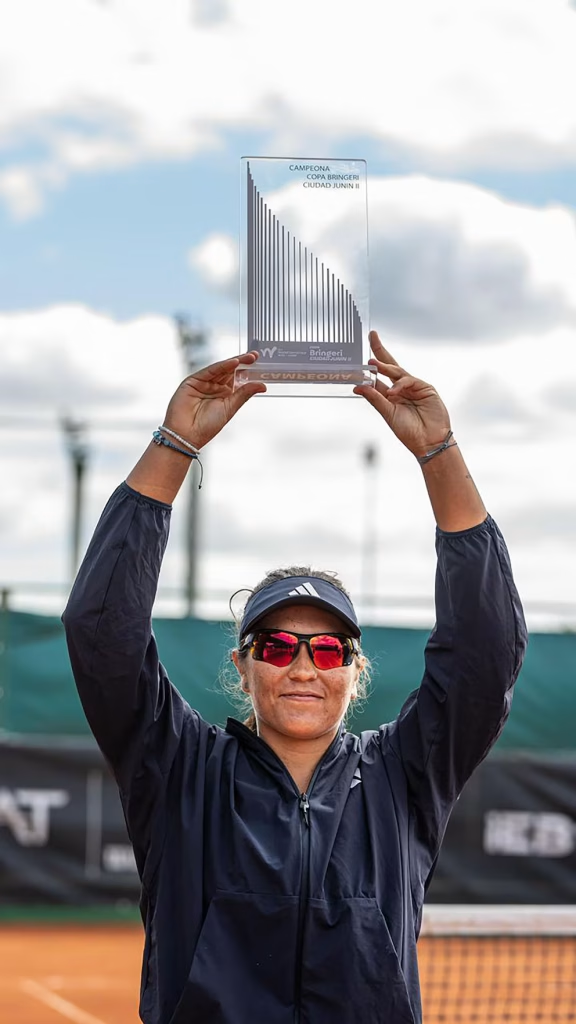
There is also a national dimension to her surge. When a player starts connecting ITF success with the prospect of bigger draws and team representation, she begins to carry more than her own individual projection. She starts to embody renewal for her country’s tennis ecosystem. In Argentina, where the sport still holds symbolic prestige, that matters more than rankings alone.
What makes Giovannini’s moment especially interesting is that it does not feel inflated by hype. It feels earned through accumulation. She is not being propelled by one isolated upset or a sudden media wave, but by repeated performances that are gradually forcing the broader tennis conversation to take notice. That kind of ascent is often slower, but more credible.

The Grand Slam dream around her is therefore no longer romantic speculation. It now looks like the next logical test. That does not guarantee an easy transition, because the jump from strong regional results to elite qualifying competition can be unforgiving. But the rhythm of her season suggests she is arriving at that threshold with more substance than illusion.
For Argentine tennis, that may be the most valuable part of this story. Junín did not simply crown a champion. It may have marked the moment when a rising player stopped being a future possibility and started becoming a present force.
Behind every datum lies an intention. Behind every silence, a structure.
Detrás de cada dato, hay una intención. Detrás de cada silencio, una estructura.