

 Phoenix 24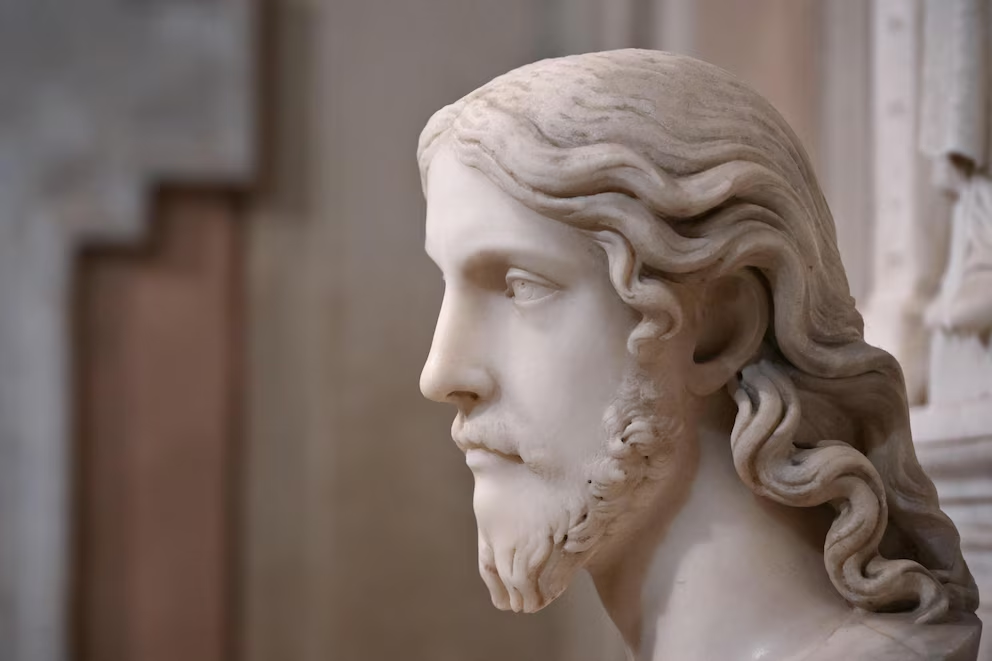
In art, proof must outlive headlines.
Rome, March 2026
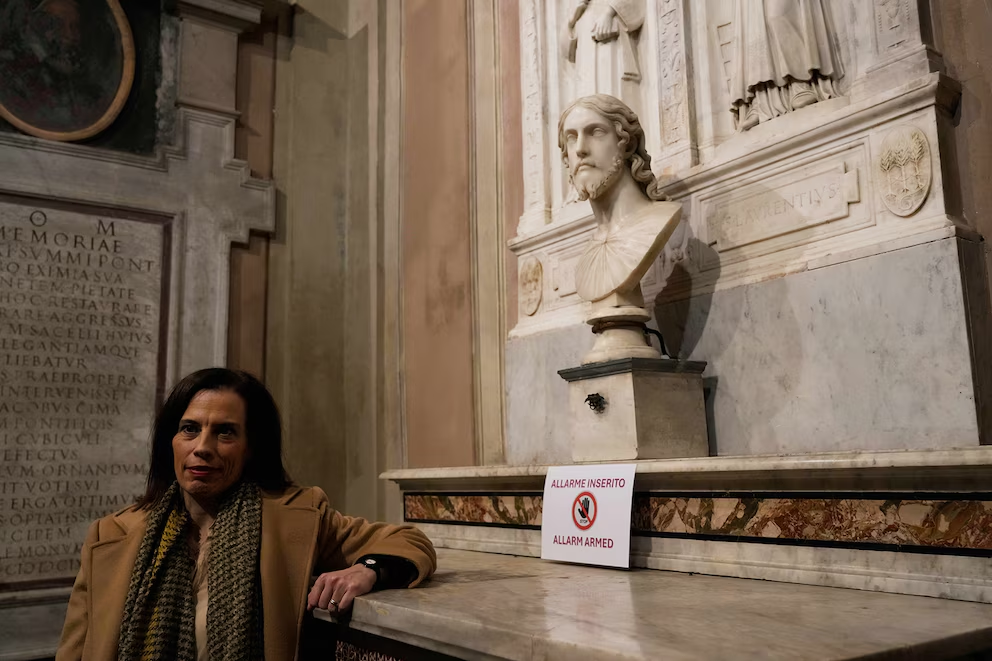
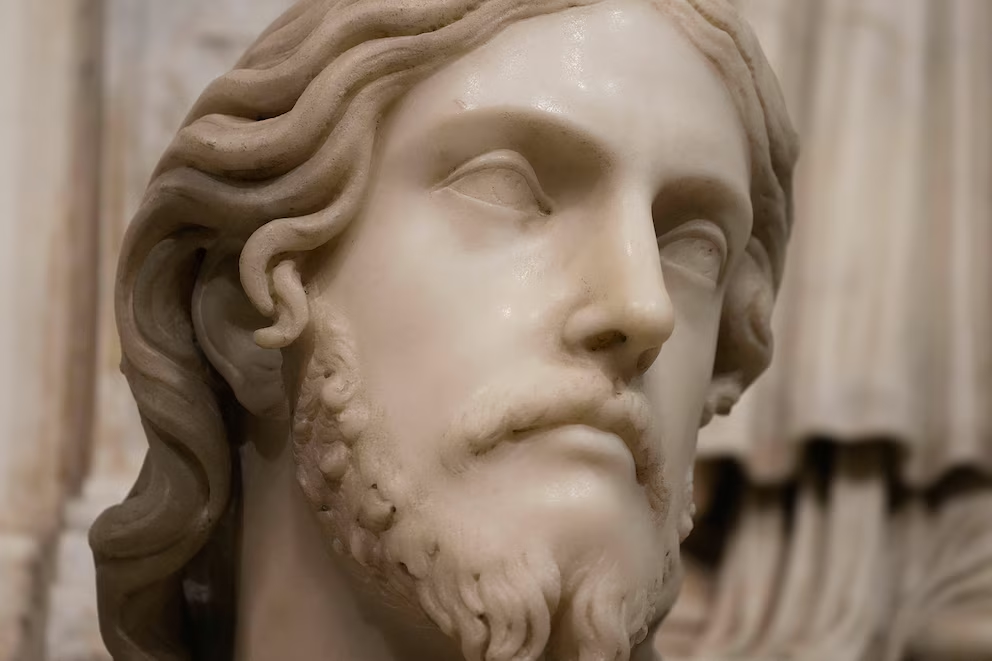
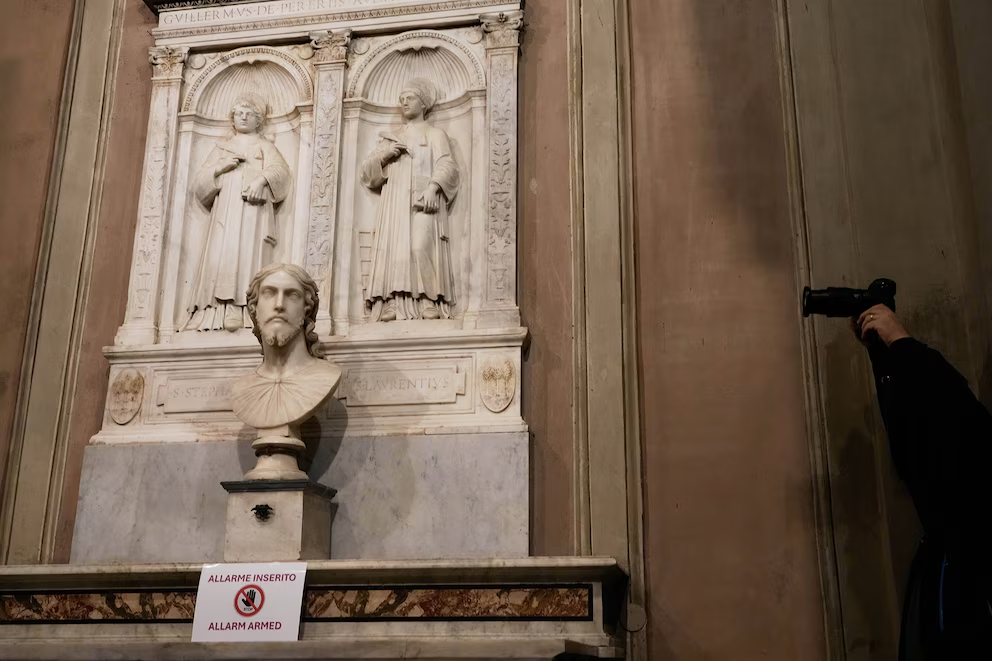
A marble bust of Christ that has stood for centuries in the Basilica of Sant’Agnese Fuori le Mura is suddenly being treated as a global test case for how the art world handles discovery, doubt, and the politics of naming. The spark is a claim by Valentina Salerno, an independent researcher, that the sculpture should be attributed to Michelangelo, a claim released into public view during the 550th anniversary year of the artist’s birth and amplified by the promise of “previously unseen” documentary traces. The immediate controversy is obvious: if the attribution were accepted, it would reshape a small corner of Michelangelo’s late corpus and add a high-profile object to his already heavily contested legacy. The deeper controversy is structural: attribution has become an arena where scholarship, institutions, media velocity, and market value collide, often long before the evidence is fully shareable.
Salerno’s argument, as reported, rests on archival work rather than technical forensics. She says she built the hypothesis through wills, inventories, and notarial records housed in church and state archives, and that she found references from later centuries linking the bust to Michelangelo Buonarroti. She also argues that a corrective attribution made in 1984 helped entrench a long-lived error by pushing the sculpture back into anonymous status. This is the kind of claim that can be credible in principle and still insufficient in practice, because the field does not reward conviction alone. It rewards transparency of primary sources, reproducibility of method, and the capacity for peer scrutiny. The most sensitive detail in the reporting is that Salerno has described a “pact of indissolubility” among disciples and a secret chamber protected by three keys, yet has not published transcriptions of the documents that would allow other specialists to test the claim. In attribution disputes, the absence of primary text is not a small gap. It is the gap that decides whether a story remains media-grade or becomes scholarship-grade.
The academic reaction has therefore been cautious rather than celebratory, and the caution has its own history. William Wallace, a veteran Michelangelo scholar at Washington University in St. Louis, recalled that the same bust has been wrongly attributed to Michelangelo before, pointing to a nineteenth-century reference by Stendhal as an example of how easily prestige claims can attach themselves to devotional sculpture. Wallace’s skepticism is not a dismissal of Salerno’s work as such. It is a reminder that Michelangelo is one of the most imitated artists in Western art, and that “Michelangelo” is often the first name assigned when a piece feels powerful enough to demand a master. Wallace also signaled a second reality: European art history has a tradition of contributions from researchers outside formal academic pathways, but that tradition only matters when the evidence is made available for disciplined evaluation.
The controversy is amplified by precedent fatigue. Since 2000, dozens of new attributions to Michelangelo have been proposed, and most have not survived the filters of expert consensus. That pattern creates a defensive posture among specialists, because every new claim arrives in a market and media environment that rewards novelty regardless of durability. The temptation for institutions is to flirt with the headline while outsourcing the burden of proof to “future verification.” Yet the public rarely follows the later verification cycle. It remembers the first announcement. This is why attribution has become a reputational hazard not only for scholars, but for museums, basilicas, and cultural authorities that must decide whether to endorse, merely host, or actively distance themselves.
The Vatican’s role in the Salerno case shows how delicate that institutional posture can be. Reporting indicates Cardinal Mauro Gambetti, who oversees St. Peter’s Basilica, formed a scientific committee in 2025 to examine Salerno’s broader attribution work, including Salerno and her mentor. The committee reportedly included high-profile figures such as Barbara Jatta, director of the Vatican Museums, and Hugo Chapman, a curator associated with the British Museum. Yet the same reporting suggests ambiguity around participation, with Jatta describing her involvement as proposed rather than formally positioned as a Vatican project, and Chapman constrained in public comment. That pattern is familiar: institutions want proximity to potential discovery, but they also want plausible distance if the claim collapses. In the current climate, even being “seen near the claim” can be interpreted as endorsement.
Italian state institutions have chosen a different form of distance: operational protection without authentication. The Carabinieri’s cultural heritage unit has reportedly avoided taking a position on authorship while emphasizing that the sculpture remains protected as national patrimony, now with security measures that match the renewed attention. This is the most defensible posture for an enforcement body. Authenticity debates are not its jurisdictional core. Protection is. Yet the optics still matter. Once heritage police are visibly involved, the public tends to read that presence as confirmation that something extraordinary is happening, even when the state is simply doing its standard job of safeguarding an object exposed to theft, vandalism, or opportunistic handling.
The market layer is never far behind, and it is part of why these claims ignite so quickly. The reporting points to a recent sale of a work attributed to Michelangelo for roughly 27.2 million dollars, a number that functions as a warning flare to anyone who understands how attribution changes value. Even when a contested attribution is never fully accepted, the mere possibility can raise the “attention value” of an object, increasing tourism interest, donor interest, and private collector pressure. This does not mean every claimant is motivated by money, but it does mean the system surrounding the claim is never neutral. Michelangelo’s name is not only an art-historical label. It is a financial instrument and a prestige machine, and that machine shapes incentives at every level.
What is at stake, ultimately, is not whether the bust is beautiful or spiritually compelling. It is whether the evidence chain can withstand the slow violence of scholarly critique. If Salerno publishes the archival transcriptions and the documents hold up under independent reading, the claim moves from sensational to discussable. If the documents remain private or selectively paraphrased, the claim is likely to remain stuck in the limbo where many modern “rediscoveries” live: highly visible, lightly verified, and permanently contested. Either outcome will still teach the same lesson. In the Michelangelo ecosystem, discovery is not a moment. It is a process, and the process is designed to be cruel to certainty.
Against propaganda, memory. / Contra la propaganda, memoria.