

 Phoenix 24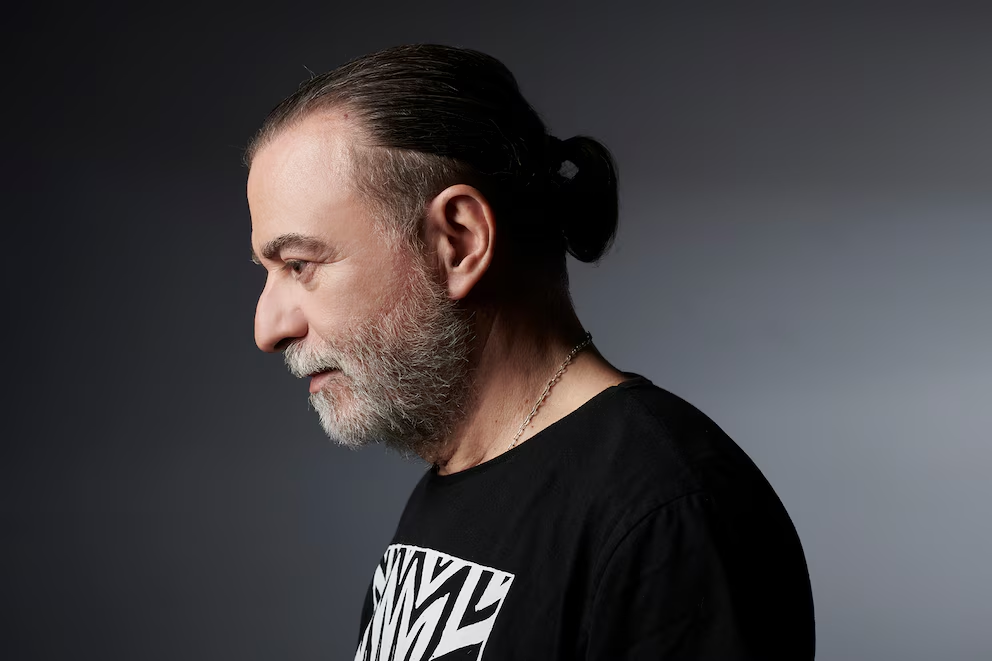
Grief becomes method before it becomes peace.
Buenos Aires, March 2026
A memoir-like novel does not begin with a plot twist. It begins with a question the writer cannot stop hearing. That is the engine of Cabrón, Reynaldo Sietecase’s new book, presented as his most intimate work and structured around a son’s insistence on reconstructing a father who is no longer available for explanations. The excerpt published by Infobae opens with an object that feels small but behaves like a key: the father’s eyeglasses, heavy lenses held by a thin metal frame, kept in a case inside a desk drawer. The gesture of taking them out is not nostalgia. It is an act of excavation, a choice to handle the evidence again, to accept that memory is not a clean archive but a living site that can still bruise the hands.
The book’s premise is simple and brutal: a son tries to rebuild the figure of his father using what time did not destroy. The surviving inventory is both material and emotional. Infobae highlights the tangible triggers, a recorded voice on video, glasses, a chess clock, books mixed into the family library, records that endured the years. The list matters because it models how grief operates when it becomes chronic. You do not mourn only with feelings. You mourn with objects that refuse to stay neutral. The same item can be proof of love one day and proof of absence the next. Cabrónleans into that instability, treating remembrance not as a monument but as a restless field where discoveries and scars are inseparable.
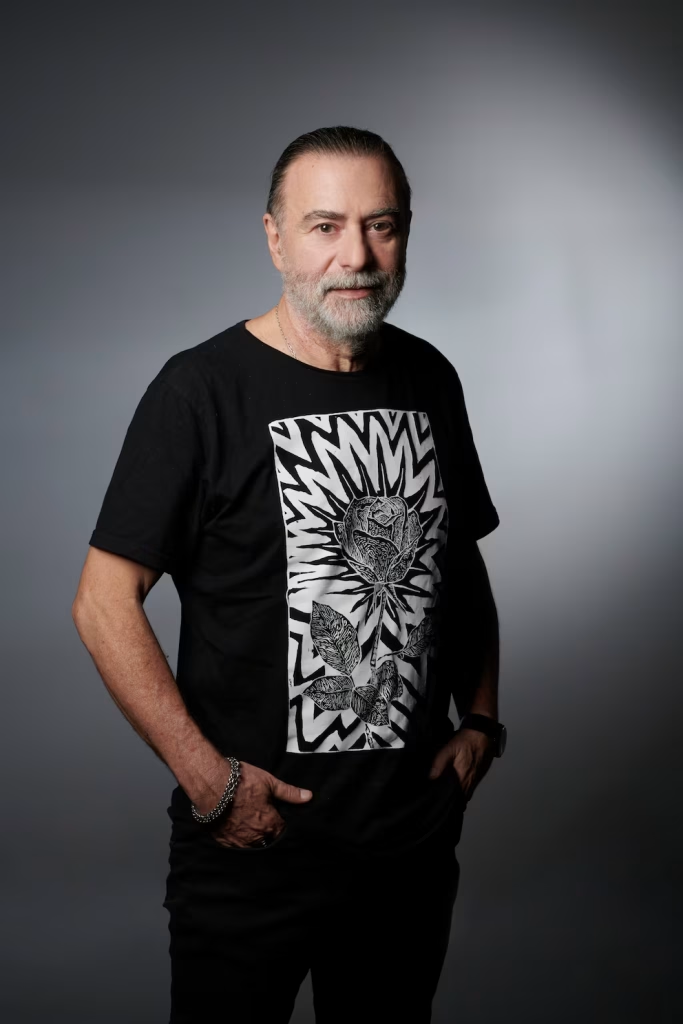
Sietecase’s decision to write this book is framed, even inside the excerpt, as a departure from his habitual territory. He describes himself as someone shaped by poetry and long practice in fiction, yet also as a writer whose narrative comfort zone has often been darkness, violence, thriller architecture, criminal worlds. That contrast is not a marketing hook. It establishes the stakes. Writing about a father is riskier than writing about a crime precisely because you cannot solve it, and because the reader can smell when a family portrait is idealized to protect the author’s self-image. Infobae emphasizes that Sietecase avoids both traps: neither canonization nor reduction of memory into a sentimental scrapbook. The ambition is harder: to recover a complex father without converting complexity into a performance of sophistication.
One of the most revealing moves is that Cabrón refuses the fantasy of total reconstruction. The book is described as an “archaeology” of a parent, which implies gaps, uncertain layers, and fragments that do not line up. Even the title carries abrasion. It signals that the father is not being remembered as a saint, and that tenderness here will not be sanitized. In the surrounding coverage and publisher descriptions, the book is framed as an intimate search that can be painful, at times illuminating, and ultimately oriented toward understanding the marks a father leaves on a son’s identity. That word, marks, is doing the real work. A father is not only an origin story. He is also a set of residues, gestures inherited, phrases repeated, fears learned, loyalties and grudges that travel forward without permission.
The excerpt’s opening with eyeglasses is not accidental because glasses are a metaphor you can touch. They carry a paradox: they exist to help someone see, yet in the son’s hands they reveal how much remains unseen. The father’s gaze is gone, but the instrument of his seeing survives. That is the logic of inheritance in grief. You do not inherit answers. You inherit interfaces, the devices, habits, and emotional reflexes through which a life once navigated reality. In Cabrón, the son’s reconstruction becomes a confrontation with that interface, not only a remembrance of the man.
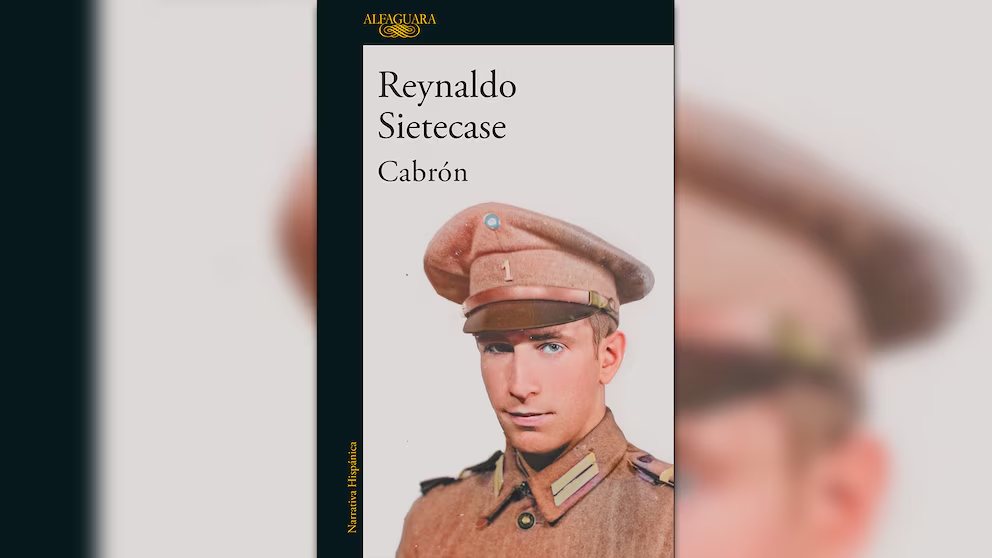
This is also a book about the ethics of telling. The excerpt contains the question that gives the piece its pulse: why stop to tell my father. It is a deceptively simple line, but it carries an accusation against the author’s own craft. If your professional identity is built on inventing plots, why turn toward autobiography-adjacent material where the consequences are personal and the material is morally charged. The implied answer is that some stories are not chosen. They arrive as unresolved pressure. The father becomes the case file the son cannot close, and writing becomes a form of controlled exposure, a way to approach the subject without pretending that closure is guaranteed.
Sietecase’s public biography adds another layer to the reading. He is not only a novelist; he is also a journalist and political analyst, a voice trained in interpretation and public narrative. Cabrón therefore sits at an intersection that matters culturally: the writer who lives in public discourse turns inward and admits that the most consequential archive is private and unstable. That move often produces a specific kind of literature, less interested in performance than in accuracy of feeling, but also aware that memory is not a court transcript. The book’s structure, built through objects, gestures, sporadic generosity, episodes of authoritarianism, travel shared, implies that the father is being reconstructed as contradiction, not as lesson.
There is a broader cultural reason this kind of work lands now. Across Latin American literature, the father frequently appears as authority, absence, wound, or myth. Yet contemporary readers often demand a different kind of paternal narrative: not heroic, not purely monstrous, but human in the way humans actually damage and love at the same time. The promise of Cabrón, as described in the coverage, is that it meets that demand without turning it into a tidy moral. It suggests that life becomes, in the end, the story that survives us, not because it is coherent, but because it persists in others as fragments that keep speaking.
The most honest way to read the book from its excerpt is as a controlled refusal of simplification. It does not offer the father as a symbol to be used. It offers him as a presence reconstructed from residues, and therefore as a question that can be worked on but not solved. That is why the opening image matters: a son holding eyeglasses that are heavier than their frame, an object whose imbalance mirrors the emotional imbalance of grief itself. The weight does not match the structure, yet the structure still holds.
Beyond the news, the pattern. / Más allá de la noticia, el patrón.