

 Phoenix 24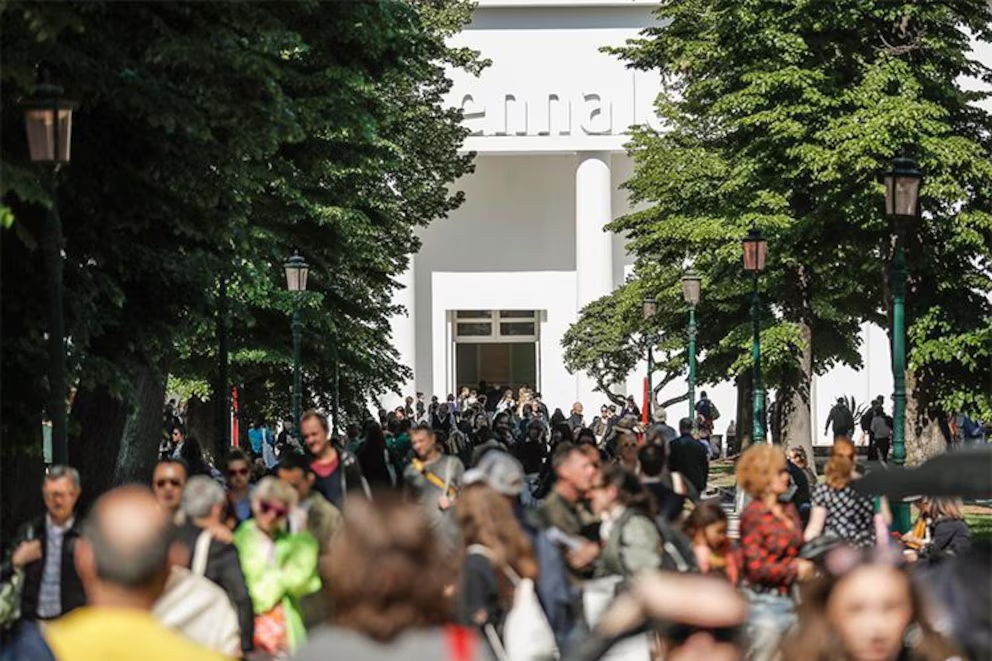
Art openings can become political frontlines.
Venice, March 2026
Russia’s planned return to the Venice Biennale has detonated a European argument that is no longer only about art, but about legitimacy, timing, and the rules of cultural visibility during an active war. After two editions in which Russia was absent following the 2022 invasion of Ukraine, the Biennale confirmed that the Russian Federation appears again on the list of national participants for the 2026 exhibition, scheduled to run from May to November. The decision immediately drew public opposition from Italy’s government and produced a cascade of condemnations from European lawmakers and regional foreign ministries. The central tension is blunt: whether a global cultural platform can claim neutrality by refusing “exclusion,” or whether neutrality becomes complicity when a state waging war is welcomed back under its national flag.
The backlash is significant not because it is loud, but because it is multi-institutional. Italy’s government, led by Giorgia Meloni, expressed opposition to Russia’s inclusion, framing it as symbolically unacceptable given the current context of the war. Lithuania’s foreign minister, Kestutis Budrys, went further, calling the decision “abhorrent” and arguing that offering Russia a cultural red carpet amounts to enabling a form of dark diplomacy. A cross-party group of European Parliament lawmakers also sent a letter to Biennale organizers describing the return as “unacceptable,” warning that it risks legitimizing a regime responsible for ongoing violence and will damage the Biennale’s moral standing. When criticism arrives simultaneously from government, diplomatic, and parliamentary channels, it stops being a niche cultural debate and becomes a reputational crisis.
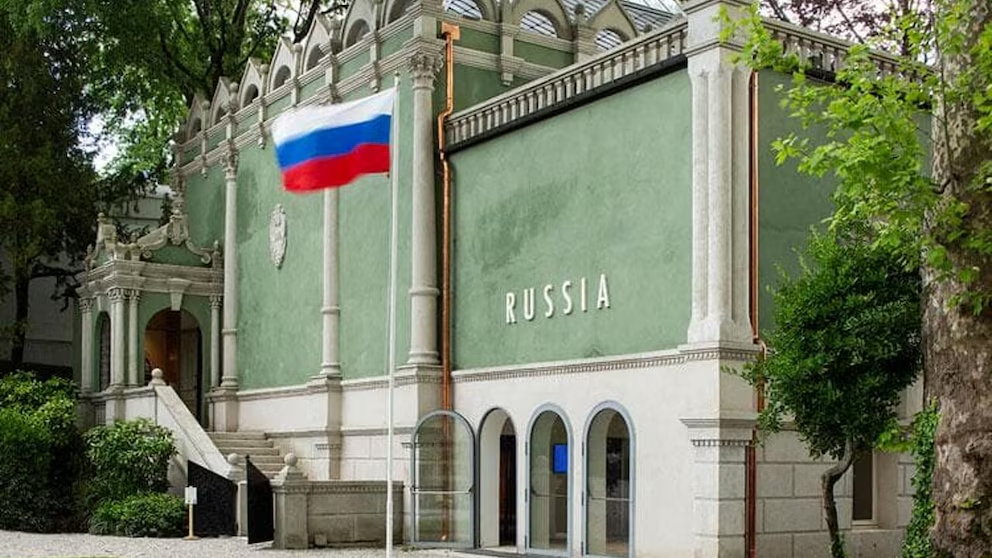
The Biennale’s defense is built on principle language that is designed to sound universal. In its public statement confirming Russia’s participation, the institution said it rejects exclusion and censorship of culture and art, and emphasized Venice as a place of dialogue, openness, and artistic freedom. It framed the exhibition as a connective space between peoples and cultures, holding out hope for an end to conflict and suffering. That argument is internally consistent within the old idea of art as a bridge, but it collides with the modern reality that nation pavilions are not abstract. They are instruments of state representation, and in wartime, representation is part of power. The Biennale is asking the public to separate art from the state while simultaneously hosting art in the state’s name.
Pietrangelo Buttafuoco, the Biennale’s president since March 2024, has tried to widen the moral frame by arguing that artists from “all war zones” should be invited so that they can share their perspectives. He has described the Biennale as a kind of “UN of the arts,” a space where political tensions should not justify cultural exclusion and where dialogue is possible precisely because antagonists can be present in the same place. That framing is not accidental. It attempts to turn inclusion into ethical leadership rather than moral surrender. Yet critics answer with a hard counterpoint: that when one side is an aggressor state, “dialogue” can function as a cosmetic cover for normalization.
Italy’s cultural ministry responded with a clarification that reveals another fault line: governance. It stated that the Biennale Foundation acted autonomously, without intervention by the Italian government, and reiterated that the government remains critical of Russia’s presence in the current context. The ministry also publicly contradicted Buttafuoco after he suggested the matter had been discussed with Culture Minister Alessandro Giuli, insisting no institutional debate had produced a government endorsement. This is not bureaucratic theater. It is political containment. Italy wants to preserve the Biennale’s statutory independence while preventing the decision from being read as a national policy shift. In effect, Rome is saying: we do not control the Biennale, and we do not agree with it. That is an awkward message, but it is also a way to reduce diplomatic blowback.
The controversy also exposes how cultural institutions now operate as semi-sovereign actors with global consequences. The Biennale’s autonomy has long been treated as a virtue, a protection against political pressure. But autonomy becomes a liability when it produces outcomes that governments then have to explain to allies and publics. The question is not only whether Russia should be present. It is who bears responsibility for the signal sent by that presence. If the Biennale invites Russia, the institution claims it is defending artistic freedom. If governments criticize the invite, they are accused of censorship. If governments remain silent, they are accused of normalization. There is no clean exit, only tradeoffs.
The decision also pulls other states into a shared frame that many will find uncomfortable. Buttafuoco has pointed out that artists from Russia, Ukraine, Belarus, Iran, Israel, and the United States will all be present, positioning the Biennale as a stage where conflict zones meet symbolically. That parity argument can sound fair, but it risks flattening moral categories that politics insists are not symmetrical. Ukraine is widely framed in Europe as the victim of aggression. Belarus is widely framed as an enabler. Russia is widely framed as the aggressor. Collapsing them into “war zones” may be an artistic framing, but it is a political provocation, because it shifts focus from responsibility to coexistence.
What this dispute ultimately tests is not the Biennale’s ability to host art, but Europe’s ability to defend its own lines when culture becomes a domain of strategic contest. Russia has historically treated cultural presence abroad as part of soft power, and European critics fear that returning to Venice will function as a reputational laundering mechanism, even if the art itself is not propaganda. The Biennale insists it is a forum, not a tribunal. Its critics insist that forums are not neutral when the invitation itself is a form of recognition. The argument, then, is about the meaning of “platform” in wartime: whether platforming is dialogue, or endorsement, or both.
The deeper pattern is that international cultural events are no longer protected spaces. They are contested spaces where moral posture is measured publicly and quickly. Venice has become a case study in how institutions try to defend openness while governments try to defend coherence, and how those aims collide when a war continues and symbols remain radioactive. Whether Russia’s pavilion ultimately proceeds, changes form, or becomes the site of sustained protest, the message is already clear: in Europe’s current climate, cultural reintegration is not a technical decision. It is a political act with consequences.
Every silence speaks. / Cada silencio habla.