

 Phoenix 24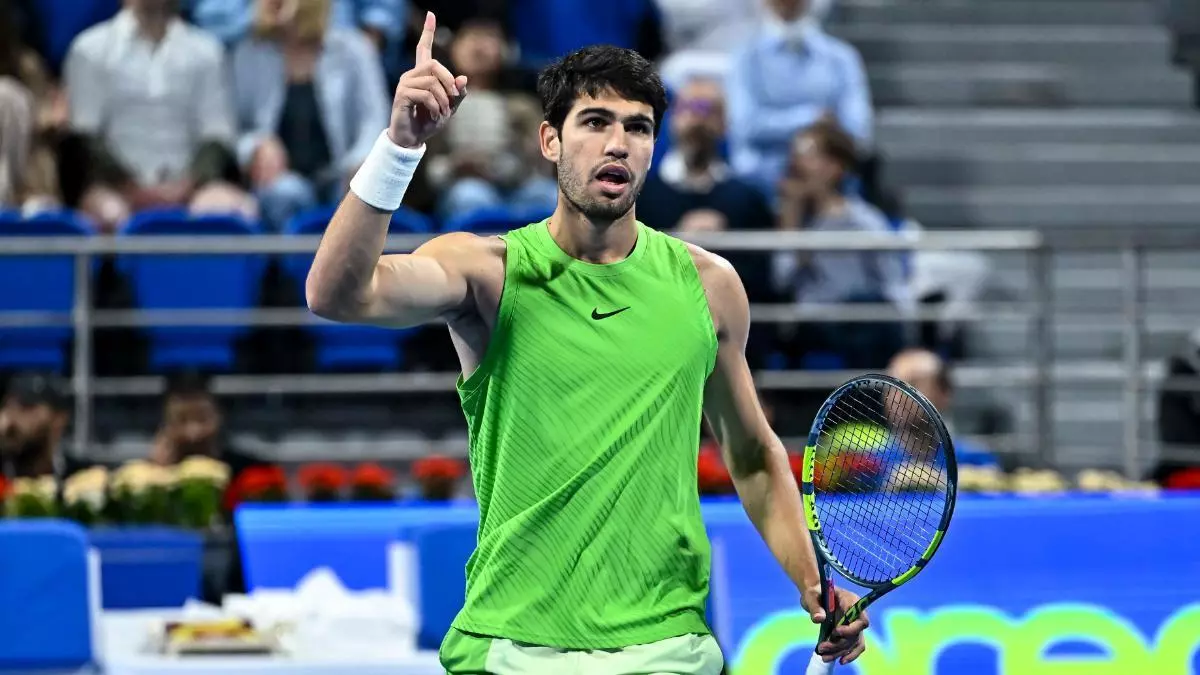
In tennis, comparisons are never innocent.
Madrid, February 2026
Carlos Alcaraz has received what many in tennis would consider the highest compliment available in this era, the kind of praise that places a player in symbolic conversation with the sport’s modern giants rather than simply celebrating another win. Spanish coverage presents the moment as a major endorsement, and that framing is important because in elite tennis, certain compliments function less as admiration and more as historical positioning. When Alcaraz is described through the language of Federer, Nadal, or Djokovic, the message is not only that he is excellent. The message is that he is being evaluated as a player who can shape an era.
That distinction matters because Alcaraz is no longer being discussed as a promising champion. He is being discussed as a reference point. After his strong start to 2026, including major wins and continued dominance near the top of the rankings, the tone around him has shifted from future potential to present authority. In that environment, praise becomes more loaded. It starts to carry comparative weight, and every compliment from former champions, analysts, or rival camps immediately enters the broader debate about legacy, style, and historical trajectory.
What makes this kind of recognition especially powerful is the nature of tennis memory. The sport remains structured by the long shadow of the Big Three, and almost every rising star is measured against that standard, usually unfairly and too early. Most players are praised for isolated traits, one has the movement, another the forehand, another the mentality. Alcaraz, however, increasingly receives a different category of praise, one that emphasizes synthesis. He is often described not as a specialist in one dimension, but as a player whose game blends power, creativity, athletic range, and competitive nerve at a level that feels historically familiar while still distinctly his own.
That is why the compliment resonates beyond fan excitement. It reflects a broader consensus forming across the tennis ecosystem, Alcaraz is not merely winning matches, he is forcing experts to use legacy language. This happens when a player’s toolkit becomes difficult to describe with ordinary terms. His ability to defend and counterattack, improvise at speed, change rhythm, dominate from the baseline, and still produce soft touch under pressure creates a profile that invites grand comparisons. The praise may sound excessive in headlines, but it also reveals an analytical problem. Traditional labels are no longer enough.
There is also a psychological layer to this. High praise can elevate a player publicly, but it also increases the burden of expectation in ways that are rarely neutral. Once a player is framed as heir, hybrid, or generational standard, every defeat becomes a referendum and every title becomes a requirement rather than an achievement. Alcaraz has already lived inside that pressure cycle, and his career so far suggests he handles it better than most. Even so, the larger the compliment, the narrower the margin for ordinary weeks. Admiration at this level can become a form of surveillance.
Still, the current moment justifies the intensity of the language more than many earlier hype cycles in men’s tennis. Alcaraz is producing results, not just highlights. He is pairing charisma with hard output, and that combination is what turns media praise into durable credibility. Tennis audiences will always debate whether any new champion can truly be compared to the legends, but the fact that the comparison now sounds less absurd than inevitable tells its own story. He has crossed a threshold where superlatives no longer feel like promotion alone.
The deeper significance of the so called greatest praise, then, is not the sentence itself but the timing. It arrives at a moment when Alcaraz is consolidating status, not chasing relevance. He is already inside the serious historical conversation, and the sport’s language is adjusting around that reality. In tennis, compliments of this scale are never just compliments. They are signals that the hierarchy of the present may be reorganizing around a player who is no longer being introduced to the stage, but increasingly defined as one of its central authors.
Phoenix24: journalism without borders. / Phoenix24: journalism without borders.