

 Phoenix 24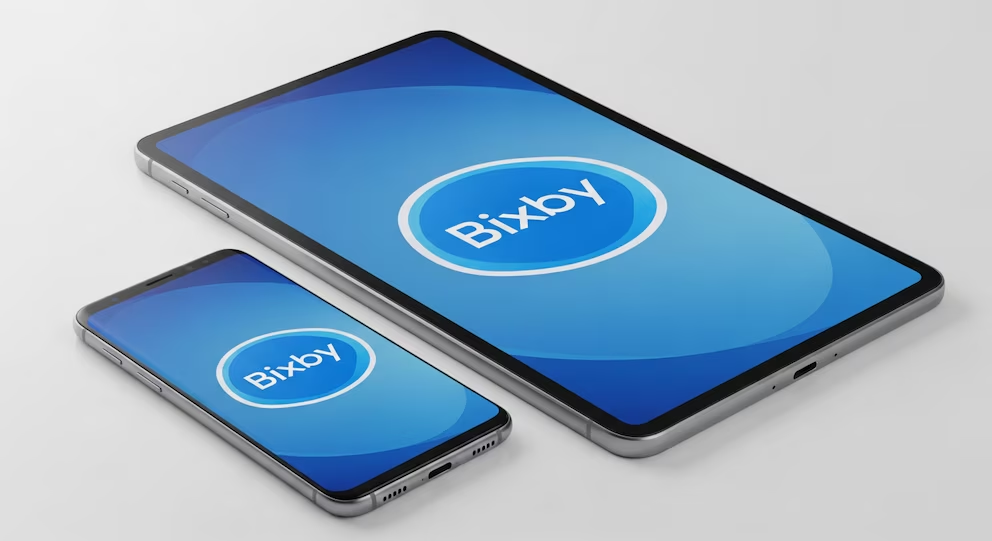
Assistants are moving from answers to control.
Seoul, February 2026.
Samsung is issuing a quiet but consequential warning to its own users: stop treating Bixby like a legacy bot. With One UI 8.5, the company is positioning Bixby as a conversational device agent, something designed to interpret intent in natural language and then act inside the phone’s settings and features. That framing matters because it changes the standard of accountability. A bot can be forgiven for being shallow, an agent is judged by whether it executes correctly.
What Samsung is promising is not a better personality, but a better operating layer. The new Bixby is meant to navigate menus without the user needing to remember exact setting names or command syntax, which is where most assistants have historically failed in real life. Instead of asking users to learn the phone’s taxonomy, the assistant is expected to translate everyday phrasing into actions, including troubleshooting style queries about why something is happening on the device. If that translation works reliably, Bixby stops being a novelty and becomes infrastructure.
Outside Samsung’s own messaging, tech coverage has emphasized a shift that users will feel immediately: fewer “scripted” interactions and more adaptive interpretation. Reports describe the assistant identifying the relevant setting from a question rather than forcing the user to hunt through nested menus. That sounds minor until you map it to daily friction, screen timeout behavior, connectivity toggles, battery constraints, permissions, and the small annoyances that accumulate into churn. In this model, Bixby’s job is to absorb complexity, not to explain it.
A second pillar is live information retrieval, the ability to answer with up to date material rather than being limited to on device commands. Several outlets have pointed to real time web search as part of the upgraded capability set, which aligns with the broader industry baseline. Users now expect assistants to know what changed today, not what was true when the phone shipped. Yet retrieval is also the easiest way to lose trust, because it increases the chance of confident, wrong outputs. A device agent that blends web answers and system controls must be conservative by design or it will feel dangerous.

The most discussed detail is the possible involvement of Perplexity as a search and answer layer powering parts of the experience. This has been framed as a notable strategic move because Samsung has publicly leaned on Google’s AI stack in other areas of the Galaxy AI branding. Coverage suggests that an earlier announcement appeared and then disappeared quickly, which fueled the interpretation that partner specifics were disclosed prematurely or before rollout details were finalized. Whether or not the partnership is formally foregrounded, the direction is clear: Samsung wants Bixby to combine deep device integration with strong retrieval.
Rollout mechanics also indicate that Samsung is treating this as a flagship level change rather than a background update. The upgraded Bixby is described as arriving through the One UI 8.5 beta program first, with a staged approach that typically starts in select markets and select devices before a broader release. Tech reporting has referenced the Galaxy S25 beta track as the initial testing ground, which is consistent with Samsung’s standard pattern for major One UI changes. The expectation in coverage is that a wider public push would align with the next major hardware cycle, when users are most open to changing defaults.
That default problem is the hard part Samsung cannot solve with code alone. Bixby carries reputational inertia, a significant portion of Android users learned to ignore it, disable it, or treat it as redundant next to Google’s assistant stack. Rebuilding Bixby as an agent is, in effect, Samsung trying to reset the habit loop by making it practical rather than charming. Practicality in this context means fewer errors and fewer dead ends, not more features. The assistant has to earn a second chance through consistency.
The privacy and security implications are not peripheral, they are central to adoption. A conversational agent that can interpret language and touch settings is sitting closer to the user’s daily routines than a search box ever did, and users have become more sensitive to what is processed on device versus what is sent to cloud services. Industry commentary has highlighted that Samsung already offers controls around AI features, including options that limit certain processing or reduce data exposure, and those controls will matter more as assistants gain agency. If Bixby can act, users will demand clearer boundaries for when it acts, what it can access, and how to reverse or audit its changes.

From a systems perspective, Samsung is converging on the same conclusion as everyone else building assistants in 2026: the winning interface is intent to outcome. The assistant that merely responds is now table stakes, the assistant that completes tasks safely is the differentiator. That shift raises the bar for guardrails, because mistaken actions are more costly than mistaken answers. The strongest version of this strategy is a Bixby that does fewer things, but does them with high reliability and transparent confirmations.
The real test will be mundane, not theatrical. Users will judge the new Bixby on whether it reduces the time spent inside settings, whether it resolves common device problems without creating new ones, and whether it behaves predictably under ambiguity. If the assistant hesitates, misfires, or overcommits, people will revert to manual control and the reboot will fade into the background again. If it consistently turns messy language into correct action, Samsung will have converted a long running liability into a platform advantage.
Detrás de cada dato, la intención. / Behind every data point, the intention.