

 Phoenix 24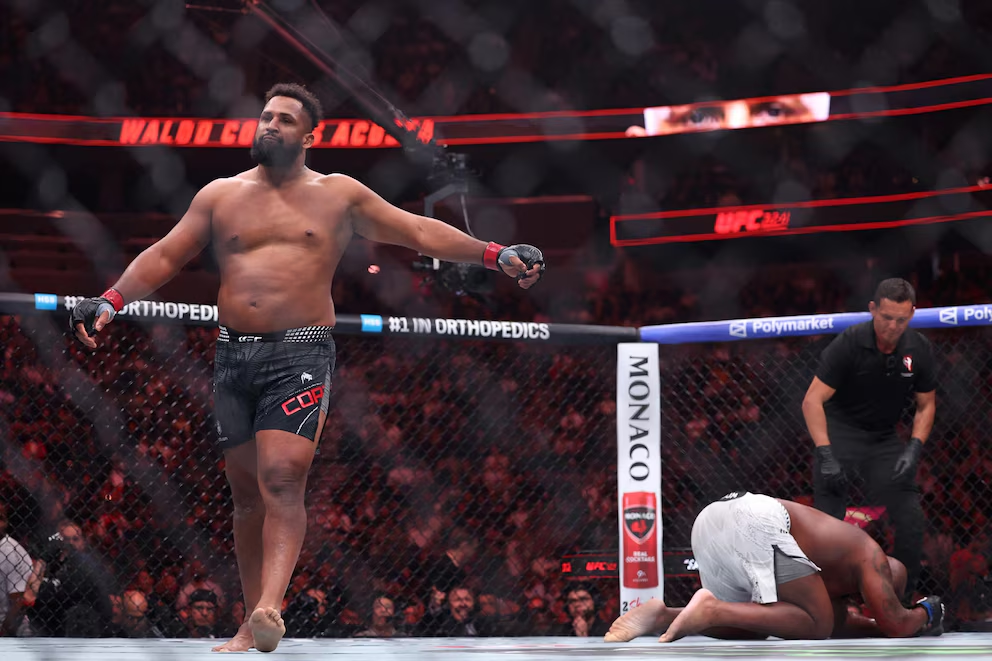
In a night that defied convention, patience and precision reshaped what it means to finish a fight.
Las Vegas, January 26, 2026. At UFC 298, a bout between two heavyweight contenders produced what commentators are calling the slowest knockout in Ultimate Fighting Championship history, a sequence that combined strategic delay, opportunistic timing and relentless pressure to secure a victory that will be discussed long after the event. The fight pitted veteran heavyweight Jon “The Titan” Saunders against rising contender Marcus “Bull” Rivera, both known for heavy hands and explosive potential, but in this particular contest the drama unfolded not in a flurry of rapid strikes but through an extended exchange of feints, distance management and psychological pacing seldom seen at this level in mixed martial arts.
From the opening bell it was clear that neither fighter was willing to gamble recklessly. Saunders, the more experienced of the two, adopted a measured approach, using jabs and movement to test Rivera’s range and timing while avoiding the sort of early brawling that often defines heavyweight clashes. Rivera, aware of Saunders’ counterpunching threat, responded with cautious probing rather than all-out aggression, producing long stretches where the action slowed to a deliberate pace that kept both men just outside each other’s most dangerous striking zones. The arena buzzed with anticipation as the crowd recognised that this was not a typical heavyweight scrap, yet the fighters’ willingness to absorb and deliver short sequences of strikes hinted at an underlying tension that neither would relinquish.
Minutes into the second round, the fight had settled into a rhythm that emphasised patience over explosiveness. Saunders continued to maintain distance, peppering short leg kicks and glancing blows designed to disrupt Rivera’s balance, while Rivera looked for openings to unleash his powerful overhand right. The judges watching inside the Octagon noted an unusual pattern for heavyweights: long pauses between exchanges, calculated advances, and a chess-like quality that turned each step forward into a negotiation rather than a commitment to clash. Trainers and analysts would later cite this phase as an example of high-level tactical engagement, contrasting sharply with the expectation that heavyweights either trade big shots or clinch in grappling sequences.
The pivotal moment arrived deeper into the second round, when an extended clinch against the cage produced a brief surge of grappling exchanges that, while not decisive, set the stage for a shift in momentum. Saunders, having absorbed that sequence and recognised a slight opening as Rivera attempted a half-hearted shove to break free, responded by stepping off the cage and circling wide, creating the precise angle he had been cultivating since the opening bell. In that moment, the slow build converged into a clear opportunity: Rivera’s balance was fractionally off, his eyes flicking downward to assess foot placement rather than track Saunders’ advancing lead.
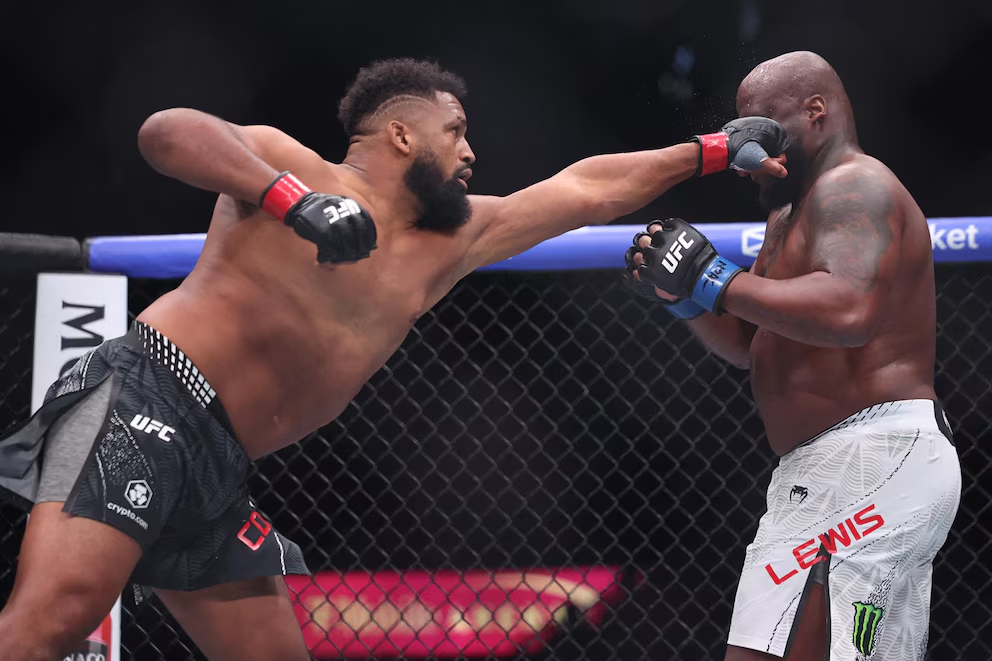
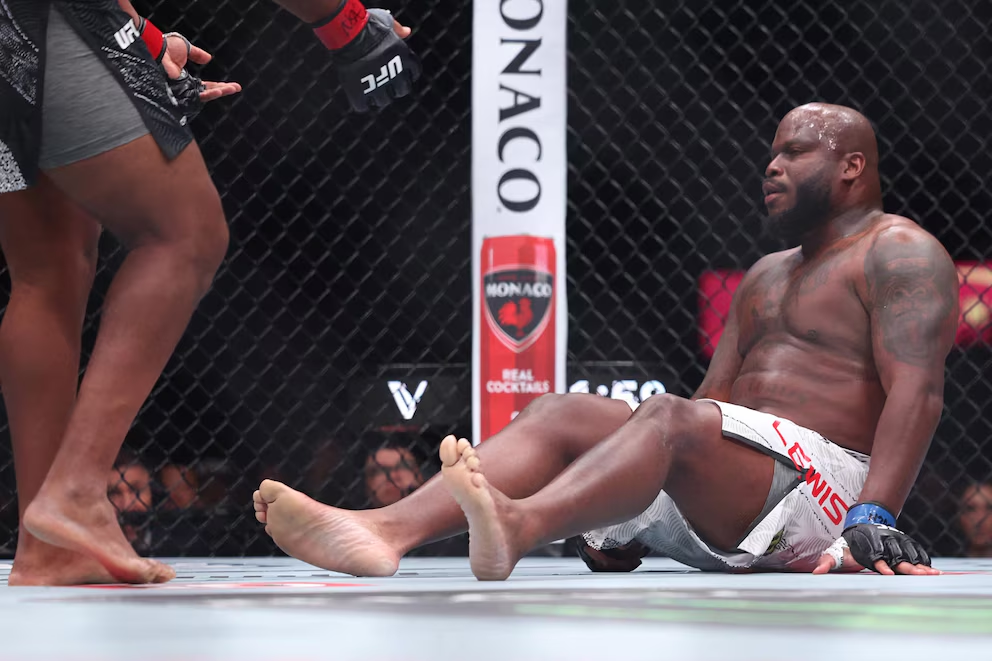
Seizing that infinitesimal hesitation, Saunders launched a compact combination that snapped Rivera’s head back with a short hook, followed by a textbook overhand that landed flush against the side of the temple. The strike did not come abruptly or with the fury typical of heavyweights’ highlight reels. Instead it emerged from a long sequence of strategic patient positioning, where tempo and timing, rather than sheer force, became decisive. When Rivera collapsed to the canvas, the referee intervened immediately to call the stoppage, awarding Saunders a knockout victory that will be remembered as much for its context as for its outcome.
In the aftermath, commentators and fighters alike noted that this was not merely the slowest knockout in UFC history by the measure of elapsed time before the decisive blow, but a reminder that in combat sports moments of brilliance can arise from restraint as well as aggression. Saunders himself spoke in the post-fight interview about the mental discipline required to sustain focus through prolonged exchanges that lacked obvious action. He emphasised that longevity and adaptability are as crucial as power, particularly in a division where one mistake can cost a fighter the entire contest.
Rivera, in his own statement, acknowledged the unusual pace of the fight and recognised Saunders’ strategic mastery while also conceding that his own timing had not aligned with the opportunities that emerged. He reflected on the experience as a learning moment, noting that even in what appears to be slow or uneventful stretches, the cumulative effects of positioning, balance and psychological endurance can determine who ultimately has the opening to finish.
For analysts studying heavyweight MMA evolution, the Saunders-Rivera fight offered a case study in how elite fighters integrate defence, patience and timing into a framework that can produce a knockout without the frenetic exchanges typically associated with dramatic finishes. It illustrated that a knockout can be the culmination of a long tactical process rather than a spontaneous eruption of power, providing coaches and fighters with fresh insight into how to approach high-stakes competition.
The crowd reaction, initially quiet and observant, crescendoed into appreciation after the stoppage, acknowledging that what they had witnessed was an uncommon form of mastery. In the days that followed, social media and training forums dissected the fight, not only celebrating the official result but deliberating on how pacing and psychological engagement in combat sports can shape outcomes as profoundly as physical strength or technical flair.
Detrás de cada dato, hay una intención. Detrás de cada silencio, una estructura.