

 Phoenix 24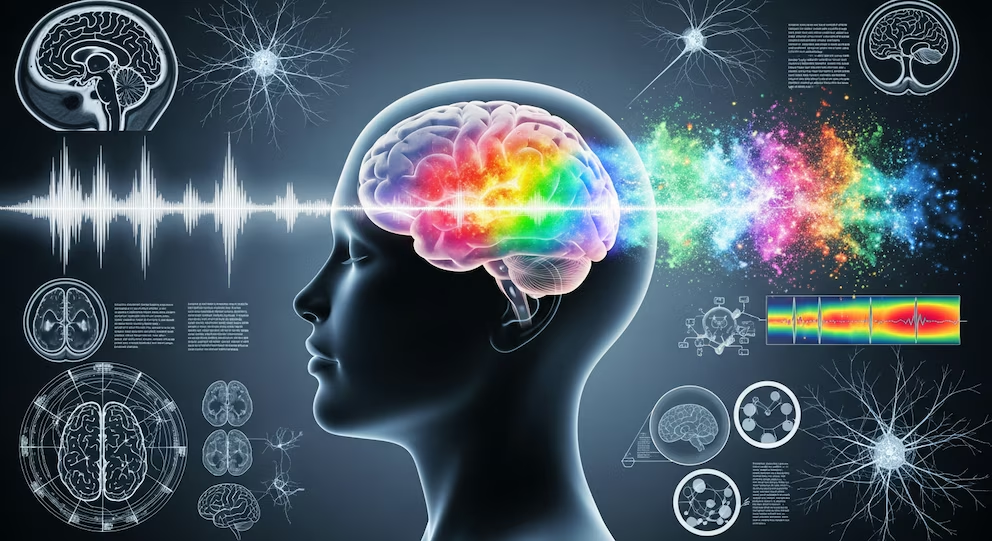
Cognition expands when we broaden the lens of human capacity.
Florence, January 2026.
Traditional measures of intelligence have long prioritized analytical reasoning, memory recall and pattern recognition, often distilled into a single quotient that claims to summarize cognitive ability. Yet growing academic discourse suggests that this narrow framing omits key dimensions of human thought and creativity. Scholars and educators argue that intelligence encompasses not only logical reasoning but also aesthetic sensitivity, emotional nuance and the capacity to navigate complexity with empathy and insight. This reconceptualization invites a more holistic view of the mind, one that honors diverse ways of knowing rather than privileging a single metric.
The historical roots of intelligence testing in North America, Europe and parts of Asia reveal both achievements and limitations. Early twentieth century psychometric pioneers developed tests to quantify reasoning and problem solving skills, producing tools that found widespread application in education and employment contexts. These instruments contributed to understanding cognitive variation but also embedded cultural assumptions about what counts as intelligent behavior. Critics in cognitive science caution that such metrics often reflect specific cultural practices rather than universal cognitive capacity, and that they risk undervaluing forms of thought central to other communities.

Across Africa, research in indigenous epistemologies highlights how different cultures conceive of intelligence in relational and environmental terms. In this view, the ability to read social situations, interpret symbolic meaning and maintain harmony within community networks is as vital as abstract logic. Such perspectives align with scholarship in cross cultural psychology, which emphasizes that human cognition cannot be fully understood without considering the contexts in which it is embedded. Intelligence, from this vantage point, is as much about connection and adaptability as it is about calculation.
Artistic expression provides another lens through which to view cognitive complexity. In Europe and Latin America, neuroscientists and philosophers have begun to explore how aesthetic experience engages multiple brain networks simultaneously, integrating sensory perception, memory and emotion. The appreciation of beauty, whether in music, visual art or movement, requires nuanced attention and pattern recognition that often eludes quantification in standard tests. These processes demonstrate that aesthetic intelligence, the ability to perceive, interpret and create beauty, is deeply interwoven with other cognitive faculties.
The concept of emotional intelligence also reshapes our understanding of the mind. Originating in psychological research in North America and gaining global traction, emotional intelligence emphasizes skills such as self awareness, empathy and social reasoning. These capacities enable individuals to navigate interpersonal landscapes with sensitivity and judgment, and they correlate strongly with leadership effectiveness, resilience and collaborative problem solving. Emotional intelligence thus challenges the primacy of analytical metrics by foregrounding relational awareness and affective nuance as core components of human cognition.
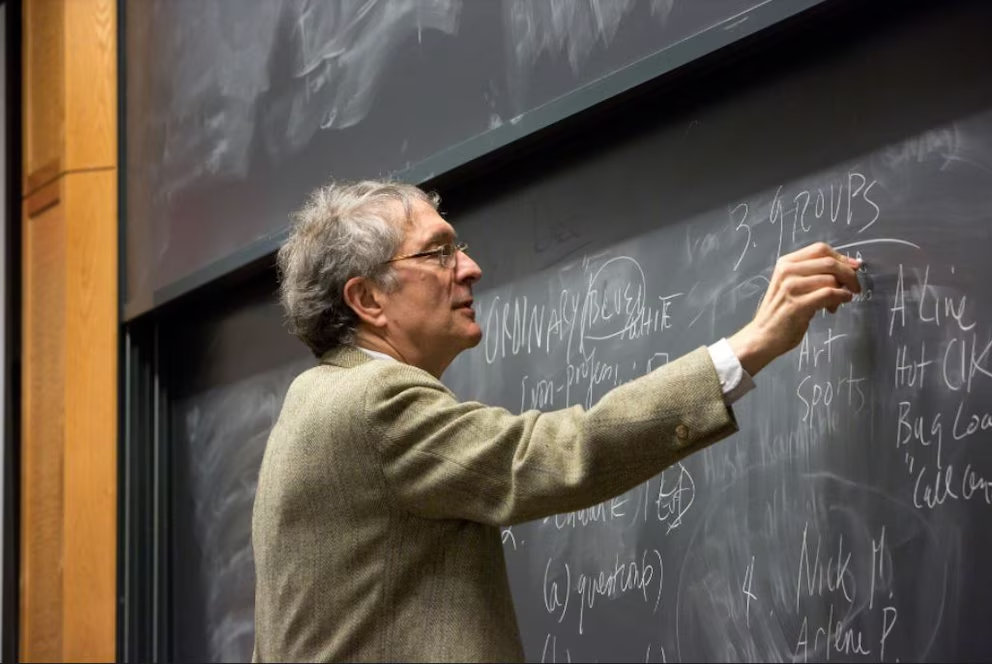
Education systems worldwide are responding, albeit unevenly, to these expanded definitions. Some institutions in Asia and Europe are experimenting with curricula that balance logical reasoning with creative arts, collaborative projects and reflective practice. The goal is not to replace classical skills, but to create learning environments where diverse cognitive strengths can flourish. Such pedagogical models suggest that students excel when their unique ways of thinking are recognized and nurtured rather than forced into narrow assessment frameworks.
Critics of holistic intelligence models caution that expanding definitions can dilute clarity, making it harder to assess learning outcomes or allocate resources. They contend that standardized measures provide benchmarks that facilitate comparison and accountability. Yet proponents of broader frameworks argue that the value of measurement must be balanced against the risk of marginalizing individuals whose strengths lie outside conventional categories. In an increasingly complex world, shaped by cultural exchange, technological transformation and social interdependence, the ability to synthesize diverse kinds of knowledge may be as crucial as analytical prowess.
Philosophers point to historical figures whose achievements defy easy categorization. Innovators in science, art and philosophy often combined deep analytical skill with intuitive insight and creative vision. Their contributions emerged not from a single cognitive domain, but from the interplay of multiple ways of knowing. This interplay suggests that intelligence is not a monolith, but a dynamic landscape of capacities interacting across contexts and cultures.
Ultimately, rethinking intelligence calls for humility as well as curiosity. It invites educators, policymakers and learners to acknowledge that human minds cannot be wholly captured by a single number. Intelligence, like beauty, resists simple definition, and its richest expressions often appear at the intersections of logic, emotion and imagination. By embracing a broader conception of cognitive capacity, societies can cultivate environments where individuals are recognized for the full breadth of their thinking and creating.
Cada silencio habla. / Every silence speaks.