

 Phoenix 24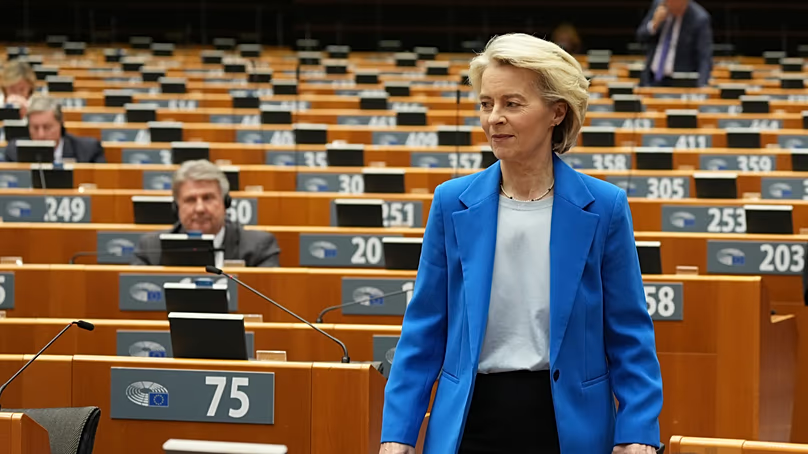
It was not a raise. It was a misunderstanding turned into a weapon.
Brussels, January 2026.
A story moved fast across social networks claiming that Ursula von der Leyen, president of the European Commission, had “automatically” increased her own salary by €2,400 per month. The framing was simple, emotional and explosive: a powerful official, quietly rewarding herself while ordinary Europeans face inflation and economic pressure. The problem is not only that the story was misleading. The deeper problem is how easily institutional processes are converted into personal accusations in an environment where outrage travels faster than explanation.
The salary of the president of the European Commission is not defined by her personal will. It is tied to a legal and statistical framework built long before her mandate and approved by member states and the European Parliament. European officials’ pay is adjusted through a formula that links salaries to the evolution of purchasing power and public-sector wages in several member states, especially the country where EU institutions are based. This mechanism does not ask whether an individual official deserves more or less. It measures economic indicators and applies them collectively. When the formula produces an upward adjustment, every eligible official is affected, from senior leaders to lower-level administrators. No single person can change that equation at will.
The rumor grew because numbers without structure are easy to manipulate. Saying “€2,400 more per month” sounds personal, direct and scandalous. Saying “a recalibration derived from long-standing staff regulations based on comparative purchasing-power indices” sounds boring, distant and technical. In digital politics, boring loses. Outrage wins. What gets lost is that this type of salary adjustment has happened under multiple Commission presidents, of different political families, across different economic cycles. It is not a privilege invented by one leader. It is a bureaucratic consequence of rules designed to avoid arbitrary political control over civil-service pay.
Another distortion comes from how people imagine EU salaries. Many believe EU officials pay no taxes and live in a financial bubble disconnected from ordinary Europeans. In reality, EU staff do not pay national income tax, but they do pay a specific EU tax that goes directly to the Union’s budget, with progressive rates that increase with income. This does not make them identical to national systems, but it also means they are not tax-free elites floating outside fiscal responsibility. The narrative of total exemption is useful for anger, but weak for accuracy.
The transformation of this technical issue into a moral accusation reflects a wider pattern. Complex institutions are increasingly forced to speak in an environment that prefers villains to systems. It is easier to attack a person than to explain a regulation. It is easier to post a number than to explain how that number is produced. The story of von der Leyen’s “automatic raise” is not mainly about her. It is about how public debate has shifted from understanding structures to hunting symbols.
This dynamic is dangerous because it erodes trust in institutions through simplification. If every bureaucratic outcome is framed as personal greed, the idea of rule-based governance collapses. The European Union, for all its flaws, is built on the promise that rules matter more than personalities. Turning every outcome into a story of individual manipulation undermines that foundation and replaces it with suspicion as default.
The political value of this rumor is obvious. It feeds into a narrative that portrays Brussels as distant, arrogant and self-serving. It connects economic anxiety with political resentment. When people struggle with prices, energy bills or job insecurity, stories about elite pay become emotional accelerators. They do not need to be fully accurate to be effective. They only need to feel true.
But feeling true is not the same as being true. The difference matters, especially in democracies that depend on informed consent rather than permanent outrage. When fact-checking organizations explained that von der Leyen did not and could not decide her own salary increase, the correction traveled slower than the accusation. This is not accidental. Corrections are complex. Accusations are simple.
The deeper issue is not whether a salary is high or low. That is a legitimate political debate. Citizens can reasonably ask whether EU leaders and officials are paid too much compared to national standards or social realities. What matters is how that debate is conducted. Arguing about the fairness of a system is different from inventing personal misconduct where there is institutional process.
The case shows how political misinformation does not always require fake documents or invented quotes. Sometimes it only needs selective framing. Take a real number, detach it from its legal context, personalize it, and release it into a polarized environment. The result is not a lie in the classic sense, but a distortion that functions like one.
Von der Leyen becomes, in this story, not a politician operating inside a structure, but a symbol of everything people distrust about supranational power. That symbolism is politically useful for those who oppose the EU or seek to weaken its legitimacy. It is less useful for citizens who want to understand how decisions are actually made.
In the long run, this kind of narrative does more than damage reputations. It damages the idea that governance can be impersonal and rule-based. If people are taught to believe that every institutional outcome is secretly driven by personal greed, they will stop believing in rules altogether. Politics becomes a permanent moral trial, not a debate about systems.
The story of the supposed “automatic raise” is therefore not about a paycheck. It is about how information is weaponized. It is about how complexity becomes vulnerability in an age that rewards simplicity. And it is about how public trust is slowly eroded not only by real corruption, but by imagined corruption that feels emotionally convincing.
The challenge for institutions is not only to be transparent, but to communicate in a world that does not like explanations. The challenge for citizens is not only to feel, but to verify. Between those two challenges lies the fragile space where democracy either survives or turns into spectacle.
Detrás de cada dato, hay una intención.
Detrás de cada silencio, una estructura.