

 Phoenix 24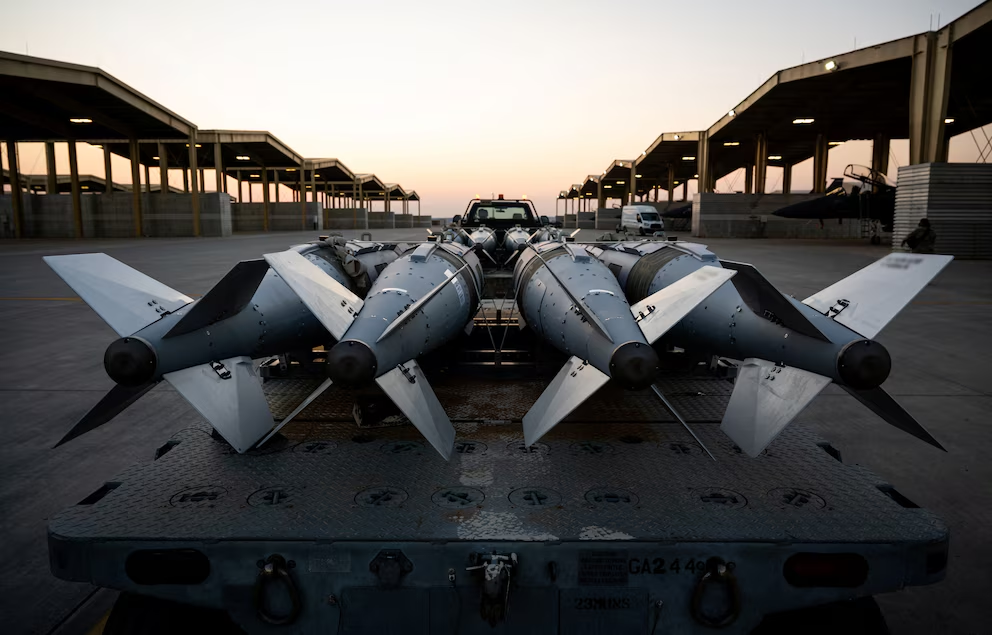
War does not pause for holidays.
Abuja, December 2025
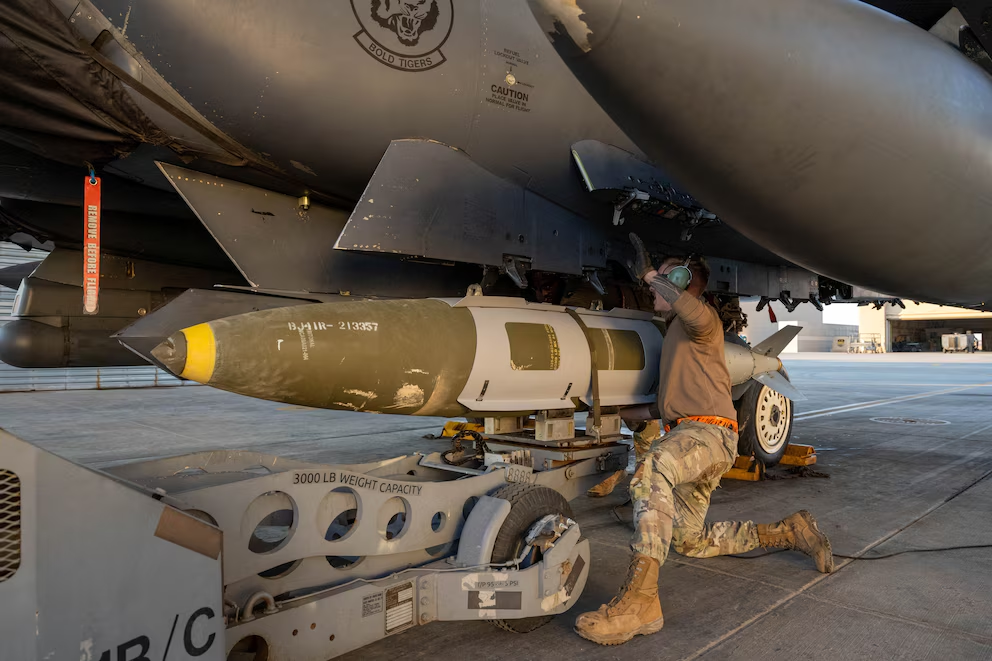
The United States carried out airstrikes on December 25 against positions linked to the Islamic State in northwest Nigeria, marking a notable expansion of Washington’s direct military involvement in West Africa. The operation, framed by U.S. authorities as a response to escalating attacks on civilians, including assaults on Christian communities, reflects a broader shift in how American counterterrorism policy defines both geography and urgency.
The strikes targeted militant groups operating in a region that has increasingly become a convergence zone for jihadist activity, criminal banditry, and intercommunal violence. Northwest Nigeria, unlike the country’s northeast where Boko Haram and Islamic State offshoots have long operated, represents a newer and more fragmented theater. Armed groups there blend ideological affiliation with profit-driven violence, exploiting weak governance, porous borders, and chronic insecurity.
From a strategic perspective, the operation departs from the United States’ historically limited role in Nigeria, which has focused on intelligence cooperation, training, and logistical support rather than direct combat. Conducting airstrikes places Washington more visibly inside a complex conflict environment where attribution, alliances, and objectives are less clearly defined. The choice of Christmas Day added a symbolic dimension, reinforcing the administration’s framing of the mission as both a security action and a moral response to religiously targeted violence.
U.S. officials emphasized that the strikes were intended to degrade militant capabilities and deter further attacks on civilians. However, analysts caution that air power alone rarely produces lasting stability in regions where violence is sustained by local grievances, economic marginalization, and governance failures. In northwest Nigeria, insecurity is fueled as much by land disputes, resource competition, and criminal networks as by transnational jihadist ideology.
For Nigeria, the strikes present a double-edged dynamic. External military pressure may disrupt militant operations and offer short-term relief to overstretched security forces. At the same time, foreign air operations raise sensitive questions about sovereignty, coordination, and domestic legitimacy. Nigerian authorities must balance the tactical benefits of external support with the political risks of being seen as reliant on foreign force in areas where state authority is already fragile.
Regionally, the operation fits into a wider West African security crisis. Militant groups linked to global jihadist networks have expanded southward from the Sahel, destabilizing areas once considered peripheral to such threats. International interventions over the past decade have demonstrated that while tactical gains are possible, the absence of durable political and economic solutions often allows violence to resurface in new forms and locations.
The U.S. decision also highlights how counterterrorism narratives are evolving. By explicitly citing violence against Christians, Washington taps into a powerful moral frame but risks oversimplifying a conflict shaped by multiple, overlapping drivers. Human rights observers and regional experts stress that protecting civilians requires not only military action but also sustained investment in governance, justice, and local conflict resolution mechanisms.
There is also the risk of unintended escalation. Islamic State affiliates have historically used foreign intervention to bolster recruitment narratives, portraying themselves as defenders against external aggression. Even limited strikes can be repurposed in propaganda, underscoring the importance of minimizing civilian harm and coupling force with credible political engagement.
Within U.S. foreign policy, the Nigeria strikes reflect a continuation of a strategy centered on selective, geographically dispersed use of force rather than large-scale deployments. Whether this model can contain expanding militant threats without drawing the United States deeper into complex local conflicts remains an open question.
For civilians in northwest Nigeria, the strategic debate offers little immediate comfort. Airstrikes may weaken armed groups, but daily life remains shaped by displacement, fear, and the absence of effective state protection. The long-term test of the operation will not be measured in targets hit, but in whether communities experience a sustained reduction in violence and a return of basic security.
Cada silencio habla.
Every silence speaks.