

 Phoenix 24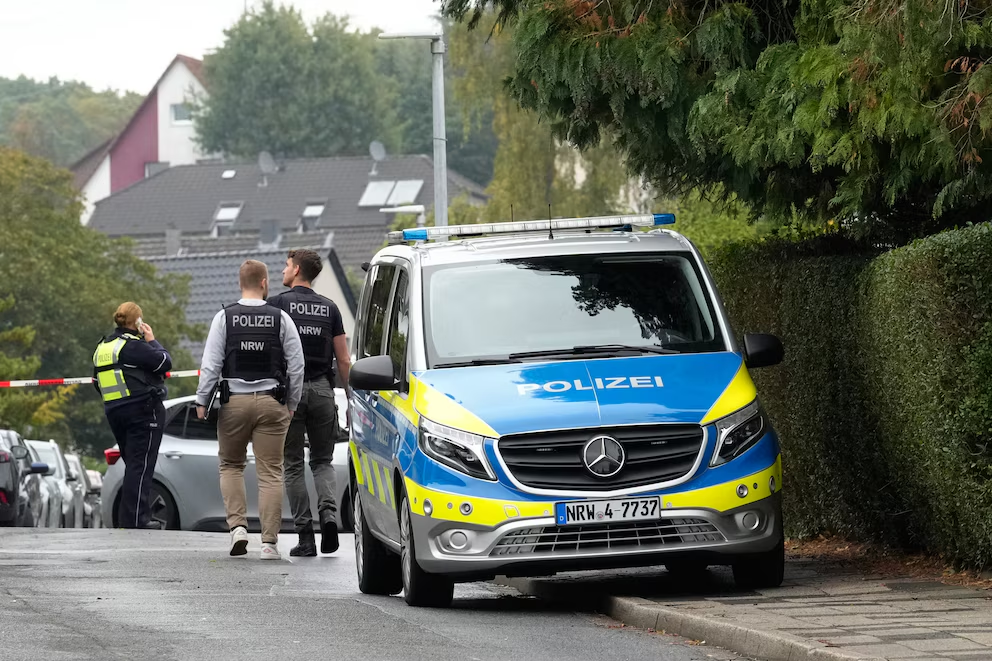
The warning signs were there, but the arrest made the threat impossible to ignore.
Berlin, November 2025. German federal authorities detained a Lebanese national suspected of acting as an operational link for Hamas inside Europe, an arrest that immediately intensified concerns about transnational planning connected to the Middle Eastern conflict. Investigators indicated that the suspect had moved across borders within the Schengen area and had allegedly acquired firearms and ammunition intended for attacks against Jewish or Israeli targets in Germany and potentially elsewhere on the continent. The operation was executed by Germany’s federal police and intelligence services after weeks of surveillance, during which the man was monitored for his interactions with individuals already under investigation for connections to extremist networks.
According to security officials in the Americas, Hamas has increasingly diversified its logistical chains across Europe, exploiting open borders, fragmented intelligence coordination and a rise in extremist discourse across digital platforms. Analysts in Asia add that European services face the dual challenge of confronting traditional clandestine networks and a newer layer of cyber enabled support systems that facilitate financial transfers, weapons procurement and recruitment. In Europe itself, counterterrorism agencies acknowledge that the threat landscape has shifted toward fluid, decentralized cells designed to remain operational even when isolated from leadership structures abroad.
Authorities in Berlin reported that the arrested suspect had transferred firearms to an accomplice who had already been taken into custody earlier in the year. Additional weapons were recovered in coordinated operations in Vienna and London, suggesting the existence of a broader regional apparatus rather than a lone actor. Intelligence units indicated that these seizures may be connected to previous arrests of suspected Hamas operatives in Germany who were accused of preparing attacks and seeking weapons caches across multiple European jurisdictions. The pattern points to a potential logistical network operating in parallel with criminal intermediaries, exploiting gaps in oversight and procurement pathways.
The geopolitical backdrop provides additional weight to the case. Following the escalation of the Hamas conflict in 2023, European countries significantly increased protective measures around Jewish institutions, synagogues and diplomatic sites. Law enforcement agencies have warned that regional instability in the Middle East often reconfigures extremist strategies abroad, turning Europe into a symbolic and strategic extension of conflict zones. Counterterrorism analysts in North America argue that this diffusion is intentional, designed to strain European intelligence capacity and generate political ripple effects. Asian security think tanks note that the integration of digital communication tools allows extremist operatives to coordinate with minimal footprint, complicating traditional surveillance methods.
Within Germany, the implications reach beyond the immediate criminal charges. Prosecutors intend to pursue accusations of membership in a foreign terrorist organization and preparation of violent acts that threaten state security. These charges have historically been difficult to prove in European courts due to evidentiary standards, but investigators say the material seized provides a stronger basis for prosecution. German authorities will now determine whether further arrests are necessary and whether the case warrants broader cooperation with partner states across the continent.

The arrest also resonates deeply within Germany’s Jewish communities, who remain acutely aware of their historical and contemporary vulnerabilities. Community leaders highlighted that the case underscores the persistence of cross border networks capable of mobilizing violence far from their original theaters of conflict. For them, the operation reinforces the importance of preventive intelligence, rapid response mechanisms and international coordination to mitigate risks. Security officials maintain that the threat is not limited to planned attacks but extends to online radicalization, propaganda dissemination and targeted intimidation.
From a strategic perspective, the case reflects how extremist organizations adapt to global surveillance. European analysts emphasize that modern cells no longer depend on centralized hubs; instead, they operate through modular links capable of activating independently. This flexibility complicates counterterrorism operations, particularly when operatives move between jurisdictions with differing legal frameworks. North American observers argue that Europe must deepen intelligence sharing and harmonize legal tools to reduce the gaps these groups exploit. In Asia, security researchers highlight that the increasing sophistication of extremist logistics mirrors broader global trends in hybrid conflict, where non state actors adopt methods traditionally associated with state level espionage.
As the investigation continues, German authorities are expected to present the detainee before a federal judge in Karlsruhe, where decisions regarding provisional detention and formal charges will be made. Officials have not disclosed whether they will pursue asset freezes or international warrants linked to the case, but they acknowledge that further inquiries may extend into financial networks, digital communications and cross border supply routes.
The Berlin arrest marks more than the interruption of a plot. It exposes an ecosystem of transnational coordination that challenges the limits of European security structures. It signals that extremist organizations continue to exploit global movement, legal asymmetries and technological gaps to expand their operational reach. And it reminds Europe that threats shaped abroad do not remain abroad; they travel, adapt and embed themselves in new environments unless met with sustained vigilance and structural preparedness.
Phoenix24: resistance in the global narrative.
Phoenix24: resistencia en la narrativa global.