

 Phoenix 24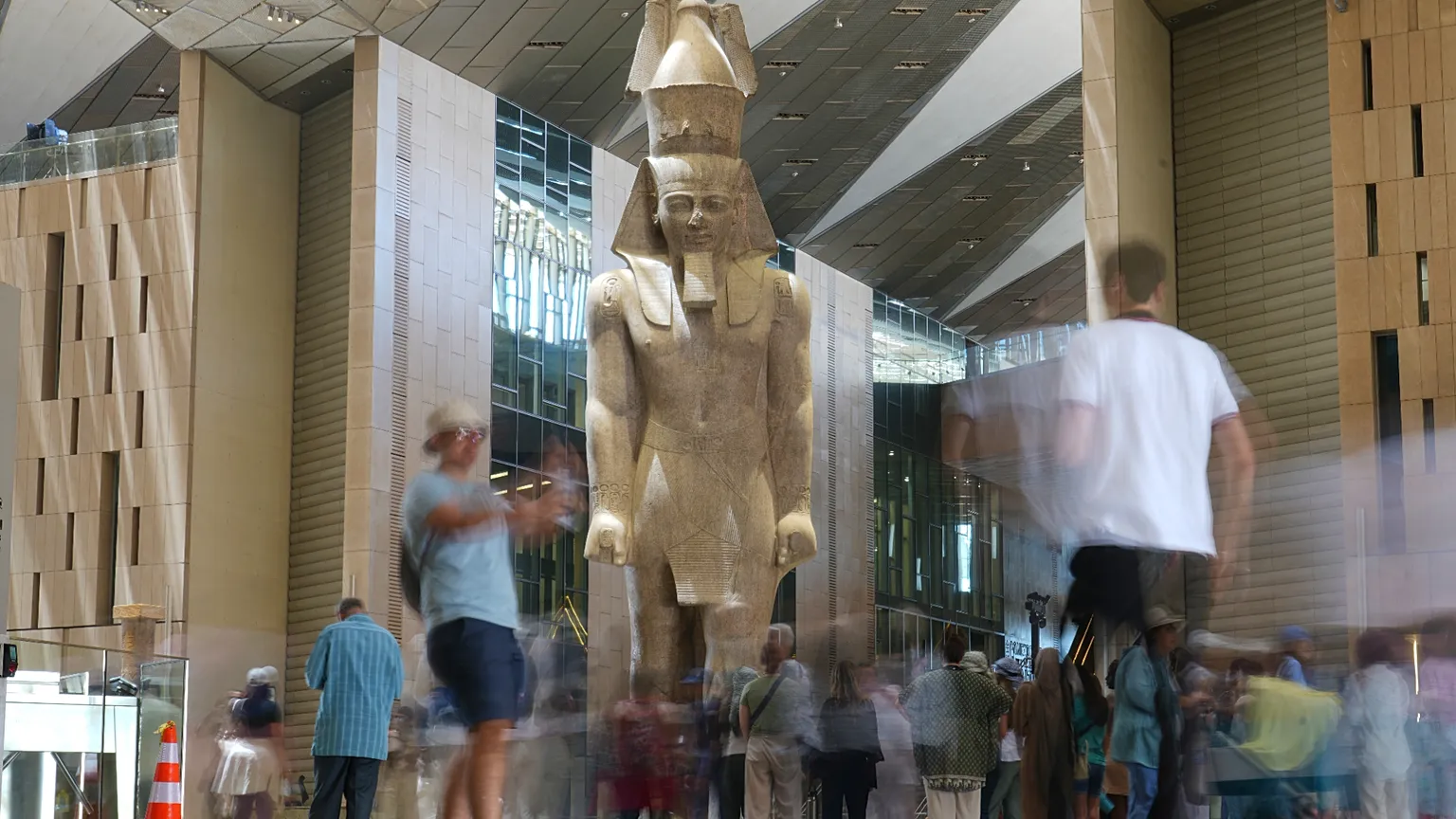
The desert kept the secret for two decades before finally revealing its crown of glass and stone.
Giza, November 2025.
After twenty years of construction, setbacks and political transitions, Egypt has officially inaugurated the Grand Egyptian Museum, the most ambitious cultural project in the modern Middle East. Rising beside the Pyramids of Giza, the vast structure now stands as a bridge between antiquity and the digital age, between archaeology and statecraft.
The museum’s opening was a spectacle of scale and symbolism. Delegations from over forty nations attended a ceremony where the night sky above Cairo glowed with drones forming hieroglyphic patterns. Egypt’s president called it “a new chapter in national pride,” while curators described it as “a resurrection of memory.” The project’s cost, approaching one billion dollars, reflects not only architectural ambition but the country’s broader strategy to reclaim its status as a cultural power at the crossroads of Africa, the Mediterranean and the Arab world.
The Grand Egyptian Museum, or GEM, was conceived in the early 2000s as part of a long-term plan to modernize Egypt’s heritage sector. Designed by a consortium of Irish and Egyptian architects, its translucent façade mirrors the slope of the nearby pyramids, creating an intentional dialogue between ancient geometry and modern engineering. Visitors ascend a monumental stairway lined with colossal statues until they reach the main halls, where more than fifty thousand artifacts are displayed, including the complete collection of Tutankhamun’s treasures for the first time in a single space.
Curators from the Smithsonian Institution in the United States, the British Museum in London and UNESCO’s regional office in Nairobi were among those advising Egypt on conservation and climate-control protocols. Their collaboration illustrates how the protection of cultural heritage has become a form of international diplomacy, linking institutions across continents. For Cairo, the partnership also projects soft power, countering decades of narratives that confined Egyptian history to colonial glass cases abroad.
The museum’s debut was not without controversy. The absence of iconic artifacts such as the bust of Nefertiti, still held in Berlin, and the Dendera Zodiac in Paris reignited disputes over restitution and historical accountability. Egyptian officials reiterated demands for their return, framing cultural restitution as a matter of sovereignty rather than sentiment. Analysts in Washington and Rome noted that the GEM’s opening has amplified global conversations about the ethics of collection and the lingering asymmetry in museum ownership models inherited from the colonial era.
For Egypt’s economy, the museum is expected to become a cornerstone of the tourism sector, projected to draw up to seven million visitors annually. The surrounding development—hotels, a dedicated airport terminal and a new rapid-transit link to central Cairo—forms part of a broader economic corridor intended to boost national revenue and attract foreign investment. Economists at the African Development Bank view the GEM as both cultural infrastructure and macroeconomic instrument: a tool to diversify growth beyond fossil fuels and remittances.
Architecturally, the building itself is a lesson in sustainable design. Its internal lighting relies on adaptive skylights that diffuse desert sunlight, while natural ventilation corridors reduce energy dependence. Japanese engineers contributed seismic protection technology to stabilize the vast structure against potential tremors. From a technical standpoint, the GEM represents a hybrid of ancient inspiration and modern resilience—a metaphor for Egypt’s own path between heritage and modernization.
Within academic circles, the museum’s opening has generated a wave of new research initiatives. Partnerships with universities in Mexico, France and Canada are already mapping digital replicas of artifacts using high-resolution 3D scanning, allowing shared access without physical transport. This aligns with Egypt’s broader goal to transform Giza into a global center for heritage technology, combining archaeology, artificial intelligence and tourism analytics in one ecosystem.
Culturally, the Grand Egyptian Museum has become a statement of identity in a volatile region. For ordinary Egyptians, it symbolizes continuity after years of political turbulence; for global audiences, it renews fascination with the civilization that defined the concept of eternity. The building’s architecture, half pyramid and half prism, captures that paradox: a nation simultaneously looking backward to its roots and forward to its place in the twenty-first century.
In the cool silence of its galleries, where the golden mask of Tutankhamun reflects both candlelight and LED precision, visitors find themselves between worlds—the realm of the dead and the digital, of empire and nation. The desert outside may remain unchanged, but inside the museum, time itself has been curated.
Information that anticipates futures. / Información que anticipa futuros.