

 Phoenix 24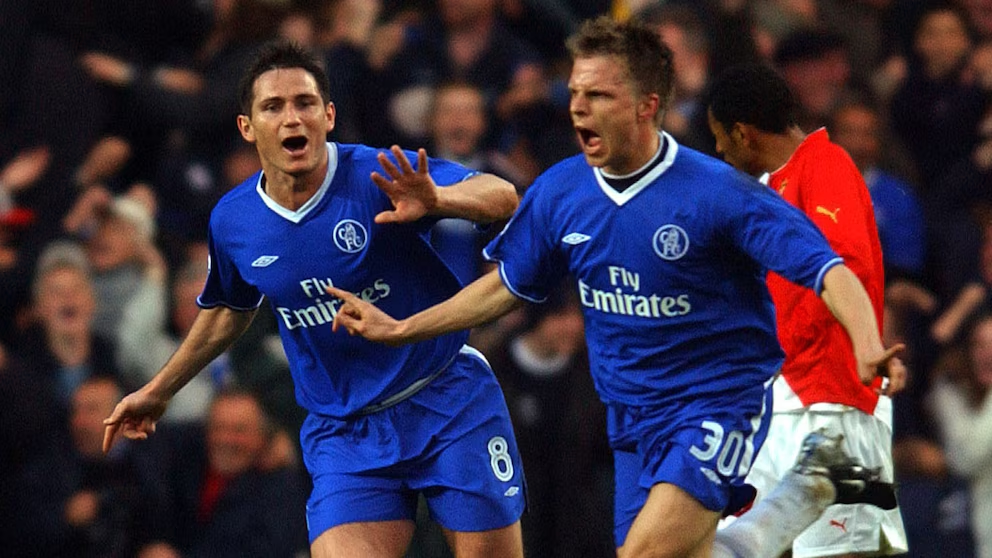
Sometimes redemption does not roar in stadiums — it builds quietly, brick by brick.
London, October 2025.
Once a rising name at Stamford Bridge, celebrated for his precision and calm under pressure, the former Chelsea midfielder now spends his days under open skies, not floodlights. His name, once printed on jerseys, now appears on the side of a small construction firm in southern England. The transformation is not a fall from grace but a conscious escape from a world that nearly broke him.
After years of anxiety and isolation masked by professional success, he walked away from football with no farewell match or press statement. “I didn’t quit football; I saved myself,” he told a local radio station. Behind the simplicity of those words lies the story of a man who faced the silent weight of depression — a struggle that elite athletes rarely voice until long after the applause fades.
The former midfielder recalls that the locker room, once a sanctuary, became a theatre of performance where emotions were considered weakness. “When you stop smiling, they notice. When you admit you’re tired, they replace you,” he said. Doctors diagnosed him with clinical depression shortly after his contract ended. What followed was not a headline but a long silence — one that stretched into months of therapy, medication, and rediscovery.
Today, at thirty-five, he runs a small construction company employing twelve workers, many of them immigrants rebuilding their own lives. “Out here, no one cares who you were — only whether the wall stands straight,” he jokes, his voice steady. What began as temporary labor to “feel useful again” evolved into a new vocation. “I like the rhythm of it. You see what you’ve built at the end of the day. In football, that feeling disappears after ninety minutes.”
Sports psychologists describe his story as emblematic of a broader phenomenon: the search for grounded identity after hyper-visibility. Dr. Amelia Torres, a researcher on athlete mental health at King’s College London, explains that “retirement from elite sport often triggers existential displacement. Without competition, many players lose the scaffolding of self-worth that the system built around them.” The paradox, she notes, is that physical strength and psychological fragility coexist more often than fans imagine.
For years, professional football has treated mental health as a marginal issue. Clubs offer performance analysts and nutritionists, but rarely permanent psychological staff. The Premier League Players’ Association has launched initiatives since 2023 to address this gap, yet stigma persists. “It’s easier to admit you tore a ligament than to say you’re afraid of waking up,” said another former teammate who battled anxiety after retirement.
The man once known for his left-foot precision now finds joy in the precision of measurement — cement ratios, steel reinforcement, the sound of rain on unfinished roofs. “Construction is honest,” he says. “You make mistakes, you fix them. In football, your mistakes live forever on the internet.” His hands, once trained to control passes, now bear calluses that he calls “a different kind of medal.”
Beyond therapy, his recovery was also social. Working alongside people outside the football bubble gave him perspective. “These guys work through pain without complaint. I learned humility all over again,” he reflected. One of his employees, a carpenter from Eastern Europe, describes him as “the calmest boss I’ve had — he listens before speaking.” The reversal of roles — from being coached to leading a team — became, in his words, “the quietest victory of my life.”
In psychological terms, this transformation mirrors what specialists call post-traumatic growth — a phase where individuals find meaning beyond their initial trauma. “He reconstructed both his environment and his identity,” says Dr. Torres. “His story illustrates resilience as a process, not a personality trait.” The athlete’s decision to speak publicly about depression, even years later, challenges the archetype of invulnerability that dominates sports culture.
The contrast between stadium and scaffolding also reveals something deeper about contemporary masculinity. “Men are allowed to win, not to heal,” he remarked during a mental-health seminar for young athletes in Brighton. His presence — dressed in work clothes, speaking softly to teenagers — carried more weight than any victory speech. “They looked at me and realized that success isn’t the same as happiness,” he said later.
When asked if he misses football, his answer comes without hesitation: “No. I miss the sound of the ball, not the noise around it.” He still watches Chelsea occasionally, not with nostalgia but gratitude. “It taught me discipline, and that discipline now keeps me alive.”
As dusk settles over the construction site, he removes his gloves, hands coated with dust, eyes lifted toward a half-built structure against the London skyline. “This,” he says, “feels like progress.” In a world addicted to comebacks, his story offers something rarer — closure without defeat.
Phoenix24: analysis that transcends power. / Phoenix24: análisis que trasciende al poder.