

 Phoenix 24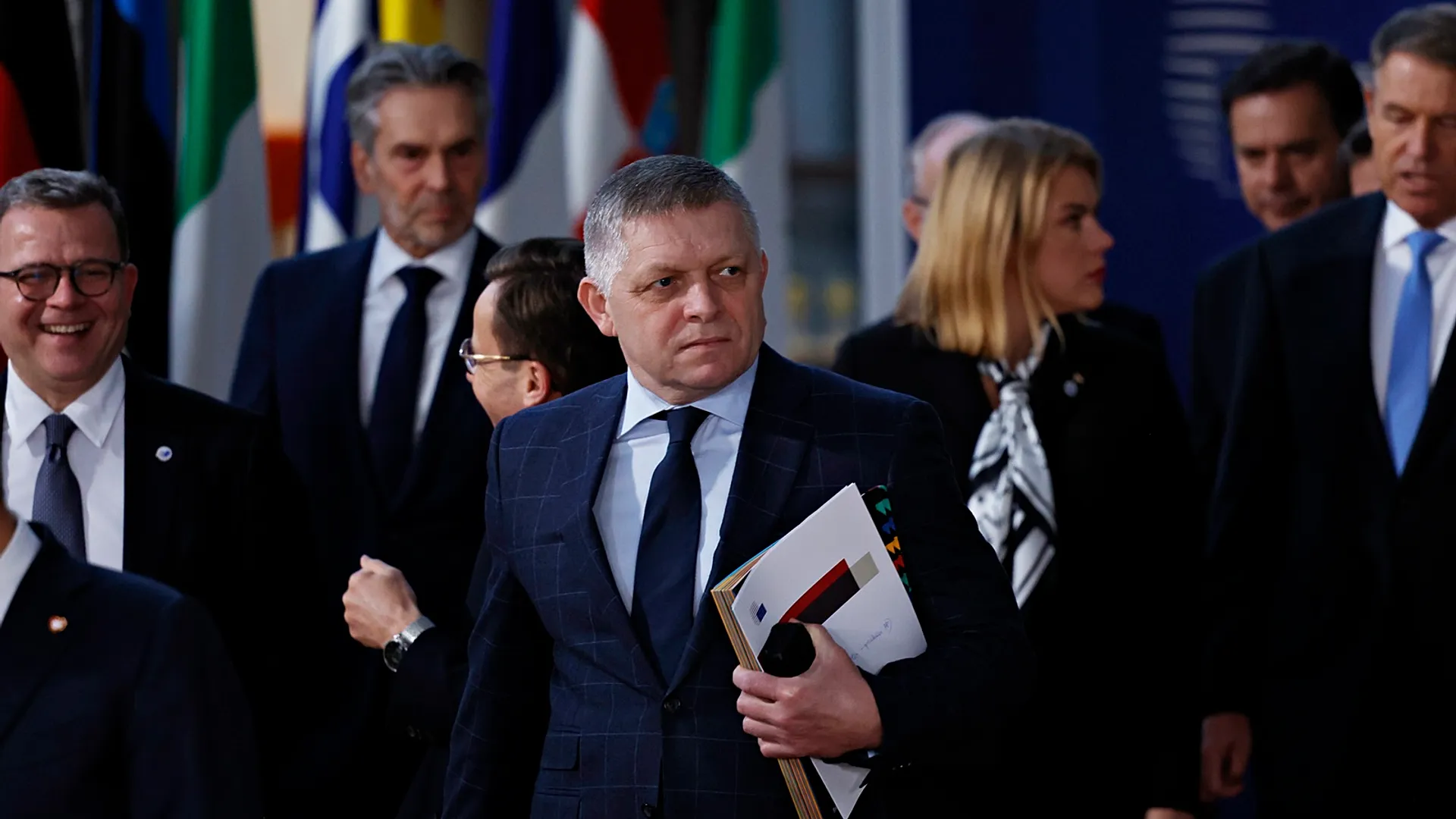
In Europe’s political machinery, a single veto can paralyze an entire continent.
Brussels, October 2025.
The European Union is confronting an internal impasse that exposes its deepest fault lines. Slovak Prime Minister Robert Fico has maintained his opposition to the bloc’s nineteenth sanctions package against Russia, demanding economic concessions in return. What appears as a bureaucratic standoff hides a far more complex reality: the collision between European unity, national survival instincts, and the limits of consensus in wartime Europe.
EU officials close to the European Commission confirm that the sanctions package—targeting Russian liquefied natural gas, oil intermediaries, cryptocurrency flows, and diplomatic access—remains blocked by Bratislava. Fico has insisted that his approval depends on two conditions: tangible relief for the European automotive industry and a plan to mitigate rising energy costs across the bloc. His message, wrapped in populist pragmatism, resonates among central European states where industrial competitiveness and energy security outweigh ideological alignment with Brussels.
Commission President Ursula von der Leyen has sought to contain the fracture. In a letter circulated to all 27 member states, she promised to accelerate revisions to the Green Deal, introduce proposals to reduce household energy bills, and revisit emission targets affecting vehicle production. Behind the diplomatic tone lies a recognition that Fico’s veto threatens to unravel the EU’s fragile cohesion at a critical moment in its standoff with Moscow.
Analysts at the Center for European Policy Studies (CEPS) describe the situation as “a test of institutional endurance,” underscoring how unanimity—a founding principle of EU decision-making—can become its own Achilles heel. The Financial Times notes that each delay in sanction approval grants Russia additional room to stabilize its wartime economy and redirect trade routes through neutral intermediaries in the Caucasus. From Washington, the Peterson Institute for International Economics interprets Bratislava’s strategy as part of a broader shift among smaller EU states seeking economic guarantees in exchange for political alignment.
Energy policy is at the heart of the dispute. Slovakia, heavily reliant on Russian gas and integrated within the German-led car-manufacturing chain, faces domestic pressure from industrial unions and pro-business factions within Fico’s coalition. According to a recent analysis by the Lowy Institute in Sydney, this kind of transactional nationalism reflects a growing fatigue in Europe’s periphery—countries willing to remain in the EU but less inclined to sacrifice short-term economic growth for geopolitical solidarity.
Diplomats in Brussels admit privately that Fico’s stance has inspired subtle emulation in other capitals. Hungary has expressed “understanding” for Slovakia’s position, while Italy and Austria are advocating for a “balanced energy framework” before endorsing additional sanctions. The political contagion could delay not only punitive measures against Russia but also key negotiations on energy diversification and defense integration.
The next European Council meeting will therefore serve as a barometer of unity. Early drafts of the summit’s conclusions already include language acknowledging “technological neutrality” in vehicle manufacturing and the “negative impact of energy volatility on competitiveness”—both clear concessions to Slovak demands. If approved, these phrases could mark the quiet institutionalization of Fico’s leverage within EU policy.
From a geopolitical perspective, the episode underscores a broader tension in Western alliances: the erosion of collective resolve under economic strain. While France and Germany push for firmness, countries like Slovakia exploit the very design of the Union to secure bilateral gains. What began as an ideological divide over Russia’s war has morphed into a structural stress test for the European project itself.
For Brussels, the challenge is no longer only to isolate Moscow but to prevent fragmentation within its own ranks. Whether Fico ultimately yields to diplomatic incentives or holds the line will determine not just the fate of a sanctions package, but the credibility of the EU’s claim to act as a unified geopolitical actor.
Facts that do not bend. / Hechos que no se doblan.