

 Phoenix 24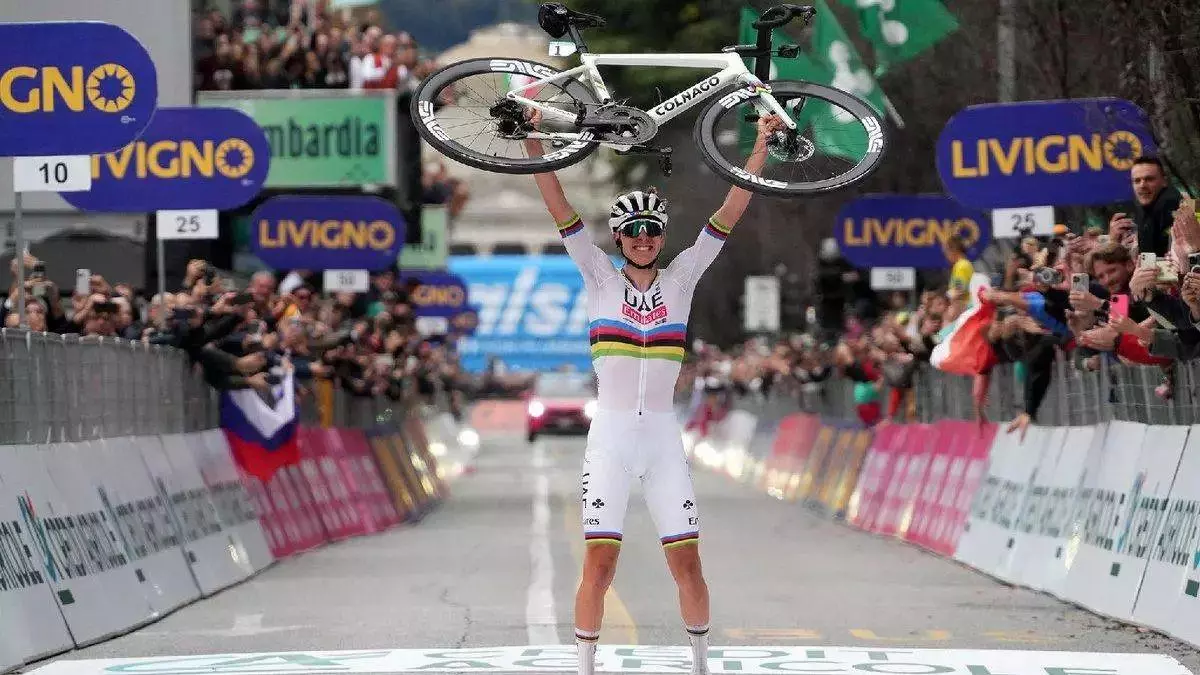
A duel across eras and inclines.
Bergamo–Como, October 2025
The 2025 Giro di Lombardia will offer Slovenian rider Tadej Pogačar a chance to touch cycling immortality: a fifth consecutive victory that would equal the record of Italian icon Fausto Coppi, whose five wins between 1946 and 1949 remain one of the sport’s most enduring milestones. Since 2021, Pogačar has owned the “Race of the Falling Leaves,” transforming what was once an unpredictable autumn classic into his personal domain.
The 119th edition covers nearly 240 kilometres from Bergamo to Como, winding through the traditional ascents of the Passo di Ganda and Madonna del Ghisallo. With roughly 4 400 metres of elevation gain, it is a course made for climbers who combine endurance, tactical nerve, and the rare instinct to strike alone. For Pogačar, it is familiar ground: in each of his previous four victories, he has attacked in the final third of the race, turning the rolling Lombard terrain into a theatre of solitude. His 2024 triumph, when he broke free on the Colma di Sormano and crossed the line three minutes ahead of his nearest rival, confirmed his dominance and placed him within one win of Coppi’s sacred number.
Coppi, Il Campionissimo, defined post-war cycling with a blend of elegance and ferocity. His record in Lombardy was long considered untouchable, a symbol of Italy’s golden generation when cyclists were national heroes and races carried the weight of renewal after conflict. Today, in a globalized peloton governed by data analytics and aerodynamics, Pogačar’s streak evokes a different kind of mastery—one forged not only through raw talent but through precise science, relentless consistency, and mental clarity.
The parallels between both eras invite reflection. Coppi raced with instinct, often attacking from 80 kilometres out, driven by audacity and myth. Pogačar, though equally aggressive, builds his supremacy on calculated timing, energy distribution, and a capacity to sustain high wattage on brutal gradients. In both cases, domination stems from a kind of solitude—Coppi against his rivals, Pogačar against the algorithms.
Team UAE Emirates has framed the 2025 edition as a campaign of legacy rather than necessity. Sports director Joxean Matxin admits that pressure has shifted from performance to history. “Tadej is racing against a ghost,” he said. “He already changed how we think about preparation; now he’s chasing something that may never happen again.” Pogačar, for his part, has downplayed the symbolism, insisting that “every race starts from zero” and that fatigue after a long season can level even the greatest riders.
Weather forecasts predict cool temperatures and intermittent rain, conditions that tend to stretch the field and favour those with precise handling on descents. Rivals like Remco Evenepoel and Jonas Vingegaard are expected to test Pogačar’s control early, seeking to force tactical errors. Yet, as the cycling world has learned, the Slovenian rarely falters once the gradient tilts in his favour. His ability to shift from patient drafting to explosive attacks remains unmatched among current contenders.
Should he succeed, the impact would reach beyond statistics. Matching Coppi’s record would fuse modern athleticism with historical resonance—a symbolic bridge between an analogue past and a digital present. It would also cement Lombardy as the race that best captures Pogačar’s dual identity: analytical and instinctive, youthful yet steeped in cycling’s oldest virtues.
Italian fans already view the contest as a generational ritual. Along the route, banners bearing Coppi’s black-and-white portrait will stand beside those in the pink and blue of Pogačar’s team, merging nostalgia with expectation. In a sport where time and memory intertwine, the idea of a living rider equalling Coppi has stirred emotions rarely seen since the days of Marco Pantani.
The Giro di Lombardia has always been a race of endings—the close of the season, the fall of the leaves, the final test of endurance. Yet for Pogačar, it represents continuity: a cycle that renews itself each autumn, linking one victory to the next. If he crosses the line first again in Como, he will not only join Coppi in the record books but also confirm that the old myths of cycling still breathe within modern performance.
Analysis that transcends power. / Análisis que trasciende al poder.