

 Phoenix 24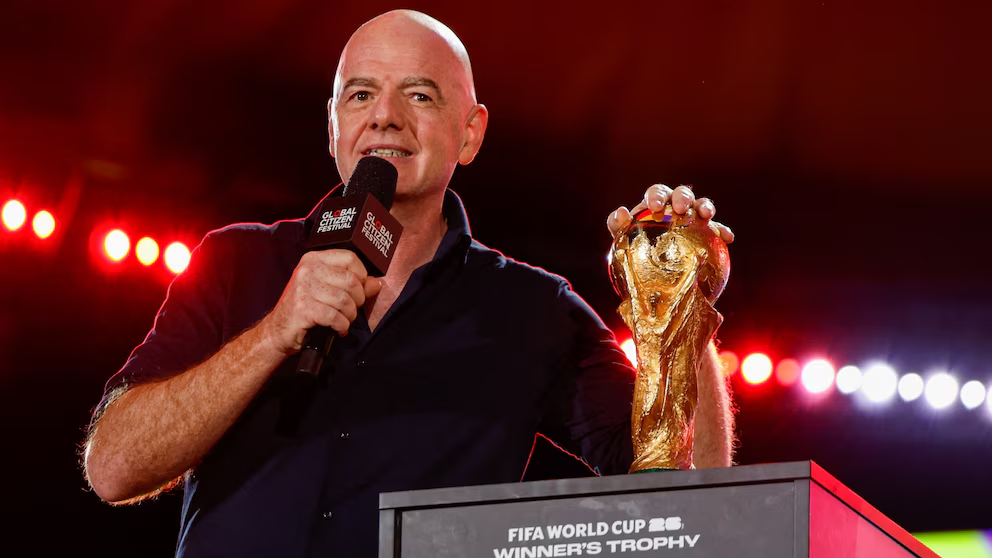
A silent revolution in football’s sacred timing.
Zurich, October 2025
FIFA is quietly preparing the most consequential change in the history of the World Cup since its creation in 1930: moving the tournament out of the traditional northern-hemisphere summer window. The debate, once unthinkable, has become central within the organisation as mounting climatic pressures, congested schedules, and geopolitical realities force world football’s governing body to rethink the rhythm of the global game.
President Gianni Infantino, speaking to members of the FIFA Council in Zurich, described the existing June-July model as “increasingly unworkable.” Behind the diplomatic phrasing lies a pragmatic recognition: the summer heat in many candidate nations is reaching dangerous levels, while the global football calendar has grown unsustainably dense. After the 2022 Qatar World Cup, which was shifted to November-December to avoid extreme temperatures, the precedent was set. What was an exception may now become the rule.
The proposal under discussion envisions a rotation system in which future tournaments could be staged in the months of March, October, or even early December, depending on regional climate conditions. Supporters argue that flexibility would expand the pool of viable host nations and ensure safer working environments for players, referees, and fans. Opponents warn that such disruption would rewrite decades of sporting tradition and collide with established domestic-league calendars.
In the corridors of European federations, the response has been divided. Northern associations, tied to long-standing summer traditions and television contracts, fear economic and logistical chaos. Meanwhile, federations from Africa, the Middle East, and Asia quietly support the initiative, viewing it as a recognition of geographical reality. For them, the old calendar privileges temperate European summers while ignoring the climatic diversity of the rest of the planet.
At the heart of the debate is the same dilemma that haunts global sport: how to balance commercial imperatives with the well-being of players. Player unions have long warned that the modern schedule is unsustainable. Between domestic leagues, continental competitions, international qualifiers, and now the expanded Club World Cup, elite footballers operate with minimal rest periods. Sports-science data reviewed by FIFA’s medical committee shows fatigue-related injuries rising by nearly 20 percent since 2018. The governing body knows that any further strain could ignite legal and ethical backlash.
The economic dimension, however, remains decisive. The World Cup generates nearly half of FIFA’s total revenue, and moving it to a different season could affect broadcasting rights worth billions of dollars. Yet internal analyses suggest that viewership peaks could be preserved or even enhanced if the event is repositioned into a less crowded media window. Executives within major networks privately admit that summer competition from other sports—particularly in North America—has fragmented attention. An autumn World Cup, they say, could actually improve global engagement.
Climate scientists advising FIFA have presented stark findings. Average summer temperatures in key regions targeted for future tournaments, including North Africa and the Arabian Peninsula, are projected to exceed 45 degrees Celsius by 2034. In such conditions, the physical integrity of athletes cannot be guaranteed. The governing body’s environmental task force has therefore recommended “seasonal diversification” as a preventive measure rather than a symbolic gesture.
Within the organisation, debate is intense. Traditionalists warn that altering the tournament’s temporal identity could alienate fans for whom the World Cup has always meant the long days of summer. Reformists counter that nostalgia cannot outweigh sustainability. Some insiders recall that similar resistance met the expansion to 48 teams, a decision now broadly accepted as inevitable.
Outside FIFA’s walls, the reaction has been predictable. European clubs, through the European Club Association, insist that any further reshaping of the calendar must come with compensation and guarantees over player release periods. Broadcasters demand years of notice to adjust programming. Sponsors, ever pragmatic, express openness as long as global reach remains intact. What unites all parties is the awareness that change is coming, whether by decision or by necessity.
The symbolic implications go beyond scheduling. Moving the World Cup out of summer would mark the definitive end of an era when football dictated its own seasons without regard for the planet’s changing climate. It would acknowledge that sport, like everything else, is now subject to environmental limits. For the first time, meteorology, economics, and ethics converge around a single question: when should the world’s game be played?
Infantino, ever the political operator, has framed the issue as one of adaptation rather than revolution. “We are not changing football,” he told delegates, “we are ensuring that football can continue.” Whether that assurance will satisfy Europe’s football establishment remains to be seen. But behind the scenes, the conversation has already shifted from ifto when.
In the coming months, a technical working group will deliver proposals outlining alternative timelines through 2040. Whatever the outcome, one fact is certain: the World Cup’s calendar is no longer sacred. The tournament that once symbolized the rhythm of summer may soon become the world’s autumn ritual.
Truth is structure, not noise. / La verdad es estructura, no ruido.