

 Phoenix 24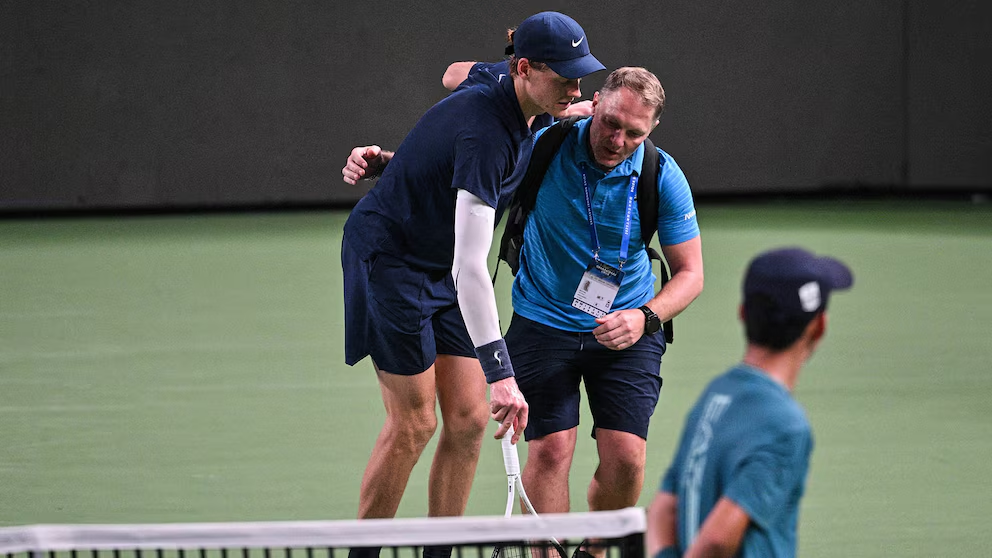
A moment of vulnerability on one of the sport’s biggest stages shows that even the brightest stars can be brought down not by their rivals, but by their own limits.
Shanghai, October 2025
The silence that descended on the Qi Zhong Tennis Center was almost surreal. Jannik Sinner, one of the most consistent and explosive players of his generation, had just signaled that he could no longer continue. His body, pushed beyond its threshold in a demanding third-set battle, had betrayed him. Leaning heavily on his racket for support and assisted by medical personnel, the Italian star abandoned his match and his Shanghai Masters title defense, leaving behind an image that has already become one of the most haunting of the season.
At just twenty-two, Sinner has carved out a reputation as a relentless competitor, a player whose baseline aggression and tactical maturity have made him a fixture in the upper echelon of the ATP rankings. Yet this match against Tallon Griekspoor was different. What began as a tightly contested encounter, with Sinner’s trademark precision from the back of the court and blistering first serves, gradually turned into a struggle against his own physical condition. As the minutes passed, subtle signs of discomfort became impossible to ignore: shortened points, slower recovery between rallies, repeated gestures toward his right leg.
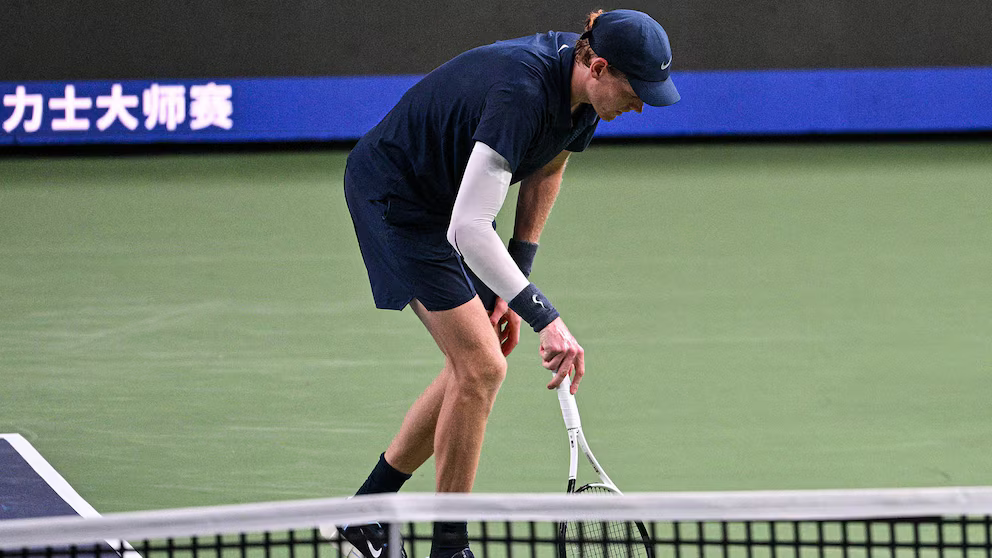
By the time the match reached the deciding set, Sinner was no longer fighting his opponent — he was fighting his own body. Down 2–3, his footwork faltered and his strokes lost depth. During a changeover, he was seen wincing in visible pain, and moments later he walked toward the umpire’s chair, signaling his withdrawal. The image of him limping toward the exit, using his racket like a walking stick, has already resonated across the tennis world.
This was not just another defeat. It was a blow with real consequences. Sinner had entered Shanghai as the defending champion, holding nearly one thousand ranking points from his 2024 triumph. His inability to defend them will narrow the margin separating him from the world number one, Carlos Alcaraz, who has consolidated his lead with remarkable consistency. More significantly, the loss to Griekspoor — a player Sinner had previously dominated — suggests that physical limitations may become a more significant obstacle than any tactical challenge on court.
The incident raises broader questions about the punishing demands of the modern tennis calendar. Players today face grueling schedules that stretch from January to November, with minimal recovery time between tournaments. The result is a relentless cycle of travel, training, and competition that tests not only physical endurance but also psychological resilience. For younger athletes like Sinner, the challenge is even more complex: balancing rapid career growth with the long-term maintenance of their bodies.
Sports scientists and trainers have long warned that the intensity of modern tennis — with its emphasis on explosive baseline rallies, extended points, and quick surface transitions — places enormous stress on joints and muscles. Injuries are no longer isolated events but cumulative risks that build over time. Sinner’s situation reflects that reality. It is not a question of whether a player will break down, but when, and how they respond to that inevitable moment.
From a psychological perspective, the decision to retire mid-match is one of the most difficult an athlete can make. Competitors at Sinner’s level are conditioned to push through pain and adversity. Yet knowing when to stop — to preserve one’s future rather than jeopardize it for a single match — is a mark of maturity that separates those who endure from those who burn out. In that sense, Sinner’s choice was as strategic as it was painful.
For his team, the path forward will involve more than just medical evaluations. They will need to reassess training loads, adjust recovery periods, and possibly rethink tournament scheduling. It is a delicate balance: stepping back long enough to allow the body to heal, while maintaining the momentum that has fueled Sinner’s ascent. Done correctly, this setback could serve as a turning point that extends his career. Done poorly, it could become a recurring obstacle that defines it.
Beyond the numbers, the rankings, and the headlines, what happened in Shanghai carries a deeper resonance. It is a reminder that elite sport is not just about strength, talent, or willpower. It is also about vulnerability — about the moments when the body says “no” even as the mind insists on continuing. The sight of Jannik Sinner leaving the court in visible pain is one of those moments, and it will linger not because of what it cost him in points or trophies, but because it showed the world just how human greatness really is.
Against propaganda, memory. / Contra la propaganda, memoria.