

 Phoenix 24
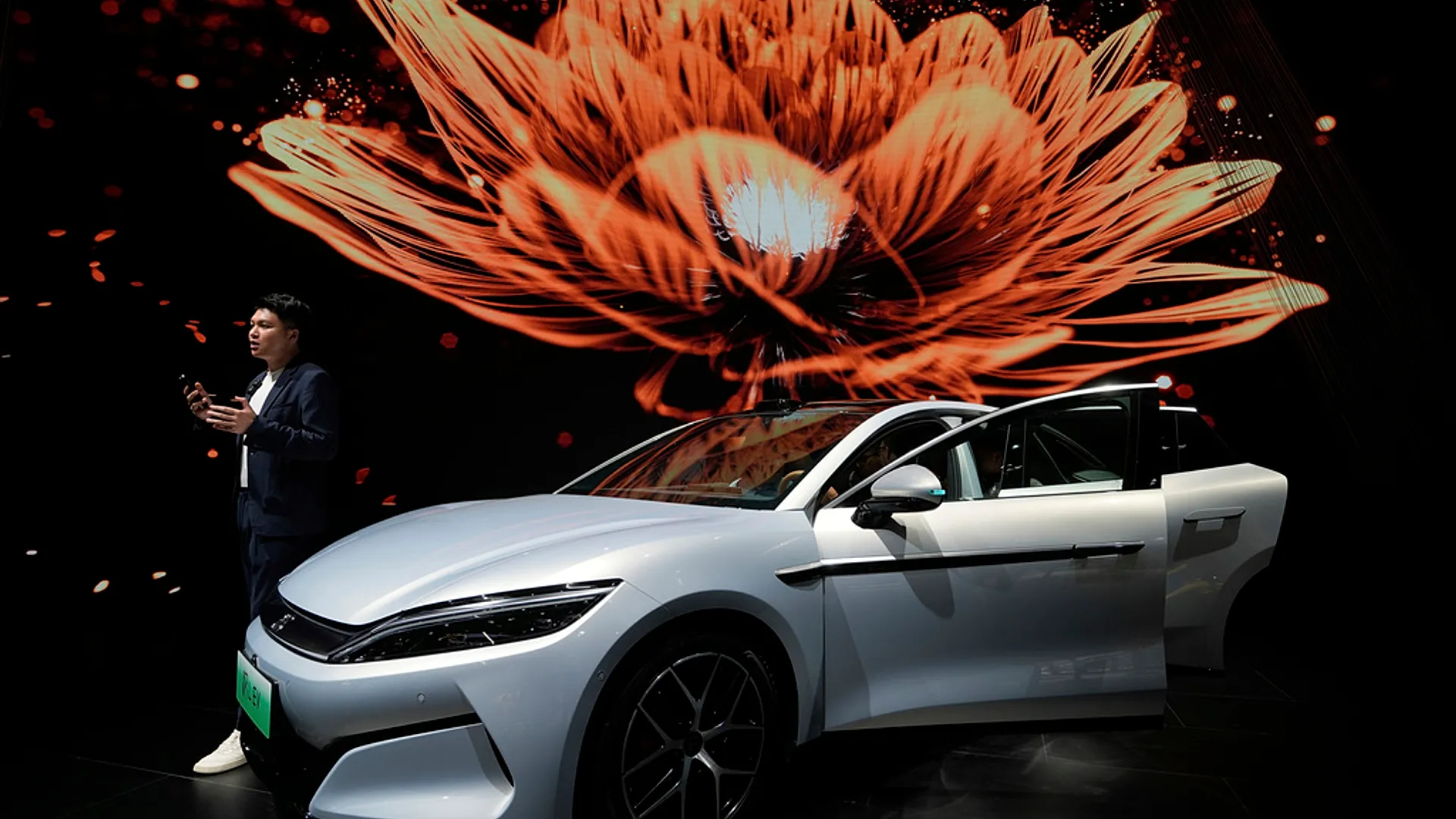
A pivotal shift in Europe’s EV battleground.
Madrid, September 2025
Tesla’s presence in the European electric vehicle market is eroding at a dramatic pace, while Chinese automaker BYD accelerates its rise. In July, Tesla’s sales across Europe dropped by nearly forty percent, falling below nine thousand units. BYD, in sharp contrast, more than tripled its deliveries in the same month. The divergence is not only a matter of numbers; it reflects deeper structural changes in the continent’s automotive landscape, where new players are reshaping consumer preferences and regulatory alignment.
Figures compiled by European industry bodies show Tesla’s registrations plunging by more than forty percent compared with the same period last year. It marks the continuation of a downward trend across multiple markets. BYD, meanwhile, registered growth above two hundred percent, reaching approximately eighty-four thousand units sold in the first seven months of the year. The contrast illustrates how the European EV market, which as a whole grew by more than a quarter, is being redistributed among emerging competitors.
The national breakdown offers even starker contrasts. In the United Kingdom, Tesla’s deliveries in July were almost halved, with cumulative year-to-date numbers also falling steeply. Norway remains one of the few bright spots, with a modest increase in Tesla registrations, but in Sweden the company collapsed by more than eighty percent. Denmark and France also saw sharp double-digit declines, further underscoring the fragility of Tesla’s European foothold.
BYD’s advance, on the other hand, is underpinned by several converging dynamics. The Chinese company and its peers have brought to market a broader range of vehicles, including hybrids, that appeal to cost-sensitive European consumers while still complying with evolving environmental standards. Tesla has not launched a genuinely new mass-market model since 2020, beyond minor updates to the Model Y. That lack of product diversification leaves it vulnerable in an increasingly competitive field where variety and affordability matter as much as brand reputation.
Perception is also shaping outcomes. Elon Musk’s polarizing political profile has alienated segments of European consumers, where association with far-right positions undermines the aspirational aura once tied to Tesla. At the same time, used Tesla values have collapsed in several countries, with the Model Y losing over forty percent of its value in the United Kingdom. While this fuels a secondary market boom, it signals waning confidence in long-term brand stability. BYD, by contrast, benefits from a perception of reliability and accessibility, positioning itself as a practical alternative rather than a luxury statement.
Beyond market metrics, the geopolitical echo of this rivalry is significant. In Brussels, trade analysts see Tesla’s retreat as an opportunity for the European Union to recalibrate its industrial strategy, potentially encouraging both domestic champions and Chinese entrants to fill the vacuum. In Asia, BYD’s leap forward demonstrates China’s ability to project industrial power into mature Western markets. Observers in Latin America and the Middle East are also taking note, reassessing how global supply chains might realign if Chinese producers consolidate their dominance over European demand.
The broader financial community is also recalibrating. Investment banks and risk consultancies warn that Tesla’s European weakness could spill into global valuations, especially if compounded by monetary tightening in the United States. The Federal Reserve’s restrictive stance on inflation control means that Tesla cannot count on cheap credit to offset sales slumps abroad. Legal and regulatory uncertainty adds another layer, with European governments weighing tariffs and anti-subsidy measures targeting Chinese automakers. This creates a paradox where Tesla may be squeezed simultaneously by competition from China and by regulatory pushback against Chinese imports, leaving little room to maneuver.
Tesla’s own strategic rigidity deepens the challenge. Analysts caution that unless the company broadens its product portfolio, realigns its pricing strategies, and repairs its damaged brand image, it risks further erosion of relevance in Europe. The company that once symbolized the electric revolution is now portrayed in some circles as lagging behind the very market transformation it helped to ignite.
In sum, what is unfolding is more than a contest between two carmakers. It is a structural realignment of the global electric vehicle race. For BYD, this is a moment of decisive ascendancy, a proof of concept that a Chinese brand can dominate in the heart of Europe. For Tesla, it represents a crossroads, one that demands either adaptation to new realities or acceptance of gradual decline. Europe’s electric future may well be written without Musk’s signature, as consumer choice, industrial policy, and geopolitical competition converge to redraw the map of global mobility.
Truth is structure, not noise.
La verdad es estructura, no ruido.