

 Phoenix 24
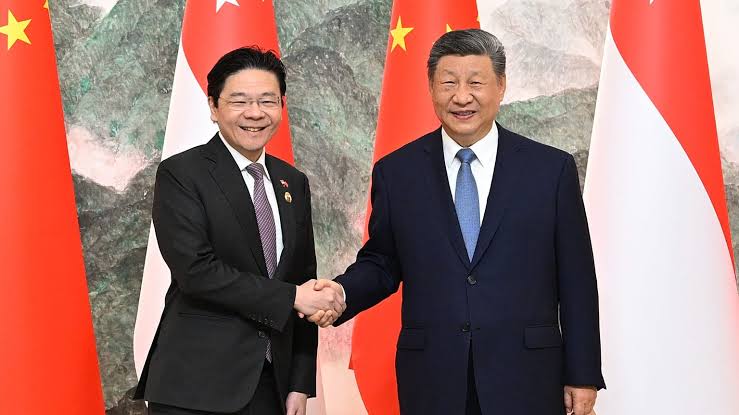
Asia’s financial integration reveals a changing monetary balance.
SINGAPORE — November 2026
China and Singapore have agreed to expand access to financing denominated in the Chinese yuan, advancing Beijing’s long-term ambition to increase the international use of its currency and reduce dependence on the United States dollar. Announced during high-level bilateral meetings on November 23, the agreement introduces new financial mechanisms intended to facilitate trade, corporate investment and cross-border payments. Although the initiative represents a meaningful development in Asian financial integration, its immediate significance lies in expanding monetary options rather than displacing the dollar from the global financial system.
The measures were presented during the 22nd meeting of the China-Singapore Joint Council for Bilateral Cooperation, co-chaired by Singapore’s Deputy Prime Minister Gan Kim Yong and Chinese Vice Premier Ding Xuexiang. The gathering produced 29 agreements and cooperation initiatives covering finance, technology, trade, healthcare and other strategic sectors. Within this broader framework, monetary cooperation emerged as an important component of the relationship between Asia’s largest economy and one of its leading international financial centers.
The central element involves restructuring an existing renminbi financing arrangement supported by a bilateral currency swap agreement between the Monetary Authority of Singapore and the People’s Bank of China. Rather than establishing an entirely new monetary system, the authorities will divide the current arrangement into two facilities designed to address different financial requirements. The initiative expands the permissible uses of yuan financing and the range of assets that financial institutions can provide as collateral, without announcing an increase in the total funding available.
The first mechanism, the RMB Corporate Facility, will allow eligible financial institutions to obtain yuan funding for a wider range of commercial activities. These include international trade involving third countries, working capital, capital expenditure and financing between related companies. Funding will be available for periods of one, three or six months, providing businesses with additional flexibility when managing short-term financial requirements.
The inclusion of trade with third countries is particularly important. Previously, the internationalization of the yuan was concentrated largely on transactions directly involving China, where commercial relationships naturally created demand for the currency. Allowing Singapore-based financial institutions to support broader regional operations could encourage companies to consider yuan-denominated financing even when their commercial activities extend beyond bilateral trade.
The second mechanism, the RMB Liquidity Facility, will continue providing financial institutions with access to yuan funding when additional liquidity is required. Its purpose is to support the stability of Singapore’s offshore renminbi market, where financial institutions conduct transactions in Chinese currency outside mainland China. Both facilities will accept Singapore government securities and Monetary Authority of Singapore bills as collateral, in addition to Singapore dollar cash.
Authorities are also examining whether Chinese government bonds could eventually be accepted as eligible collateral. That possibility remains under discussion rather than constituting an approved operational measure. If implemented, broader collateral eligibility could make it easier for financial institutions to obtain funding without relying exclusively on cash reserves.
The agreement extends into digital financial infrastructure. Both central banks are exploring a connection between their fast-payment systems, potentially allowing smaller cross-border transfers to move more efficiently between the two countries. The proposal could reduce transactional friction for businesses and individuals, although technical integration, regulatory approval and operational arrangements remain necessary before such a system can be introduced.
Capital market cooperation represents another strategic dimension. Singapore and China intend to support companies seeking stock market listings and financing opportunities in each other’s jurisdictions, while promoting additional exchange-traded funds and financial indices. Singapore’s DBS Bank has also begun providing yuan clearing services, strengthening the infrastructure available to companies conducting transactions in the Chinese currency.
These developments reflect an increasingly deliberate attempt to build financial networks around regional trade relationships. Singapore occupies a distinctive position because it combines an internationally connected banking system, established regulatory institutions and extensive commercial links across Southeast Asia. For China, cooperation with Singapore offers an opportunity to expand the practical use of its currency through an established financial center without immediately requiring comprehensive liberalization of domestic capital movements.
Beijing’s motivations are both economic and geopolitical. The extensive use of the dollar in international transactions creates exposure to exchange-rate fluctuations, dollar-denominated funding conditions and financial restrictions associated with United States policy. Increasing yuan settlement and financing can reduce certain vulnerabilities, particularly for Chinese enterprises and trading partners that already maintain substantial commercial relationships.
However, reducing dependence on the dollar is not equivalent to replacing it as the world’s principal reserve currency. International monetary influence depends on more than the volume of trade conducted in a particular currency. Investors and central banks also evaluate market liquidity, capital mobility, legal protections, exchange-rate flexibility and the availability of financial assets that can be traded efficiently during periods of uncertainty.
Research published by the Reserve Bank of Australia in August 2026 illustrates this distinction. The proportion of China’s trade settled in yuan has increased from less than 20% in 2021 to approximately 35%, demonstrating meaningful progress in the currency’s international use. Yet the yuan accounts for less than 2% of global official foreign exchange reserves, substantially below the shares held in dollars and euros.
The discrepancy reveals a structural limitation. A currency can become increasingly attractive for settling trade without achieving comparable acceptance as an international store of value. China’s restrictions on cross-border capital movements, together with the comparatively limited depth of its financial markets, continue to constrain broader international adoption.
China’s financial authorities therefore face a difficult policy balance. Greater internationalization generally requires foreign investors to possess confidence that assets can be acquired, transferred and liquidated under predictable conditions. At the same time, Chinese policymakers have traditionally maintained considerable control over capital flows to protect domestic financial stability and manage currency volatility.
The expansion of offshore yuan markets offers a partial response to that dilemma. Financial centers such as Hong Kong and Singapore provide international institutions with additional channels for accessing Chinese currency while allowing Beijing to maintain important restrictions within its domestic financial system. Nevertheless, offshore liquidity arrangements cannot fully substitute for the market openness and institutional confidence associated with established reserve currencies.
For multinational corporations operating across Asia, the new facilities could create practical financial advantages. Companies purchasing Chinese equipment, financing manufacturing investments or managing regional subsidiaries may find it beneficial to borrow in yuan when their revenue and expenditure patterns justify doing so. Such decisions will depend on borrowing costs, currency exposure and the availability of instruments to manage exchange-rate risk rather than political preferences alone.
The agreement also complements wider economic cooperation between Singapore and China. Both governments are considering initiatives linking Singapore with Tianjin Eco-City and Xiong’an New Area, while discussions continue over improvements to their bilateral free trade arrangements. Together, these initiatives connect monetary policy with investment, infrastructure development and the geographical organization of regional production networks.
The broader consequences for international trade may emerge gradually. If firms increasingly obtain financing, settle invoices and manage treasury operations in yuan, regional banking institutions could develop deeper markets for Chinese-currency assets. However, whether that process produces a meaningful shift in the international monetary hierarchy will depend on sustained commercial demand and broader structural reforms.
For the United States, the development signals continuing efforts by trading partners to diversify their financial arrangements. It does not demonstrate that the dollar’s international dominance is approaching an imminent collapse. The American currency retains substantial advantages through the depth of United States Treasury markets, extensive global financial networks and its established role in international borrowing, payments and central bank reserves.
China and Singapore are consequently pursuing an incremental transformation rather than announcing a new global monetary order. Their agreement expands the infrastructure necessary for companies to conduct selected financial activities in yuan, potentially strengthening the currency’s regional importance over time.
The decisive question is whether these arrangements can generate sufficient demand, liquidity and institutional confidence to make the yuan more attractive beyond transactions involving China. The answer will depend less on political declarations about replacing the dollar than on the practical decisions of banks, businesses, investors and monetary authorities.
In an increasingly fragmented geopolitical environment, the future of international finance may involve greater currency diversification without the immediate disappearance of established monetary hierarchies. The China-Singapore agreement illustrates how that transformation could develop through gradual changes in financing practices, payment infrastructure and cross-border investment.
Beyond the Numbers, the Consequences.