

 Phoenix 24
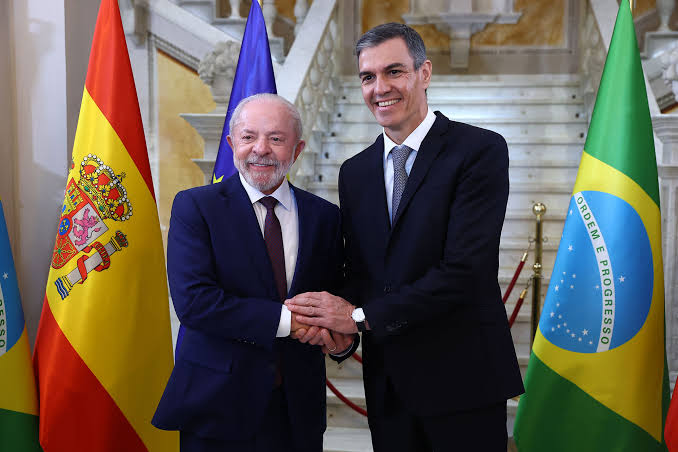
Two leaders place democratic institutions and international cooperation at the center of diplomacy.
MADRID, Spain — November 2026. Spanish Prime Minister Pedro Sánchez welcomed Brazilian President Luiz Inácio Lula da Silva to La Moncloa on November 16, reaffirming their commitment to international cooperation, democratic institutions and closer bilateral relations during a politically sensitive period for Spain.
The meeting marked Lula’s first visit to a European country since his reelection as Brazil’s president. It also came less than two weeks before Spain’s general election, scheduled for November 29.
According to the Spanish government, discussions focused on the future of the United Nations, respect for international law and the importance of multilateral institutions in addressing global challenges.
Both leaders also expressed concern about political movements they characterize as threats to democratic institutions and social cohesion. Their shared position reflects the ideological relationship between Sánchez’s Spanish Socialist Workers’ Party and Lula’s Brazilian Workers’ Party.
However, the meeting extended beyond political alignment.
The two governments reaffirmed their intention to strengthen economic and social cooperation, building on longstanding diplomatic and commercial relations between Spain and Brazil.
Lula described the encounter as an opportunity to reinforce their historical partnership and advance cooperation on strategic international issues. He emphasized dialogue, peace, development and the defense of democratic institutions.
Following their official discussions, Sánchez and Lula held a second conversation addressing the future of progressive politics in Western democracies.
They examined policy approaches involving labor conditions, taxation and economic prosperity, reflecting their preference for combining social protections with economic development.
The visit also carries significance within the broader Ibero-American diplomatic landscape.
Lula had not attended the 30th Ibero-American Summit, held in Madrid earlier in November. His absence, alongside that of Mexican President Claudia Sheinbaum, attracted attention amid visible political divisions among participating governments.
The summit also highlighted tensions between Sánchez and Argentine President Javier Milei, whose political priorities differ sharply from those of the Spanish leader.
Lula’s subsequent visit therefore offered an opportunity to reinforce bilateral dialogue outside the larger regional forum.
Domestic politics provided another important backdrop.
Sánchez called an early general election after disagreements with parliamentary partners over government measures addressing Spain’s housing crisis.
The November 29 vote will determine the composition of the next parliament and the possibilities for forming a government. The meeting with Lula does not itself indicate how Spanish voters will respond.
For Brazil, closer cooperation with Spain provides another channel for engagement with European institutions and discussions about the international economic order.
For Spain, the relationship reinforces its diplomatic connections with Latin America at a time of significant political and geopolitical uncertainty.
No new bilateral agreement was announced during the meeting.
Nevertheless, the encounter illustrated how shared policy priorities and established diplomatic relationships can provide opportunities for cooperation despite political differences across the wider international community.
Behind Every Decision, a Larger Consequence.