

 Phoenix 24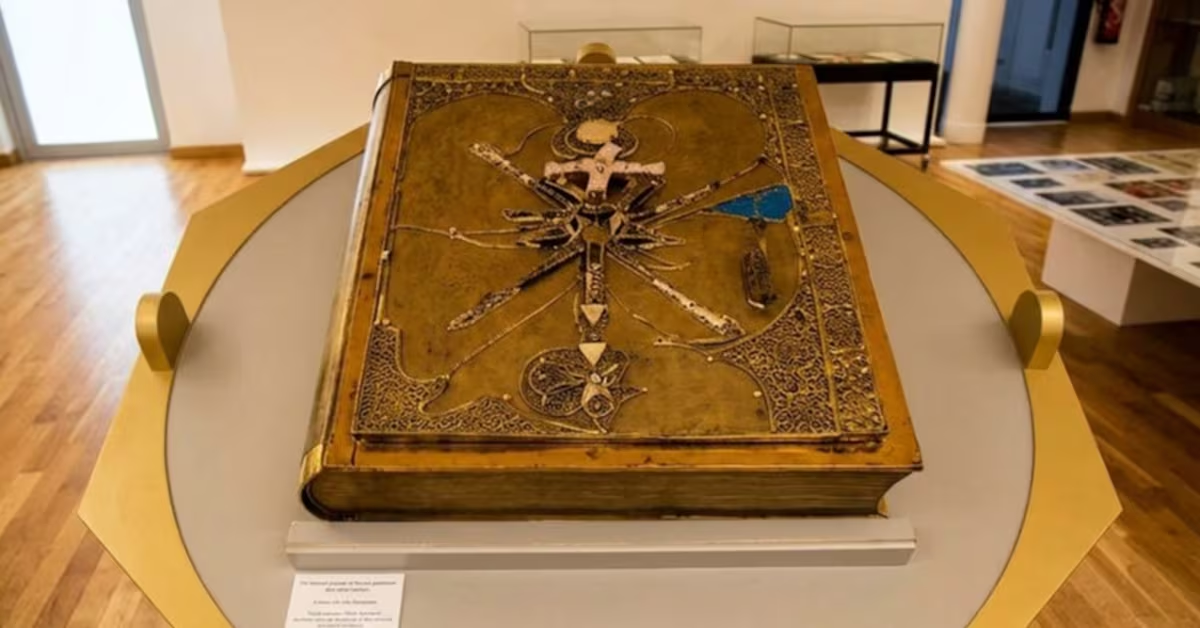
One of France’s strangest art thefts involved a work almost impossible to carry.
Issoire, France
A unique 210-kilogram copy of the Book of the Apocalypse, featuring contributions from Salvador Dalí, Jean Cocteau and other major twentieth-century artists, has been stolen from a private contemporary art center in Issoire, in France’s Auvergne region. The theft occurred during the night of October 4 to 5 and immediately attracted attention because of both the enormous physical dimensions and the extraordinary cultural value of the work. French prosecutors have opened an investigation while authorities attempt to determine how such a massive object could have been removed without detection. The stolen volume is valued at several million euros.
The work was conceived by Auvergne publisher Joseph Forêt as a total artistic interpretation of the Apocalypse of Saint John. Created between 1958 and 1961, it consists of 150 sheets and combines the work of seven major writers and seven painters, including Jean Cocteau, Léonard Foujita, Ossip Zadkine and Jean Giono. Salvador Dalí created the sculpted cover using the lost-wax technique, giving the object a physical presence closer to monumental sculpture than to a conventional book. Its scale and multidisciplinary character turned it into a singular artifact within European modern art.
The volume also carries an unusual international history. Between 1961 and 1972, it appeared in nearly 150 exhibitions around the world before disappearing from public view for years. It was later stored in Switzerland and eventually acquired by Japanese collectors, who reportedly considered selling it sheet by sheet. In 2003, art restorer and collector Christian Karoutzos acquired the work and preserved it as a complete object, later displaying the cover and selected pages in Issoire.
Its theft raises practical questions as unusual as its artistic importance. Moving a 210-kilogram object requires planning, physical capacity and likely prior knowledge of the building and the work itself. That immediately gives investigators a different profile from the classic theft of small paintings or jewelry. The investigation will now focus not only on who took the book, but also on whether the operation involved specialized knowledge or a prearranged destination within the international art market.
The cultural damage may prove more significant than the financial figure attached to the work. Because the volume was conceived as a single artistic object, its fragmentation would destroy much of the original intention behind it. That risk is especially serious in a market where individual pages or components associated with famous artists can become difficult to trace once separated. Preserving the integrity of the book is therefore as important as recovering its monetary value.
Some artworks are stolen for what they are worth. Others are stolen despite being almost impossible to replace.
Cultural heritage becomes most fragile when uniqueness becomes value.