

 Mario López Ayala, PhD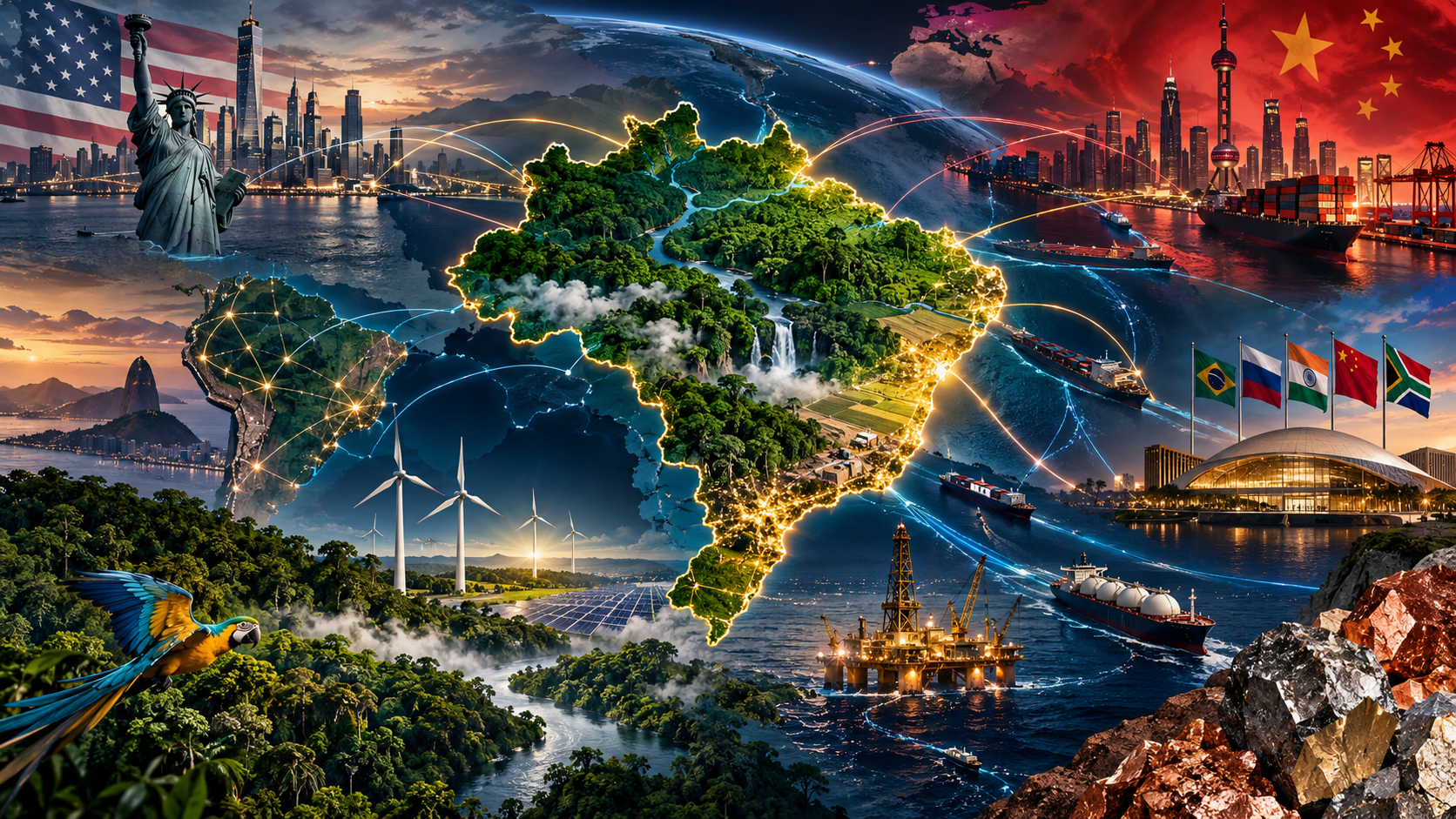
Brazil’s election has already moved far beyond Brazil’s borders.
Brasília, Brazil
Brazil did not simply hold the first round of a presidential election. What emerged from the ballot box was also a snapshot of Latin America’s shifting political balance and, on another scale, a quiet dispute over the place South America’s largest power will occupy in the international system. Flávio Bolsonaro received 47.03 percent of valid votes, while Luiz Inácio Lula da Silva obtained 45.16 percent, a margin narrow enough to prevent any definitive conclusion but significant enough to reshape the political landscape ahead of the runoff. The most important fact is that Brazil enters October 25 deeply polarized, while external actors watch closely to see what strategic direction may emerge from that division.
The first vector is domestic and cannot be separated from geopolitics. The rise of the right was not confined to the presidential race, as the Liberal Party and other conservative forces also strengthened their legislative presence. Whoever reaches the Planalto Palace will therefore have to govern with a Congress different from the one that accompanied the early years of Lula’s current administration. Even a presidential victory for the incumbent would not erase this new distribution of power. Brazil may consequently enter a period in which foreign policy becomes increasingly dependent on domestic negotiations, particularly over fiscal policy, energy, the environment and security.
The second vector inevitably leads to Washington. For the United States, Brazil is not simply another Latin American country: it combines territory, natural resources, agricultural capacity, industry, oil, strategic minerals and enough diplomatic weight to resist any automatic form of hemispheric alignment. A government led by Flávio Bolsonaro would likely find greater political convergence with Donald Trump’s Washington on security, economic orientation and several international issues. Lula, by contrast, has built his foreign policy around strategic autonomy, allowing Brazil to engage the United States without accepting full alignment. The Brazilian election therefore reflects an old geopolitical constant: major powers prefer predictable partners, while regional powers seek room to maneuver.
The third vector lies in Beijing. China can no longer be viewed merely as a distant trading partner because it occupies a structural position within the Brazilian economy. Soybeans, minerals, energy, infrastructure, manufactured goods and supply chains have created an interdependence that would probably survive either candidate. The difference would lie in the political architecture surrounding that relationship. Under Lula, Brazil may continue using China and BRICS as instruments of international diversification; under Bolsonaro, political proximity to Washington could increase, although any meaningful economic rupture with Beijing would be costly.
This is precisely where one of Brazil’s central paradoxes emerges: ideology and trade do not necessarily move in the same direction. Brazil can move politically closer to the United States without abandoning China as a central economic partner, just as it can strengthen its presence within BRICS without breaking with the West. That strategic elasticity is one of Brazil’s main sources of international leverage. The issue is not choosing a single bloc, but maximizing negotiating capacity across several.
A fourth vector is BRICS. Brazil occupies a unique position because it has belonged to the group since its original configuration while maintaining deep historical ties with the West. It is not Russia, nor China, and certainly not an actor dependent on a single sphere of influence. Brazil has traditionally used multilateral institutions to expand its autonomy, and under Lula that strategy once again gained prominence. A change in government could alter the tone of Brazil’s participation, but it would hardly eliminate the incentives the country gains from sitting at a table that includes some of the most important emerging powers.
There is also a fifth vector that reacted almost immediately: the markets. Brazilian equities rose sharply following Flávio Bolsonaro’s stronger-than-expected performance, while the real appreciated against the dollar. That reaction reflects expectations surrounding fiscal discipline, privatization, reduced spending and policies considered more favorable to capital, but it does not amount to an economic referendum on Brazil’s future. Markets price scenarios; they do not guarantee outcomes. Brazil continues to face substantial fiscal constraints, and either political project will have to govern an economy far more complex than a single trading session.
The sixth vector is regional. Argentina, Mercosur and the rest of South America are watching an election capable of once again shifting the continent’s political balance. Brazil possesses an economic and diplomatic mass that no other South American country can reproduce on its own. If its political orientation changes, the center of gravity in negotiations over trade, security, migration, infrastructure and relations with Washington will also move. If Lula remains in office, Brazil will probably preserve its preference for greater Latin American autonomy and a multidirectional foreign policy.
In either scenario, Buenos Aires, Santiago, Bogotá and other capitals will have to recalibrate. A Brazil more closely aligned with Washington could reinforce a conservative axis in South America, while Lula’s continuity would more clearly preserve the logic of regional autonomy, multilateralism and balance among major powers. Neither path, however, would be absolute. Regional structures require negotiation even among governments separated by considerable ideological distance.
A seventh vector, less immediate but strategically decisive, involves the Amazon, the energy transition and critical minerals. Europe watches Brazil through this lens as much as through electoral politics. So does the United States. So does China. Whoever governs Brazil will administer a decisive portion of the Amazon, vast freshwater reserves, a global agricultural power, offshore oil and resources increasingly important to technologies associated with the energy transition.
In a world where climate, energy and national security are becoming part of the same equation, that combination substantially increases Brazil’s international weight. Environmental policy can no longer be separated from economics, nor economics from geopolitics. The Amazon, critical minerals and energy infrastructure increasingly belong to the same strategic map. Brazil holds assets that every major power must interpret within its own security and development agenda.
For that reason, I consider it insufficient to interpret the runoff simply as left versus right. What Brazil faces is also a decision about how it will distribute power internally and translate that power into international positioning. Washington sees possibilities for closer alignment; Beijing calculates economic continuity; BRICS watches cohesion; Europe looks toward the Amazon and trade; markets assess fiscal discipline, while Latin America considers what new political equilibrium may emerge from a country that represents roughly half of South America’s territory and economy.
On October 25, Brazilians will choose their president. But surrounding that ballot are many other questions that will never appear on the voting paper: how close Brazil will move toward Washington, how much strategic space it will preserve in relation to China, what role it will play within BRICS, what direction Mercosur will take and how far its strategic autonomy can extend. The outcome will not redefine the international system by itself, but it could alter South America’s political balance and reshape the way a major regional power negotiates with the world’s largest powers.
Brazil votes within its borders. The consequences, however, stopped fitting inside them long ago.