

 Ren Takahashi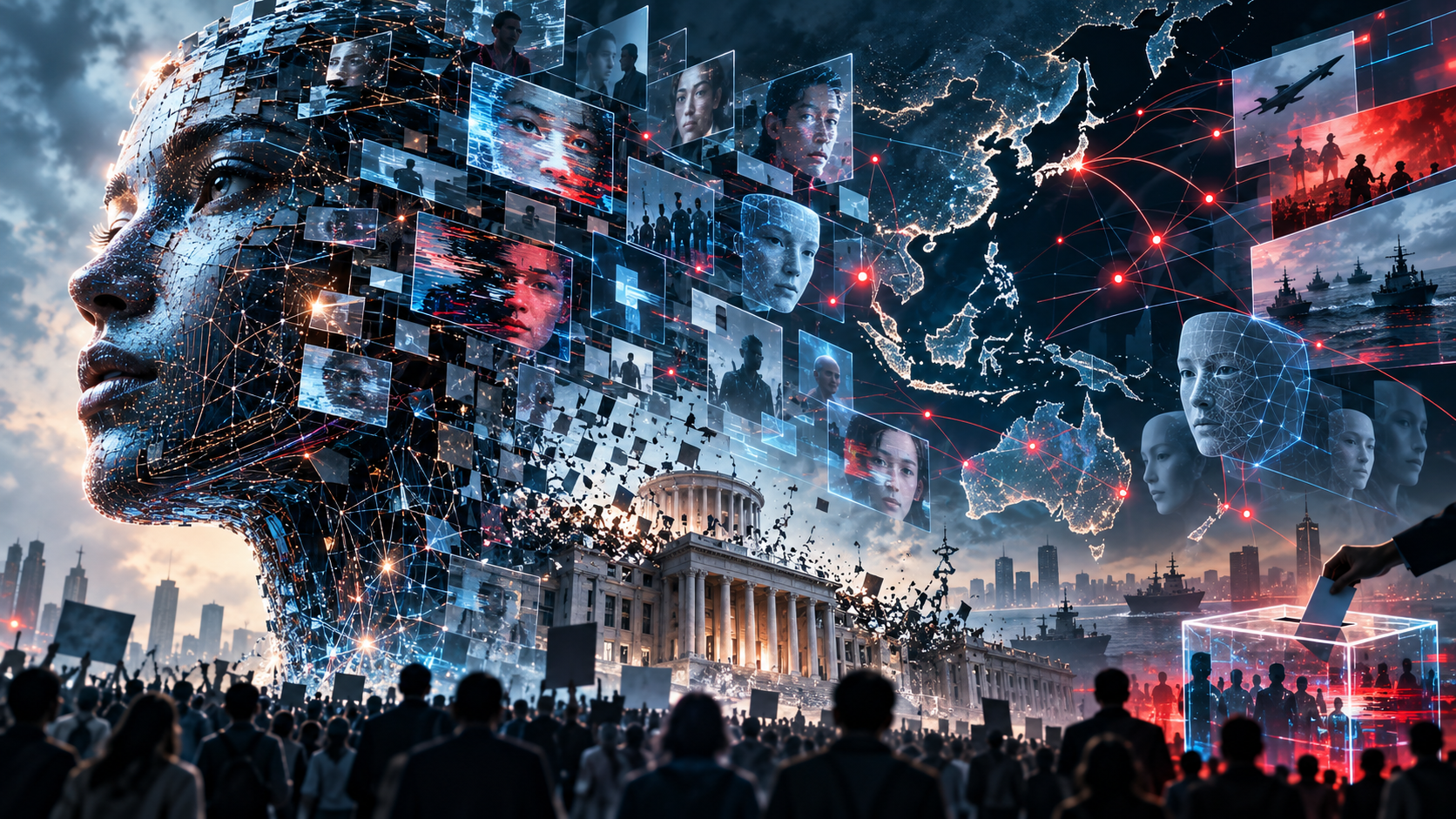
The next battlefield may not be territory. It may be perception.
Tokyo, Japan
Democracies have spent decades learning how to defend borders, elections and critical infrastructure. Artificial intelligence introduces a less visible vulnerability because the target may no longer be a network or institution, but the way citizens interpret reality. Across the Indo-Pacific, that possibility is moving from theoretical concern to strategic problem.
Generative systems can produce persuasive text, synthetic voices, realistic images and localized narratives at a scale that previously required large organizations. The issue is not simply that false information can be created faster. More significant is the ability to produce hundreds of plausible variations, test which ones attract attention and adjust them almost immediately.
Taiwan offers one of the clearest examples. Its democratic system operates under sustained geopolitical pressure while public debate remains highly open and digitally connected. Narratives surrounding military preparedness, relations with Washington, economic dependence on China and confidence in domestic institutions constantly compete for attention. Some are demonstrably false; others begin with recognizable facts and move gradually into interpretation.
That distinction matters because modern influence does not always require convincing citizens that one actor is trustworthy. It may be enough to weaken confidence in everyone else. A society that begins to doubt its government, journalists, allies and even authentic visual evidence can become politically exhausted without embracing any alternative narrative.
Artificial intelligence makes that ambiguity easier to manufacture. Deepfakes attract attention because they are visible, but the deeper problem may be the uncertainty they create around genuine evidence. Once people understand that voices, photographs and videos can be fabricated, authentic material can also be dismissed as artificial.
The Philippines faces a different version of the same problem. Its intensely networked political culture allows information, entertainment and partisan communication to circulate through the same digital spaces. Generative AI can now adapt political messaging to local language, cultural references and specific communities at relatively low cost. A coordinated network of synthetic identities can imitate public sentiment before it is clear whether that sentiment exists organically.
Japan should not assume that linguistic and institutional stability provide permanent protection. Japanese once created meaningful friction for foreign influence operations because successful persuasion required cultural knowledge and linguistic precision. Generative systems are reducing that barrier. They do not need to become perfect; they only need to make repeated experimentation inexpensive.
South Korea adds another dimension because information already moves at extraordinary speed through a politically competitive digital environment. In such settings, producing misleading content may take seconds, while disproving it can still require documents, interviews and human judgment. This asymmetry favors manipulation even when the falsehood is eventually corrected.
Democratic institutions therefore confront an uncomfortable boundary. Stronger mechanisms for identifying manipulation are increasingly necessary, but centralized control over political information would undermine the openness democracies are trying to defend. Technology companies face a similar contradiction because platforms optimized for emotional engagement cannot treat political manipulation as entirely external to their architecture.
Artificial intelligence did not create this environment. Social platforms had already transformed political attention by rewarding outrage, identity conflict and immediacy. AI adds production capacity to a distribution system already optimized for reaction, allowing information to be generated partly because algorithms predict that it will circulate.
For journalism, this changes the object of verification. Reporters increasingly need to examine not only whether a photograph is authentic or a statement false, but why a narrative appeared, which anxiety it activates, how it travels and who benefits from its circulation. The information system itself becomes part of the story.
The Indo-Pacific is encountering these pressures early because geopolitical rivalry and digital sophistication already overlap there. Taiwan, Japan, South Korea and the Philippines differ sharply in political culture, yet all face environments in which strategic competition can enter through civilian screens rather than military borders.
The most difficult question may therefore be civic rather than technological. Democracies depend on disagreement, but disagreement requires some shared confidence that reality exists independently of political preference. If that confidence erodes, societies may not collapse dramatically; they may simply become more suspicious, more fatigued and less capable of distinguishing evidence from manipulation.
Artificial intelligence will not determine that outcome by itself. It has arrived at a moment when weaknesses in trust, media economics and political communication are becoming easier to exploit. The deeper contest may ultimately be over whether citizens retain enough cognitive independence to decide what deserves belief.
Ren Takahashi (高橋 蓮) | Global Opinion Editor, Phoenix24 | Asia-Pacific, Technology & Digital Democracy